GPT-6-Designed Proteins Validated in Lab; ERNIE 5.5 Preview Open-Sourced
GPT-6 designed proteins via reasoning and passed wet-lab validation, while open-source and agent products landed densely the same day.
OpenAI reported that GPT-6 designed small proteins using only reasoning and coding, with binding evidence across five targets in partner labs, though specialized models were still used for sequence screening. Baidu open-sourced ERNIE 5.5 Flash Preview weights under Apache 2.0 (280B total, 1.4B activated, 1M context), and Tencent Hunyuan released HYMT-3 covering 102 languages. Doubao's agent Xiaodou opened invite-only, and OpenAI shifted GPT/Codex usage sharing plus a same-priced Healthcare tier.
OpenAI has announced a landmark result: GPT-6 designed small protein structures using only its reasoning and coding abilities—without calling any specialized biology model—and binding evidence was observed for all five targets in partner laboratory tests. Meanwhile, Baidu has released the weights of ERNIE 5.5 Flash Preview on Hugging Face, and Tencent Hunyuan has open-sourced its third-generation translation model. In a single day, both the open-source and closed-source tracks saw substantive moves.
GPT-6 Crosses Into Protein Design: A Stress Test of Reasoning
According to OpenAI's official post, GPT-6 did not rely on specialized biological structure prediction models when designing proteins; instead, it directly produced structural and sequence proposals through reasoning. Lab tests involving partner Onawa showed that small proteins synthesized according to the structures designed by GPT-6.2 exhibited binding evidence across all five targets.
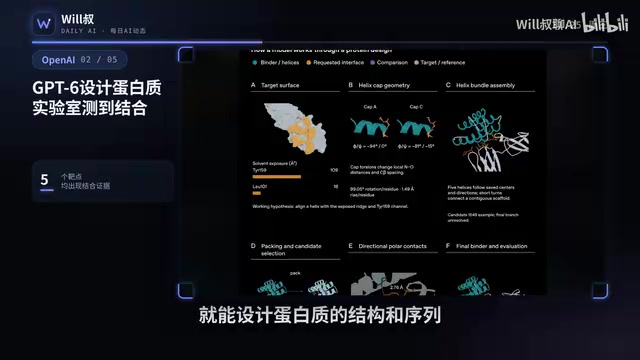
The significance of this news lies in the validation path: wet-lab data is far harder to fake than any benchmark score. However, the original post also included an honest footnote—specialized models still helped in the subsequent sequence screening and optimization stages. This shows that general reasoning models are already usable at the "generating hypotheses" step, but domain models still have a place where large-scale enumeration and fine-grained scoring are needed. For discussions of AI for Science, this is a more realistic picture: not replacement, but division of labor.
The difference between wet lab and dry lab: In computational biology, purely computational and simulation-based work is often called "dry lab," while experiments actually performed in test tubes, cells, or animals are called "wet lab." The field of protein design has long faced a gap—no matter how high a model's structural score is, it may not fold correctly or bind stably in a real environment. Wet lab requires gene synthesis, protein expression, and binding affinity assays (such as SPR, ITC, or pull-down), which are costly, time-consuming, and noisy. Therefore, positive results are far more convincing than any in silico benchmark. This is precisely why binding evidence across all five targets is regarded as a meaningful signal rather than just a demonstration.
Why small proteins (mini-proteins / peptides) are well suited as validation vehicles: Compared with full proteins of hundreds of residues, small proteins have short sequences, can be synthesized, are easy to express, and have a much smaller computational search space, making them ideal for testing whether a model can propose feasible solutions from scratch. But the trade-off is that stability and binding affinity are often more sensitive—a tiny change in sequence can cause the structure to collapse. This is also the practical reason the original post mentioned that specialized models are still needed for subsequent sequence screening.
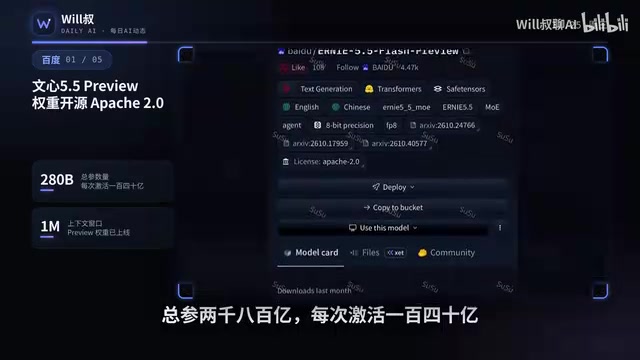
ERNIE 5.5 Flash Preview Open-Sourced: 280 Billion Parameters, Apache 2.0
Baidu released the weights of ERNIE 5.5 Flash Preview on Hugging Face under the Apache 2.0 license. According to the original data, total parameters are 280 billion, 1.4 billion are activated per pass, and the context length is 1 million.
One thing to note is the scope of coverage: only the Preview weights are open this time, while the Base version remains under a stricter license. For teams looking to commercialize directly or redistribute, the licensing difference between Preview and Base will directly affect technology choices. Apache 2.0 is a fairly permissive signal for Preview, but "what you can get" and "what you can use it for" are two different things—reading the license terms matters more than looking at the parameter count.
The meaning of total parameters vs. activated parameters: ERNIE 5.5 Flash Preview's "280 billion total parameters, 1.4 billion activated" points to a mixture-of-experts (MoE) architecture. Such models consist internally of multiple expert feed-forward networks, and each forward pass routes only to a few of them. As a result, the actual compute overhead during inference is close to that of a small model with just over a billion parameters, while knowledge capacity comes from all 280 billion parameters. This has been a mainstream approach in recent years for balancing capability and inference cost in large models. Understanding this is necessary to correctly interpret parameter numbers and avoid equating total parameters directly with inference overhead.
The difference between Apache 2.0 and "open weights": Apache 2.0 is an OSI-approved, business-friendly license that allows commercial use, modification, and redistribution, provided copyright and license notices are retained. However, it is important to distinguish "open weights" from "open-source models": publishers usually provide only the weights and inference code, while training data and training procedures may not be disclosed, so strictly speaking these are open-weight models. In addition, different versions within the same model family may use different licenses—the difference between Preview and Base is a typical example—so the license text must be checked version by version when making selections.
Doubao's Xiaodou Opens Invite-Only: Agents Move Into Life Services
Domestically, Doubao's personal agent "Xiaodou" opened invite-only access on November 24. Officially described capabilities include long-term memory, proactive reminders, and—after authorization—placing orders and making phone calls on the user's behalf in life-service scenarios.

The direction of these capabilities is clear: shifting from a conversational assistant to an agent that can handle affairs. Long-term memory addresses cross-session context continuity, proactive reminders test trigger timing, and placing orders and making calls push the permission boundary into real transactions. The invite-only approach itself also indicates that the product is still controlling the pace of rollout. Authorization mechanisms and responsibility allocation will be unavoidable issues when such agents are deployed.
Agents and the authorization mechanism behind "placing orders on behalf": A conversational assistant only outputs text, whereas an agent must call tools, read and write memory, and execute actions. When actions involve real transactions (placing orders, making payments, making phone calls), the system must be designed around three aspects: permissions, identity, and responsibility—how users grant authorization step by step, whether the scope of authorization can be revoked, and who bears responsibility when an action fails or causes losses. Common industry practices include tiered authorization, secondary confirmation before actions, auditable operation logs, and setting quotas or whitelists for sensitive actions. The invite-only phase is often also a period for collecting such edge cases and refining authorization interactions, so product pacing and compliance design usually advance in parallel.
OpenAI Adjusts Usage Rules and Launches Healthcare Configuration
OpenAI has notified users that starting in December, usage for Plus, Pro, and Business will be shared between GPT and Codex; complex tasks consume more quota, while Instant chats do not use this quota. For users who use both chat and coding agents, quota planning needs to be recalculated.
The API pricing page has also added a Healthcare configuration: GPT-6.2 AstraHealthcare is priced the same as the base version, with the promotion lasting at least until December 31.
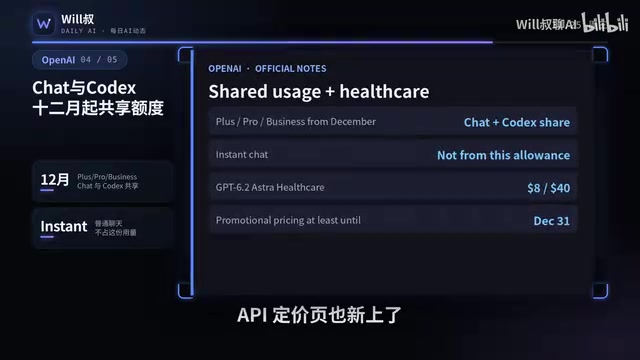
Same-price promotions usually mean OpenAI wants to quickly build usage in the healthcare vertical. For developers, what is worth paying attention to is how such scenario-prefixed configurations differ from the base version in terms of capability boundaries and compliance requirements—not just price.
The considerations behind "shared usage" and "scenario-specific configurations": Merging GPT and Codex quotas essentially shifts billing from product lines to total account compute, reflecting the fact that complex tasks (long context, multi-turn tool calls, coding agents) consume significantly more than ordinary chat. For users, what needs to be reassessed is quota allocation during peak periods, not the unit price itself. As for scenario-prefixed configurations like Healthcare, they usually imply targeted adjustments to system prompts, safety policies, data usage terms, or compliance statements. The same price does not mean the same capability and responsibility boundaries, so the corresponding usage policies and data processing terms should be checked before integration.
Tencent Hunyuan Open-Sources HYMT-3: Language Coverage Expanded to 102
Tencent Hunyuan has open-sourced its third-generation translation model, HYMT-3. Pre-training language coverage has expanded from 38 to 102 languages, with releases for 1.8B, 7B, and 30B with 3B activated versions. The multiple size options cover deployment needs ranging from edge devices to servers, while the large expansion in language count directly affects usability for low-resource languages. For teams building cross-border products or distributing multilingual content, this is an option worth evaluating in practice.
A Few Observations
On the same day, the closed-source side was proving that general model reasoning can spill over into experimental science, the open-source side was opening up weights and language coverage, and the product side was pushing agents into real transactions. What the three tracks have in common is this: the capability-demonstration phase is passing, and what comes next is competition over permission design, license terms, and real-world deployment. For users, clearly understanding "to what extent can this actually be used" is more valuable than chasing parameter counts.
One-line Summary
GPT-6 designed proteins through reasoning with wet-lab validation, while open-source releases and agent products landed densely the same day.
Paragraph Summary
OpenAI announced that GPT-6 designed small protein structures and sequences using only reasoning and coding abilities without calling specialized biology models, with partner labs observing binding evidence across all five targets; however, specialized models were still used in sequence screening, illustrating a division of labor between general reasoning and domain models. On the same day, Baidu released ERNIE 5.5 Flash Preview weights on Hugging Face under Apache 2.0, with 280 billion total parameters, 1.4 billion activated, and a 1 million context length, though the Base version has a stricter license; Tencent Hunyuan open-sourced the HYMT-3 translation model, expanding language coverage from 38 to 102. On the product side, Doubao's agent "Xiaodou" opened invite-only access with long-term memory and the ability to place orders and make calls; OpenAI also announced that starting in December GPT and Codex usage will be shared and launched a same-priced Healthcare configuration. Overall, the capability-demonstration phase is giving way to permission design, license terms, and real-world deployment.
Related articles
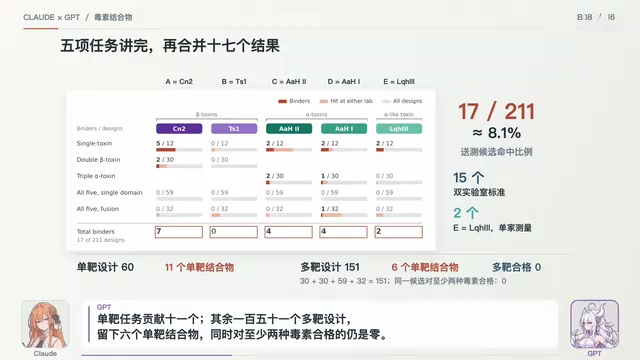
Claude Designs Scorpion Venom-Neutralizing Proteins: With 17 Binders, How Far Are We From an Antidote?
Anthropic's Claude helped design scorpion venom-neutralizing proteins: only 17 of 211 candidates passed, multi-target coverage failed, and channel function and animal testing remain absent.
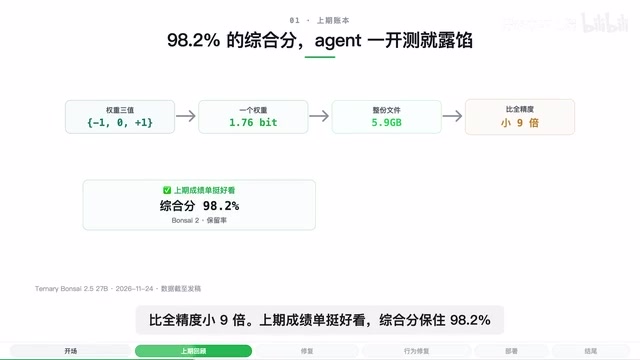
Fitting a 27B Model into 5.9GB: Ternary Bonsai 2.5 Fixes Its Agent Weaknesses
Prism ML releases Ternary Bonsai 2.5: a 27B model in just 5.9GB, with ternary quantization compressing weights to 1.76 bits. The new version focuses on fixing Agent capabilities, raising Tao3Bench Verify to 75.6 and Upworld from 51.2 to 90.5, hitting 291 tokens/s on a single A700, open-sourced under Apache 2.0.
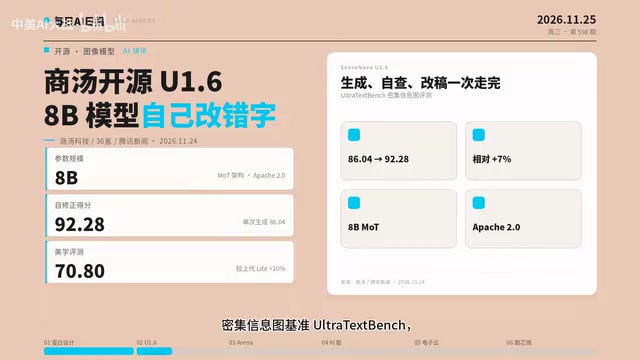
GPT-6 Designs Proteins Autonomously; SenseTime Open-Sources Self-Correcting Image Model
OpenAI preprint shows GPT-6 designs proteins without specialized bio models, 35 of 322 designs bind; SenseTime open-sources 8B Sansnova U1.6 with native image self-correction; LM Arena top three swept by one company, AI stocks rebound lasts one day.