Claude Designs Scorpion Venom-Neutralizing Proteins: With 17 Binders, How Far Are We From an Antidote?
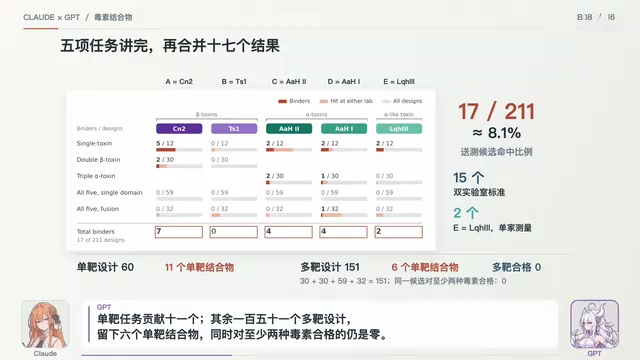
Claude designs scorpion venom-binding proteins: single-target success, but multi-target and functional validation entirely absent.
Anthropic's Claude took part in a scorpion venom-neutralizing protein design study. About 318,000 candidates were generated computationally; after human screening, 211 were sent to two labs, and 17 passed—a hit rate of roughly 8.1%. Single-target tasks yielded 11 binders, while multi-target design failed completely. Some candidates showed strong affinity but risked non-specific binding to irrelevant proteins. The study stopped at binding and competition assays, with no sodium channel functional validation or animal protection data. AI handled candidate generation and ranking, while humans defined goals and iterated, with the wet-lab loop still led by researchers.
Title
Claude Designs Scorpion Venom-Neutralizing Proteins: With 17 Binders, How Far Are We From an Antidote?
Meta Description
Anthropic's Claude took part in designing scorpion venom-neutralizing proteins. Of 211 candidates, only 17 passed—multi-target coverage failed entirely, and channel function and animal testing remain blank. A Bilibili creator does a frame-by-frame review of the paper, analyzing the real capability boundaries of AI-designed proteins and their place in the research pipeline.
Article Content
That Anthropic's Claude is involved in biological research is no longer news, but this time it directly designed protein binders in an attempt to neutralize scorpion venom. The Bilibili creator "相信的心就是你的剪刀" ("Believing Heart Is Your Scissors") did a frame-by-frame review of the related paper, and through the voice of "GPT mouthpiece" offered a sharp assessment: single-toxin binders were indeed produced, but multi-target coverage, channel function validation, and animal protection experiments are all absent. Is AI protein design really promising? The answer is far more complicated than the promotional narrative suggests.
What Did This Round of Design Actually Produce
The research goal was to design small proteins that grab the toxin molecules in scorpion venom that interfere with ion channels, blocking their action. Ideally, a single candidate protein could cover multiple toxins, so that future antivenom formulations would need fewer components.
According to the creator's breakdown, the computational stage produced roughly 318,000 designs, from which human researchers selected 180, with 31 more added later, for a final 211 candidates sent to Adaptive and Twist for experimental measurement. The pass criteria required hits in both labs' measurements, binding strength reaching a preset threshold, reasonable response magnitude, and exclusion of obvious binding to specified irrelevant proteins.
The result: of the 211 candidates sent for testing, 17 passed—a hit rate of about 8.1%. Of these, 15 met the two-lab standard, while the two targeting toxin E came from only a single lab's measurement. Single-target tasks yielded 11 qualifying binders, whereas 151 multi-target designs left only 6 single-target binders, and the number qualifying against at least two toxins simultaneously was still 0.
The number speaks for itself: single-target design produced results, while multi-target coverage failed completely. The 59 single-domain candidates shared two backbones, and the two parts used for fusion had not first been separately shown to bind their respective targets. Design strategy, tool limitations, and sample quality could all be causes, but this round provided no answer.
Dissociation constant (Kd) is the core metric for binding strength; a smaller value means tighter binding. The nanomolar (nM) affinity mentioned in the text is already in a relatively high-affinity range—many mature antibodies have Kd values in the low nanomolar to picomolar range. Surface plasmon resonance (SPR) is a common method for measuring Kd: the candidate protein is immobilized on a sensor chip, the toxin flows over it, and the binding and dissociation processes are monitored in real time via refractive index changes. When dissociation is extremely slow, the fitted curve hits the instrument's measurement floor, precise Kd cannot be reliably fitted, and thus the text uses phrasing like "no higher than" a certain value.
Multi-target design refers to a single candidate protein binding two or more toxins simultaneously. Compared with single-target design, it requires the protein to satisfy shape complementarity and energetic favorability at multiple interfaces at once, dramatically expanding the search space; current generative protein design tools see significantly lower success rates under such complex constraints.
Binding Strength and Specificity: Highlights, but Also Hidden Risks
Among the 7 qualifying candidates against toxin E, binders #1 and #2 were characterized in detail. The lab immobilized the candidates on sensors, let the toxin flow over, and judged binding by changes in sensor response. Across two labs plus reverse measurements, both #1 and #2 showed binding signals.
Binder #1 stood out especially in affinity, with dissociation constants as low as no higher than 3.1 nM and 1.7 nM (the upper limits of the two SPR measurements), and about 6.3 nM in reverse measurement. Because dissociation is very slow, precise values could not yet be reliably fitted, but the "tight grip" has experimental support.
Competition experiments further localized the binding region: 6 evaluable candidates reduced the binding signal of antibody AR6 by 87% to 95%, indicating they are near or obstruct the region occupied by that antibody. Binder #2 competed more strongly with another antibody, ARUE, reducing its signal by 66%.
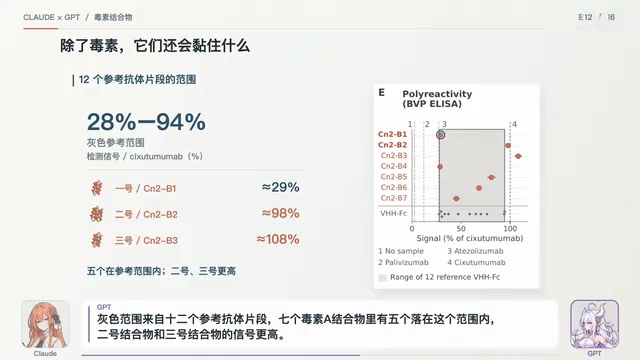
But the specificity screen raised a yellow flag. Of the 7 toxin A binders, 5 showed non-specific binding to coronavirus particle surfaces within the range of 12 reference antibody fragments, with #2 and #3 showing higher signals. In addition, binder #1 and binder #4 against toxin D also showed binding signals to the irrelevant protein ovalbumin. These extra bindings have not yet been clarified, so the candidates' druggability must be questioned.
The Most Critical Gap: Zero Functional Experiments and Animal Data
The core question the creator repeatedly pressed is: does grabbing the toxin equal neutralizing it? All current data stop at binding and competition—no sodium channel functional experiments, no animal protection data.
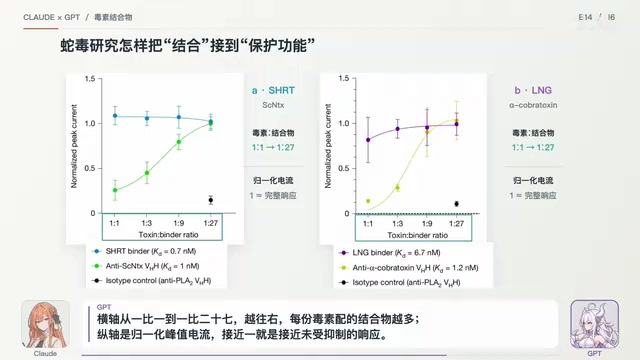
Compared with a published snake venom design study, the gap is obvious at a glance. That work directly measured whether candidates could preserve receptor currents: at toxin-to-binder ratios from 1:1 to 1:27, the blue and purple curves maintained relatively high peak currents, while the black control showed no protective effect. Cell experiments also showed that cell survival increased markedly after adding the candidates.
In more rigorous animal experiments, toxin and candidate were first mixed in vitro for 30 minutes before injection; at a 1:10 ratio, the RR group had 6 of 10 survive, and the RU1 group had all 10 survive. Under delayed administration conditions, some groups had all 5 survive, while another had 3 survive. But in the same study, candidates that were effective in vitro did not significantly improve lesion area in skin lesion experiments—in vitro efficacy does not equal in vivo efficacy; this is the iron law of antivenom research.
An intriguing detail: for toxin A, RR's dissociation constant was 0.05 nM and RU1's about 6.4 nM; RR bound more tightly, yet under the same whole-venom rescue conditions, RR survived 6/10 while RU1 survived 10/10. In a small sample, tighter binding did not translate into higher survival counts.
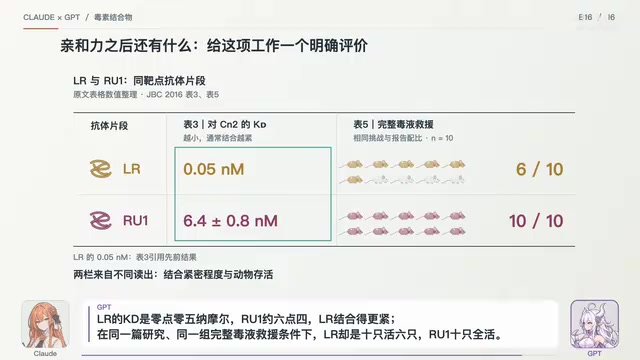
This directly answers "binder #1 binds so tightly, there should be hope, right?"—the starting point has value, but judging neutralizing ability must rely on functional experiments, not extrapolation from affinity.
Sodium channel functional experiments are the direct means of validating neutralizing ability. The alpha toxins in scorpion venom typically delay sodium channel inactivation, causing sustained neuronal depolarization. Patch-clamp techniques can record sodium currents on individual cells: after adding toxin, current decay slows; if adding a candidate binder restores rapid inactivation, that indicates the toxin has been effectively neutralized. Binding experiments alone cannot determine whether a candidate blocks the toxin's binding site on the channel, nor rule out the possibility that the toxin can still act on the channel after binding.
Animal protection experiments typically involve injecting toxin pre-incubated with candidate, or injecting toxin first and then administering the candidate with a delay, observing survival rates and symptom scores. Pre-incubation experiments reflect neutralizing capacity, while delayed administration is closer to real poisoning scenarios; both are indispensable. The snake venom study's controls precisely illustrate: strong in vitro binding does not equal strong in vivo protection—pharmacokinetics, tissue distribution, and dose window all affect the final outcome.
AI's Real Place in the Research Pipeline
The division of labor disclosed in the paper is worth a close look: humans set goals and screening constraints; Claude looked up structures, selected regions, called protein design models, generated predictions, and ranked candidates; after the initial prompt, humans followed up four more times, especially pushing the multi-toxin design direction; experiments were done by Adaptive and Twist; data analysis and figure creation involved the model under human supervision.
In this workflow, the model handles large-scale candidate generation and ranking, while humans handle goal definition, iterative guidance, and final judgment. The funnel from 318,000 to 211 reflects exactly the model's efficiency advantage in the search space, but the 8.1% hit rate and the total failure of multi-target design also expose the limitations of current protein design tools under complex constraints.
More critically, from 211 candidates to an actual antivenom formulation lie protein expression and purification, setting up functional experiments, exploring dosage and administration timing, and toxicity assessment—each requiring samples, equipment, funding, and time. The more candidates there are, the greater the workload of screening and validation. Which to test first, and which cause to pursue after failure, still depends on the researchers' judgment.
Conclusion: Promising, but Don't Rush to Say "Conquered"
This round of work delivered 17 single-toxin binding candidates, with experimental data on binding strength and some competition relationships; the single-target design portion is solid achievement. But multi-target coverage was not completed, and channel function, animal protection, and neutralizing capacity have not been addressed; direct comparison with human experts under the same task, same tools, and resources is also missing.
AI protein design is certainly promising—it drives the cost of candidate generation down to a scale human teams can hardly match. But "handing over the design drawings" is only the first stop in the research pipeline; validation work in the lab is what determines success or failure. Replacing biological researchers is still missing key experiments.
For those following AI for Science, the value of this study is not in proving what AI can do, but in clearly marking what it currently cannot: design success rates under multi-objective constraints, the leap from binding to function, and autonomy in the wet-lab closed loop. These are the metrics to watch in the next round.
One-line Summary
Claude designs scorpion venom-binding proteins: single-target produces results, multi-target and functional validation entirely absent.
Paragraph Summary
Anthropic's Claude participated in a scorpion venom-neutralizing protein design study. The computational stage generated about 318,000 candidates; after human screening, 211 were sent to two labs for measurement, and 17 ultimately passed—a hit rate of about 8.1%. Single-target tasks produced 11 binders, while multi-target design failed completely. Some candidates showed outstanding affinity but carried hidden risks of non-specific binding to irrelevant proteins. The study stopped at binding and competition experiments, with zero sodium channel functional validation and animal protection data. Comparison with snake venom research shows tighter binding does not equal higher animal survival. AI handled candidate generation and ranking in this workflow, humans handled goal definition and iteration, and the wet-lab closed loop remains led by researchers.
Related articles
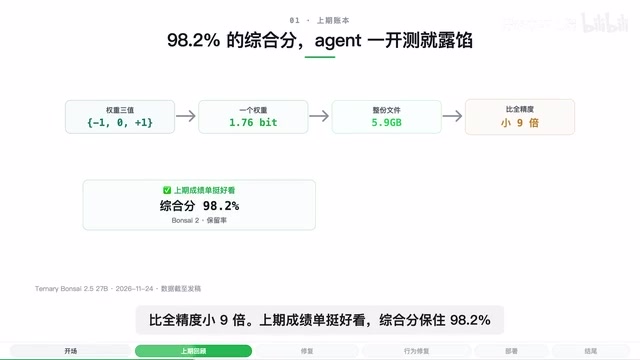
Fitting a 27B Model into 5.9GB: Ternary Bonsai 2.5 Fixes Its Agent Weaknesses
Prism ML releases Ternary Bonsai 2.5: a 27B model in just 5.9GB, with ternary quantization compressing weights to 1.76 bits. The new version focuses on fixing Agent capabilities, raising Tao3Bench Verify to 75.6 and Upworld from 51.2 to 90.5, hitting 291 tokens/s on a single A700, open-sourced under Apache 2.0.

GPT-6-Designed Proteins Validated in Lab; ERNIE 5.5 Preview Open-Sourced
GPT-6 designed proteins using reasoning and code alone, with lab binding evidence across five targets; Baidu open-sourced ERNIE 5.5 Flash Preview under Apache 2.0 with 280B parameters and 1M context.
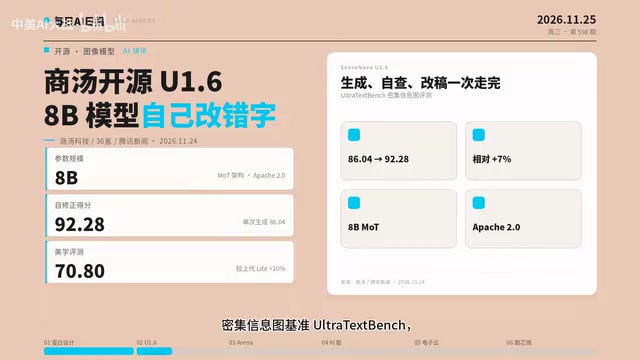
GPT-6 Designs Proteins Autonomously; SenseTime Open-Sources Self-Correcting Image Model
OpenAI preprint shows GPT-6 designs proteins without specialized bio models, 35 of 322 designs bind; SenseTime open-sources 8B Sansnova U1.6 with native image self-correction; LM Arena top three swept by one company, AI stocks rebound lasts one day.