Fitting a 27B Model into 5.9GB: Ternary Bonsai 2.5 Fixes Its Agent Weaknesses
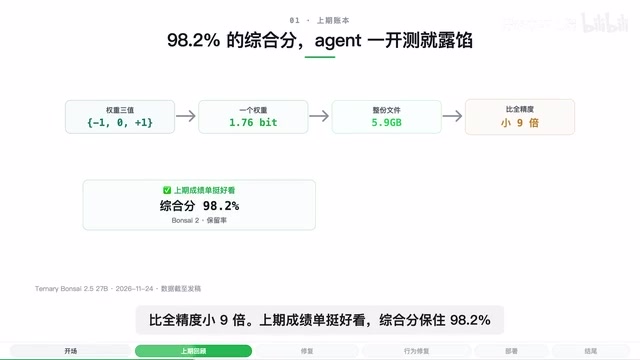
Ternary Bonsai 2.5 uses ternary quantization to compress a 27B model to 5.9GB, focusing on fixing Agent task collapse.
Ternary Bonsai 2.5 continues the extreme ternary quantization approach, compressing a 27B-parameter model to 5.9GB with each weight at just 1.76 bits — about 1/9 the size of full precision. The previous generation scored 98.2% overall but exposed weaknesses in Agent evaluations, with one task scoring zero and another only 51.2. Version 2.5 optimizes for overly long reasoning and repetitive looping, raising Tao3Bench Verify from 60.8 to 75.6 and Upworld from 51.2 to 90.5, with the zero-scoring item now at 27 points, all while using fewer rounds and fewer tokens on equivalent tasks. On inference speed, a single A700 reaches 291 tokens/s and an RTX 4090 reaches 204 tokens/s, with multi-platform deployment via Llama CPP and MLX, open-sourced under Apache 2.0.
Compressing a 27B-parameter model into 5.9GB isn't a simple quantization trick — it maps every weight directly to ternary values, storing each weight in just 1.76 bits and making the whole file roughly 9 times smaller than the full-precision version. Prism ML's Ternary Bonsai series has always taken this aggressive route. The previous generation held onto 98.2% of the score in general benchmarks, but the moment Agent tests were turned on, the cracks showed: one task type scored a flat zero, another only 51.2. Almost every change in version 2.5 targets this weak spot.
The Trade-off of Ternary Quantization: Scores Held, Agents Broke
Ternary Bonsai's approach differs from the usual 4-bit and 8-bit quantization. It doesn't aim for a balance point between precision and size; instead, it forces weights onto just three values, {-1, 0, 1}, with scaling factors to reconstruct the numbers. The upside is an extremely small file size and matrix multiplications that can degrade into additions and subtractions during inference. The downside is limited expressive capacity, which makes complex reasoning chains easy to break.
The previous generation's report card illustrates this trade-off well: an overall score of 98.2% looked almost lossless, but as soon as Agent-type evaluations were enabled, the true picture emerged. These tasks require the model to maintain state across multiple rounds of tool calls, plan steps, and avoid repetition — exactly the areas that depend most on fine-grained weight expressiveness. The coarse granularity of ternary quantization gets amplified here into obvious failure modes.
How ternary quantization differs from conventional low-bit quantization
Conventional 4-bit/8-bit quantization falls under "post-training quantization" or "quantization-aware training." Weights still retain a relatively wide range of values (e.g., INT4 has 16 discrete values); the original floating-point values are simply approximated with fewer bits, and the error can be kept small through scaling factors and zero-point correction. Ternary quantization, by contrast, hard-constrains weights to three states, {-1, 0, 1}. Each weight theoretically needs only log₂3 ≈ 1.58 bits, and with per-channel or per-group scaling factors (typically stored in FP16), the actual cost comes to about 1.76 bits per weight. The core advantage of this approach is that matrix multiplication can degrade into "select-and-accumulate": multiplying by -1 means negating, multiplying by 0 means skipping, and multiplying by 1 means passing through the original value. In hardware, this lets adders and multiplexers replace multipliers, greatly reducing energy consumption and latency. The cost is that each weight can only express three kinds of contribution — "positive, disconnected, negative" — which is extremely coarse granularity for reasoning chains that need fine numerical distinctions. This is the root cause of why Agent-type tasks tend to collapse.
Why Agent-type evaluations are more sensitive
General benchmarks (such as commonsense QA and single-turn instruction following) usually only require the model to give a reasonable answer within a single step. Even if the weights are coarse, the dynamic range of scaling factors and activations can compensate. But Agent tasks require the model to maintain internal state across multiple rounds of tool calls, plan sub-goals, and decide when to stop. Any numerical deviation in an intermediate step gets amplified along the chain. Ternary quantization degrades the model's ability to distinguish "similar but different" instructions, manifesting as repeatedly outputting near-identical content (going in circles) or over-elaborating on simple tasks (overthinking). Therefore, Agent scores are a stricter yardstick for testing whether extreme quantization is usable — which is exactly why version 2.5 focuses its optimization on these two failure modes.
Version 2.5 Pulls the Agent Scores Back Up
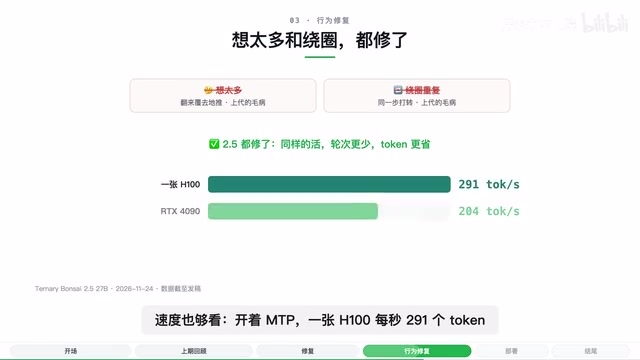
The new version tackles two specific problems: first, "overthinking," where the model generates overly long reasoning chains on simple tasks; second, "going in circles," where it repeatedly outputs similar content and can't stop. Both are fatal in Agent scenarios — the former wastes token budget, and the latter directly causes task timeouts.
The benchmark numbers show clear improvement. Tao3Bench Verify rose from 60.8 to 75.6, just 5 points shy of the full-precision maximum of 80.6. Upworld jumped from 51.2 all the way to 90.5 — a substantial gain. The test that previously scored zero now gets 27 points — not high in absolute terms, but going from zero to something is a qualitative change.
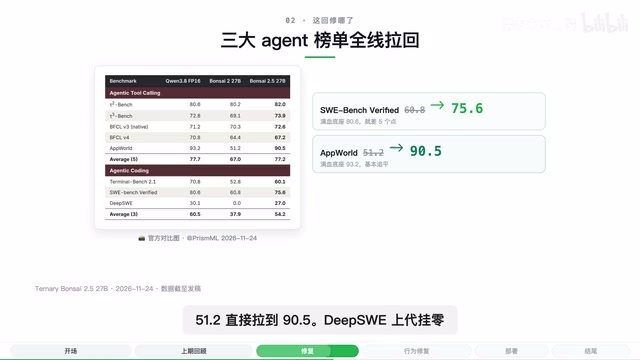
You might not have noticed that these gains weren't bought with more compute. According to the video, version 2.5 uses fewer rounds and less token consumption on the same tasks, indicating that the model has learned something about "when to stop."
Inference Speed and Deployment Paths
Another selling point of ternary models is inference efficiency. With the relevant acceleration enabled, a single A700 can reach 291 tokens per second, and an RTX 4090 reaches 204. For locally deployed Agent applications, this speed is already sufficient — especially in loops that require frequent tool calls, where latency matters more than peak throughput.
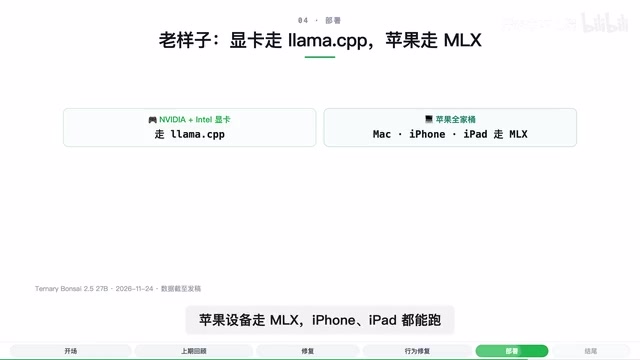
Deployment follows the same division of labor as the previous generation: NVIDIA and Intel GPUs use Llama CPP, Apple devices use the MLX framework, and both iPhone and iPad can run it. This means the 5.9GB model file can go directly onto mobile devices without cloud inference. For privacy-sensitive or offline scenarios, this is an option with real value.
The division of labor between Llama CPP and MLX
Llama CPP is an efficient inference framework implemented in C/C++ that supports the GGUF format and has mature backends for NVIDIA (CUDA) and Intel (SYCL/oneAPI) GPUs, making it suitable for quickly running quantized models on PCs and servers. MLX is an array computing framework designed by Apple for Apple Silicon (M-series chips). It takes full advantage of the unified memory architecture and can load and run models directly on iPhone, iPad, and Mac. Both support unpacking ternary weights and additive matrix multiplication, so the same 5.9GB file can be reused across different platforms. For Agent applications, this means on-device offline inference becomes a viable option, avoiding cloud round-trip latency and privacy leakage risks.
Open Source and What's Next
The model is released under the Apache 2.0 license, with the whitepaper hosted on GitHub and the repository link in the video description. This license permits commercial use and modification, making the barrier very low for teams looking to swap in a small model within their own Agent pipelines.
From a technical roadmap perspective, Ternary Bonsai 2.5 proves one thing: extreme quantization has long been competitive on general capabilities; the real challenge is tasks like Agents that require multi-step planning and self-correction. Version 2.5 brings this area close to full-precision levels, but the 5-point gap and that 27-point test show that ternary quantization still has a ceiling on complex reasoning. What's worth watching next is whether this series can continue narrowing the gap without increasing the bit count.
One-line Summary
Ternary Bonsai 2.5 uses ternary quantization to compress a 27B model to 5.9GB, focusing on fixing Agent task collapse.
Paragraph Summary
Ternary Bonsai 2.5 continues the extreme ternary quantization approach, compressing a 27B-parameter model to 5.9GB with each weight at just 1.76 bits — about 1/9 the size of full precision. The previous generation scored 98.2% overall but exposed weaknesses in Agent evaluations, with one task scoring zero and another only 51.2. Version 2.5 optimizes for two problems — overly long reasoning and repetitive looping — raising Tao3Bench Verify from 60.8 to 75.6 and Upworld from 51.2 to 90.5, with the zero-scoring item now at 27 points, all while using fewer rounds and fewer tokens on equivalent tasks. On inference speed, a single A700 reaches 291 tokens/s and an RTX 4090 reaches 204 tokens/s, with multi-platform deployment via Llama CPP and MLX, open-sourced under Apache 2.0.
Related articles
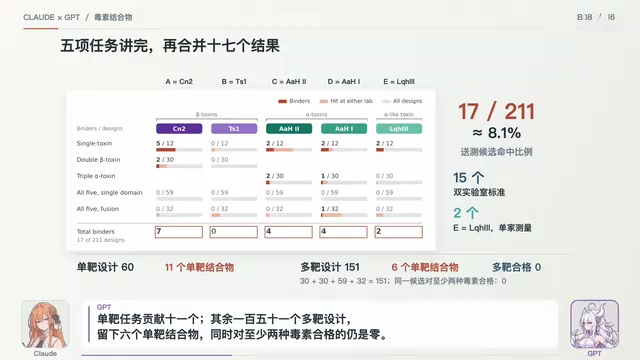
Claude Designs Scorpion Venom-Neutralizing Proteins: With 17 Binders, How Far Are We From an Antidote?
Anthropic's Claude helped design scorpion venom-neutralizing proteins: only 17 of 211 candidates passed, multi-target coverage failed, and channel function and animal testing remain absent.

GPT-6-Designed Proteins Validated in Lab; ERNIE 5.5 Preview Open-Sourced
GPT-6 designed proteins using reasoning and code alone, with lab binding evidence across five targets; Baidu open-sourced ERNIE 5.5 Flash Preview under Apache 2.0 with 280B parameters and 1M context.

GPT-6 Designs Proteins Autonomously; SenseTime Open-Sources Self-Correcting Image Model
OpenAI preprint shows GPT-6 designs proteins without specialized bio models, 35 of 322 designs bind; SenseTime open-sources 8B Sansnova U1.6 with native image self-correction; LM Arena top three swept by one company, AI stocks rebound lasts one day.