Anthropic Claude Certification Explained: The Architect Exam and Corporate Sponsorship Opportunities

A Philippine company's Claude certification sponsorship post reveals the growing gap between AI tool users and AI system builders.
A Philippine software company posted on Reddit offering to split the $125 Anthropic Claude Certified Architect exam fee 50/50 with developers, requiring candidates to have genuine hands-on experience with RAG systems, agentic workflows, and LLM API integration — not just AI-assisted coding. The post reflects two converging trends: Anthropic's official certification ecosystem is maturing, and the AI engineering talent market is rapidly stratifying between those who use AI tools and those who can architect AI systems.
A Job Post That Signals Claude Certification Is Going Mainstream
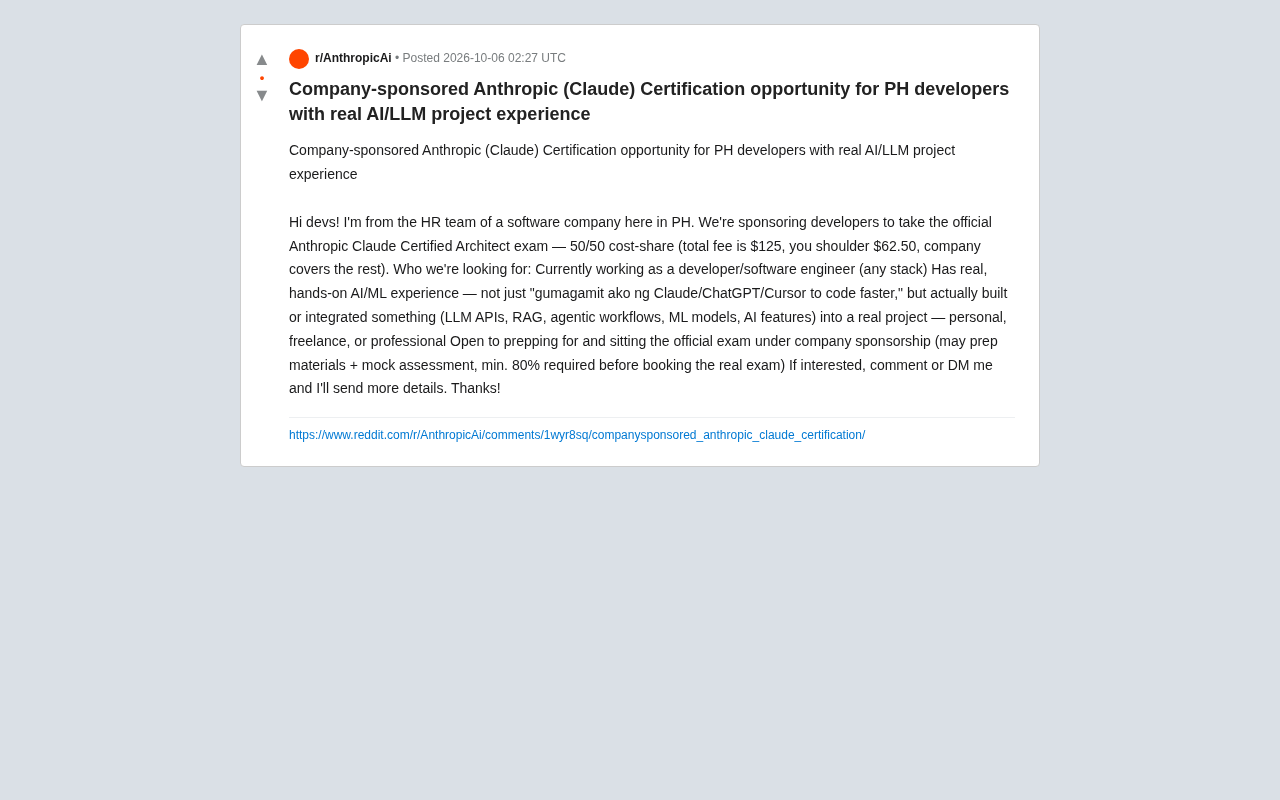
A member of an HR team at a Philippine software company recently posted on Reddit announcing that their company is willing to co-sponsor developers for the official "Anthropic Claude Certified Architect" exam — splitting the cost 50/50. The total exam fee is $125, meaning the developer pays $62.50 while the company covers the rest.
What looks like an ordinary job post actually signals a noteworthy industry trend: a formal certification ecosystem is forming around large language models (LLMs) like Claude, and companies are beginning to incorporate these credentials into their talent development and incentive frameworks. For developers navigating the rapid expansion of AI applications, this means the path to validating technical skills is becoming increasingly standardized.
What Kind of Developer Is This Company Actually Looking For?
The post is quite specific about candidate requirements — and deliberately draws a clear line.
Real, Hands-On AI/ML Experience Is Non-Negotiable
The poster explicitly stated they are not looking for people who simply use AI tools to code faster. They even used a Filipino colloquial phrase — "gumagamit ako ng Claude/ChatGPT/Cursor to code faster" — as a counterexample, making it clear that using AI as a coding assistant doesn't count.
What they want are candidates who have actually built or integrated something: called LLM APIs, built RAG (Retrieval-Augmented Generation) systems, implemented agentic workflows, trained machine learning models, or shipped AI features in real projects. The work can come from personal projects, freelance gigs, or full-time employment — what matters is real-world delivery, not surface-level tool usage.
What is RAG? RAG (Retrieval-Augmented Generation) is one of the most widely adopted architectural patterns for deploying LLMs in enterprise settings. The core idea: before sending a question to a language model, first retrieve relevant content from an external knowledge base (such as company documents or databases), then pass both the retrieved context and the original question to the model to generate an answer. This approach effectively addresses LLM limitations like knowledge cutoff dates, hallucinations, and inability to access private data. Building a functional RAG system involves multiple engineering layers — document chunking, vector embedding, vector database selection (e.g., Pinecone, Weaviate, pgvector), similarity search, and reranking — far more complex than a single chat API call.
What are Agentic Workflows? Agentic workflows go a step further — they involve using an LLM not just to answer questions, but as a "decision-making hub" that autonomously selects which tools to invoke (such as search, code execution, or database queries) based on the task at hand, orchestrating multi-step operations into complete automated pipelines. Representative frameworks include LangChain, LlamaIndex, and Anthropic's own Claude Tool Use API. The key engineering challenge is ensuring reliability and observability across the workflow — widely recognized as one of the most technically demanding frontiers in AI engineering today.
Active Developers, Any Tech Stack
Candidates must be currently working developers or software engineers. There are no restrictions on tech stack — a relatively flexible requirement that suggests the company values AI engineering competency itself over proficiency in any specific language or framework.
Willingness to Study and Pass a Pre-Assessment
The company provides study materials and a mock assessment, but there's a hard threshold: candidates must score at least 80% on the mock test before being allowed to schedule the actual exam. This acts as a quality filter, ensuring sponsored candidates have a strong chance of passing the real thing and that the company's investment isn't wasted.
Why Does "Real Project Experience" Matter So Much?
The most telling aspect of this post is its sharp distinction between "using AI" and "building with AI."
As tools like Claude, ChatGPT, and Cursor have proliferated, using AI to assist with coding has become table stakes for developers — it no longer constitutes a differentiating skill. What remains genuinely scarce is the ability to embed LLM capabilities into products, design reliable retrieval-augmented architectures, and orchestrate multi-step agentic pipelines.
The "Certified Architect" title itself is revealing — the certification targets architectural design ability, not just API consumption. This aligns precisely with the hiring requirements around RAG, agentic workflows, and AI feature integration. In other words, this credential is attempting to measure whether a developer can function as a designer of AI systems rather than a consumer of AI tools.
Why "Architect" and Not "Developer"? The "Certified Architect" positioning follows a well-established tradition in the software industry. AWS, Google Cloud, and Azure all offer Solutions Architect certifications that assess whether candidates can design scalable, highly available systems based on business requirements — not merely demonstrate proficiency with individual services. By naming Claude's top-tier certification "Architect" rather than "Developer" or "Practitioner," Anthropic sends the same signal: certification holders should be capable of designing, evaluating, and optimizing Claude-based AI systems for production environments — including model selection, context window management, cost-latency tradeoffs, and security and compliance considerations. This positioning also explains why the hiring company lists API integration, RAG design, and agentic orchestration as hard experience requirements — these are exactly the decision points an architect must navigate in real projects.
What This Means for Developers
For developers pushing into AI, this post offers several useful takeaways.
First, the certification cost barrier is low — but the experience barrier is not. At $125 total, this sits at the affordable end of professional certifications. With the company covering half, the out-of-pocket cost is just ~$62.50. The real filter is whether you've actually done AI work.
Second, corporate certification sponsorship is emerging as a talent signal. A company willing to split costs and provide study resources is signaling that it views LLM architecture skills as a core competency worth cultivating systematically — not just a personal hobby.
Third, hands-on execution matters more than tool familiarity. If you only use Claude to write code day-to-day, this opportunity probably isn't for you. But if you've independently built a RAG-based Q&A system, or integrated LLM features into a product — even as a personal project — that experience carries real weight.
Takeaway
On the surface, this Reddit post from the Philippines is a routine certification sponsorship opportunity. Beneath it, it reflects an accelerating stratification in the AI engineering talent market: the pool of people who can use AI tools keeps growing, while those who can design AI systems remain scarce. Anthropic's introduction of an official credential like the Claude Certified Architect is a direct response to this capability gap. Rather than worrying about whether AI will replace you, the more productive question is how to evolve from being a user to a builder — and that may be the most important message buried in this post.
Note: This article is based on a single Reddit post. For authoritative details on exam fees and certification specifics, refer to Anthropic's official resources and the posting company directly.
Related articles

Cursor AI Programming in Practice: Build a Student Management System from Scratch in 30 Minutes
A Bilibili creator demonstrates Cursor AI programming: generating a student management system in 30 minutes with natural language. Details on Agent mode, Claude selection, prompt techniques, and thresholds.

Top 20 AI Coding Tools Ranking: From Rock-Solid to Lackluster, a Scored Matrix
Bilibili creator releases top 20 AI coding tools ranking, tiered T0–T4 from rock-solid to lackluster, with Claude Code and Codex tied at T0. This article details the scoring dimensions (capability, reliability, robustness, durability, cost, domestic availability) and tool performances to help developers choose the right AI coding assistant.

Vibe Coding Systematic Tutorial: Master AI-Assisted Programming from Zero
A three-month Vibe Coding tutorial from a Bilibili creator covering Codex, ClaudeCode, and Cursor, from core logic to commercial project practice for beginners.