Anthropic IPO Explained: $104B Loss, $1T Valuation — How to Make Sense of It?
Anthropic IPO decoded: 13x growth but flattening, losses mostly on paper, trillion-dollar valuation bets on the future.
Anthropic's IPO prospectus shows about $33B in nine-month revenue, up 13x year-over-year, but sequential growth crashed from 144% to 47%. Of the $104B net loss, roughly $94B is paper loss from convertible note appreciation, with actual operating loss near $1.3B. A $1T valuation implies a ~29x P/S ratio, falling to ~13x on annualized October revenue. The company also carries ~$900B in firm commitments, and founders control 50.1% of votes via special shares, leaving public shareholders nearly voiceless.
Introduction: A Prospectus That Divides the Market
Anthropic, the AI company known for Claude, has officially kicked off its IPO process. According to its prospectus, the company generated $33 billion in revenue over the past nine months, yet posted a net loss of $104 billion — while the market expects a valuation approaching $1 trillion. Put together, these numbers almost defy conventional financial analysis. In a recent video, Chris, host of the YouTube finance channel Finance Hawks, went page by page through the 250-plus-page prospectus, trying to answer one core question: how exactly does this math work?
Drawing on that video's analysis, this article reconstructs the real picture of this IPO across six dimensions: offering structure, revenue growth, loss composition, valuation logic, hidden commitments, and governance structure.
1. Offering Overview: What's Being Sold?
Anthropic plans to offer 825 million shares at a price range of $70 to $78 per share. At the top end, that's roughly $64 billion raised. The stock will trade on Nasdaq under the ticker ANT. According to media reports, final pricing is expected on November 18, followed by the first trading day.
To be clear, an IPO sells a small slice of ownership in the company. A prospectus functions like a drug label — the company must disclose its profit model, cost structure, and potential risks. For Anthropic, four sections matter most: the business, the numbers, the risk factors, and voting rights.
2. Revenue Growth: The Deceleration Behind 13x Growth
Revenue is the total amount customers pay, before any costs are deducted. Anthropic's main revenue comes from enterprise customers using Claude. In the first nine months of 2025, revenue was about $2.5 billion; in the same period of 2026, that figure jumped to roughly $33 billion — about 13x year-over-year growth.
But what really deserves scrutiny is the change in growth rate. From Q1 to Q2, revenue grew about 144% quarter-over-quarter; from Q2 to Q3, that sequential growth fell to 47%. The curve is clearly flattening, and Anthropic itself acknowledges in the prospectus that growth may slow further.
This detail is crucial because it directly shapes the valuation discussion that follows. Whether the high-growth story can continue is the precondition for a trillion-dollar valuation to hold.
3. Dissecting the Loss: How Much of the $104B Is "Paper Loss"?
A $104 billion loss over nine months is enough to alarm any investor. But Chris reminds viewers in the video that it needs to be broken down.
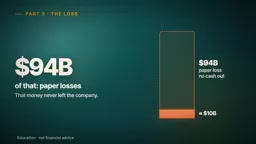
About $94 billion of it is paper loss — not actual cash leaving the company. Anthropic previously borrowed through convertible notes — loans that can later convert into shares. As the company's valuation rises, the value of the conversion rights increases, and accounting rules require that increase to be recorded as a loss. The more valuable the company, the larger the book loss.
Operating profit is a better reflection of the business. Over the first nine months, operating loss was about $1.3 billion against $33 billion in revenue — close to break-even. Q2 even posted an operating profit, while Q3 swung back to a loss.
This is a reminder for anyone reading a prospectus: don't just look at the net income figure at the very bottom. Ask whether the loss is real cash outflow or an accounting result.
Convertible Notes and Fair Value Accounting
A convertible note is a hybrid financing instrument: investors lend money and receive fixed interest, while also holding the right to convert the debt into company shares under agreed terms in the future. Because the conversion right has option value, its market value rises as the company's valuation increases. Under U.S. accounting standards (ASC 820), the conversion feature embedded in a convertible note is typically measured at fair value, with changes in fair value recognized in current earnings. This means the higher the company's valuation, the greater the fair value of the conversion right — and the larger the "loss" recognized on the books, even though no cash actually changes hands. This treatment is especially common among high-growth tech companies; the result is that net income is severely distorted, and investors need operating profit or cash flow metrics to reconstruct the true operating picture.
4. Valuation Logic: Is 29x P/S Expensive?
Total company value equals share price multiplied by total shares outstanding. At the top of the offering range, Anthropic's valuation is about $1 trillion; including all shares committed to employees and investors, it could reach up to $1.4 trillion. For reference, its last private funding round in May 2026 valued it at $965 billion.
Since the company isn't profitable, the P/E ratio doesn't apply, so the market turns to the price-to-sales ratio — company value divided by annual revenue. Over the trailing 12 months, Anthropic's revenue was about $35 billion; $1 trillion divided by $35 billion is roughly 29x. By comparison, most mature companies trade at single-digit multiples.
Why would anyone pay that price? Because the stock market prices the future, not the past. If you annualize October's revenue, annual revenue comes to about $81 billion, bringing the P/S ratio down to roughly 13x. That's the heart of the bet: if revenue keeps growing fast, today's price will look reasonable in the rearview mirror; if growth flattens faster — and it already is flattening — the same price looks very expensive. No one can be certain which scenario will play out.
When P/S Works — and Its Limits
The price-to-sales ratio is market capitalization (or total value) divided by trailing 12-month revenue, often used to value unprofitable companies with fast-growing revenue. Its advantage is that it's unaffected by accounting policies, depreciation and amortization, and capital structure differences, making cross-company comparison easier. But P/S has clear limits: it implicitly assumes all revenue is of equal quality, ignoring differences in margins, growth durability, and capital efficiency. For an AI company like Anthropic that requires massive capital expenditure, the same P/S ratio may imply very different profitability prospects. Moreover, the denominator (revenue) is historical while the numerator (market cap) reflects future expectations — so a high P/S is essentially a bet on future growth and profitability. Mature companies typically trade at single-digit P/S ratios, while high-growth tech companies can reach 10 to 30x or more.
5. The Hidden Burden: $900 Billion in Commitments and Circular Investment
The AI business requires data centers, chips, and electronics. Anthropic has signed firm payment commitments of about $900 billion, roughly half of which comes due before the end of 2030, with the rest stretching into the 2040s. Chris uses a vivid analogy: it's like signing a 20-year lease on a house ten times bigger than your current one. If the family expands as planned, that's smart; if not, the rent is still due. Costs are locked in, but revenue hasn't materialized yet.
Another detail worth noting is who's buying into the IPO. Seven tech companies purchased $26 billion of non-voting shares, including Nvidia, Google, and Microsoft — precisely the suppliers from whom Anthropic buys chips and compute. Money flows in a circle: suppliers invest in the customer, and the customer places orders with the suppliers. That can be a signal of confidence, but it also means that if any party stumbles, the whole chain feels the shock.
Firm Purchase Commitments and Off-Balance-Sheet Liabilities
Firm purchase commitments are irrevocable procurement agreements a company has signed, typically involving long-term data center leases, chip purchases, or cloud service contracts. Under accounting rules, such commitments aren't recorded directly as liabilities on the balance sheet, but they must be disclosed in the prospectus's risk factors or commitment notes. They matter because once signed, the payment obligation remains regardless of whether future revenue meets expectations, potentially creating sustained pressure on cash flow. For AI companies, long-term locking in of compute infrastructure is a competitive necessity, but it also amplifies operating leverage: when revenue rises, profits accelerate; when revenue falls short, losses accelerate just as fast. Investors should watch the maturity distribution of commitments, how well they match expected revenue, and how strict the default terms are.
6. Who's in Charge: Special Shares and the Public Benefit Mandate
The usual rule is one share, one vote — but not at Anthropic. The company has a special class of shares held jointly by seven founders, which carries no profit distribution rights but holds 50.1% of voting power. In addition, an independent body — the Long-Term Benefit Trust — is responsible for appointing four of the seven board seats.
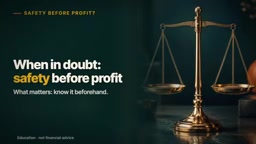
This means investors who buy shares own a piece of the company but have almost no say. Anthropic is legally a public benefit corporation, and the prospectus explicitly states that decisions made for AI safety reasons may conflict with shareholders' financial interests. In other words, when in doubt, safety may take priority over profit. You can agree or disagree with that — but it's important to know it in advance.
Dual-Class Structures and Public Benefit Corporations
A dual-class share structure means a company issues share classes with different voting rights, typically with founders holding high-vote shares and public investors holding low-vote shares. This structure is widespread among tech companies; it's designed to let founding teams retain strategic control after going public, but it can also create agency problems: management may make decisions that harm minority shareholders' interests. Anthropic's twist is that voting power is concentrated in special founder-held shares with no profit distribution rights, while the Long-Term Benefit Trust appoints a majority of directors. A public benefit corporation (PBC) is a corporate form under U.S. law that requires a company to pursue its charter-stated public benefit mission alongside shareholder financial returns and to disclose its public benefit progress periodically. This gives management a legal basis for prioritizing safety when AI safety and commercial interests conflict — but it also means shareholders must accept the potential financial cost of mission-first decisions.
7. Market Context and the Reality of IPO Investing
This IPO lands at a sensitive moment. Amazon, Google, Microsoft, and Meta are collectively spending more than $700 billion in 2026, mainly on AI data centers. The market keeps wrestling with one question: will that spending pay off? In early November, tech stocks fell sharply, with the Nasdaq dropping about 5.5% in a week. A few weeks earlier, the market was speculating that Anthropic could fetch a $2 trillion valuation; the current range is clearly below that.
For ordinary investors, Chris offers some practical reminders. Subscribing doesn't guarantee an allocation — when demand is strong, retail investors often get scraps, or nothing at all. The first day's price isn't necessarily fair; the open is often chaotic.

Then there's the lock-up period — employees and early investors can't sell for about six months, after which a large block of shares may hit the market all at once. If you're simply investing in a broad-market ETF, you don't need to do anything: after a company of this size goes public, global indexes typically include it according to their rules after a period of time, at which point it enters your ETF automatically.
Conclusion: Three Questions to Understand Any IPO
Anthropic's case offers a general framework for analyzing an IPO. First, is revenue growing? Is the growth rate accelerating or slowing? Second, is the loss real cash outflow or an accounting effect? Does the core business actually make money? Third, how much are you paying for each dollar of revenue? And who controls the company after the IPO?
Applied to Anthropic: growth is enormous but flattening, the huge loss is mostly paper loss, the valuation is high, and shareholders have almost no say. Whether this bet ultimately proves right, no one can answer today. But the method for reading a prospectus has more long-term value than the rise or fall of any single stock.
This article is based on content from the YouTube channel Finance Hawks and is for educational reference only. It does not constitute investment advice.
One-line Summary
Anthropic prospectus breakdown: 13x growth but flattening momentum, a hundred-billion-dollar loss mostly on paper, and a trillion-dollar valuation betting on the future.
Paragraph Summary
Anthropic has launched its IPO. The prospectus shows roughly $33 billion in revenue over the first nine months — 13x year-over-year growth — but sequential growth plunged from 144% to 47%, a clear flattening. Of the $104 billion net loss, about $94 billion is paper loss from convertible note appreciation, while the actual operating loss is only about $1.3 billion, close to break-even. At a $1 trillion valuation, the P/S ratio is about 29x — far above mature companies — and drops to roughly 13x if October revenue is annualized, making the valuation heavily dependent on sustained growth. The company also carries about $900 billion in firm payment commitments, and seven founders control 50.1% of voting power through special shares, leaving public shareholders with very little voice. The article reconstructs this IPO across six dimensions and distills a general framework for analyzing any IPO.
Related articles

GPT-6.2 Sol/Astra Released: ChatGPT Plus Subscription Guide and Plan Comparison
After GPT-6.2 Sol/Astra's release, how should you choose a ChatGPT membership? This article distills a Bilibili tutorial's key points, explaining the differences between Go, Plus, and Pro tiers and who each suits, plus practical steps for account registration and quick subscription—helping you pick the right plan without wasting money.
GPT 6.2 Astra/Sol Community Use Cases and In-Depth Review
GPT 6.2 Astra/Sol review: strong in 3D modeling and Computer Use, but weak in aesthetic alignment and intent understanding. Benchmarks vs Claude Fable 5.2 and value analysis.
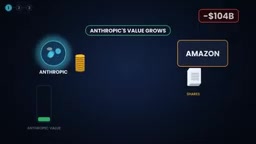
Anthropic's Hundred-Billion IPO: Growth Is Real, But the Risk Is in the Bill
Anthropic pushes toward a trillion-dollar IPO: sales grew 12x in a year, and the $104 billion loss comes mainly from accounting, not cash outflow. But $895 billion in compute contracts, spending exceeding revenue, and high customer concentration are real risks. Analysts break down the S1 filing and identify three key metrics to track after the IPO.