Anthropic's Hundred-Billion IPO: Growth Is Real, But the Risk Is in the Bill
Anthropic's growth is real, but the loss mainly comes from accounting; huge compute contracts and governance are core risks.
Anthropic is pursuing a trillion-dollar IPO. Its S1 filing shows sales surging from $386 million in 2024 to $33 billion in the first 9 months of 2026, with real growth. Of the $104 billion loss, about $94 billion comes from fair value changes on Amazon's convertible loan — not cash outflow; the business itself lost only $1.3 billion and generated $6.6 billion in cash flow. But operating spending has exceeded revenue, with cost per $100 of revenue rising from $92 to $103, mainly due to premium compute purchases. Signed compute contracts total about $895 billion, far exceeding annual sales — the bill is certain while revenue is not. Growth has slowed to 47%, customer concentration is high, and more than 40% of revenue flows through competitors like Amazon, Google, and Microsoft. On governance, the founding team holds 50.1% of voting power, so public shareholders share profits but not control. At a $1.5–1.6 trillion valuation, that is about 22–24x annual sales. After the IPO, track three metrics: growth rate, spending per $100 of revenue, and customer concentration.
Growth Is Real, and So Is the Loss — But Most of the Loss Is on Paper
Anthropic, the parent company of Claude, is moving toward an IPO that could reach a trillion-dollar valuation. After analyzing the company's S1 filing, SEBI-registered research analyst Ketan Mittal reached a counterintuitive conclusion: sales grew 12x in a year, and the company reported a $104 billion loss — both numbers are true.
Start with the revenue curve. Sales were $386 million in 2024, $4.6 billion in 2025, and had already reached $33 billion in the first 9 months of 2026 — with $17 billion of that coming in the last 3 months alone. About 11,900 enterprise customers each pay more than $100,000 a year, together contributing roughly three-quarters of revenue. This kind of growth rate is extremely rare in the history of the software industry.
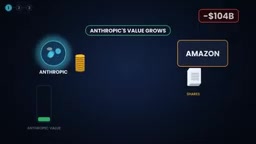
So where does the $104 billion loss come from? About $94 billion comes from accounting treatment: Amazon once provided Anthropic with a loan convertible into shares at a low price. As the company's valuation soared, the value of that swap increased, and accounting rules require it to be recorded as a "loss" for Anthropic. Using Ketan's analogy: you promised a friend a house at today's price, and after housing prices double you "feel" you've lost money, but no cash has left your pocket. The business itself lost only $1.3 billion on $33 billion in sales and generated $6.6 billion in cash flow.
So on the question of "is the growth real," the answer leans toward yes: the growth is real, and the huge loss is mostly a bookkeeping figure. But that's only one side of the story.
Convertible share loans and fair value changes: The convertible share loan Amazon provided to Anthropic is essentially a hybrid financing instrument — it initially provides funds as a loan, but under agreed conditions it can be converted into equity in the borrower at a specific price. Accounting standards (such as fair value measurement under IFRS or US GAAP) require that when the investee's valuation rises, the value of the embedded conversion right increases, and this increase must be recognized on the borrower's books as a fair value loss on liabilities. Therefore, the large loss Anthropic reports is not an operating loss but an accounting result of revaluing convertible instruments as its own valuation rises. This kind of loss does not consume cash and does not affect operating cash flow, but it significantly depresses reported net profit and can easily lead readers unfamiliar with accounting treatment to misjudge the company's operating condition.
The Bill Problem: Spending Faster Than Earning
The second question is trickier: can Anthropic afford the bill?
From April to June, every $100 of revenue cost $92 to generate; from July to September, that number became $103 — in other words, the company has already begun burning money at the operating level. The reason points to compute: buying extra capacity at a premium when capacity is insufficient, plus a one-time $2 billion accounting charge.
The positive signal is that efficiency is improving: the return on every $1 of compute investment rose from 40 cents in the past to about $2. The engine is becoming more efficient, but spending is running even faster.
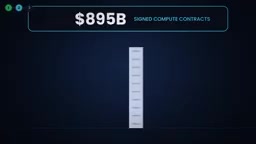
The most astonishing number in the filing is about $895 billion in signed contracts, mainly for leasing compute. Meanwhile, annual sales are about $35 million — like a shopkeeper earning 350,000 rupees a year signing a contract worth 900 million rupees. Ketan's characterization is blunt: the bill is certain; the revenue is not.
On cash reserves, Anthropic holds $132 billion in cash, with $20 billion due within the next year, so short-term coverage looks fine. The real risk lies in later years. Growth has already slowed to 47% last quarter, after previously more than doubling repeatedly. The customer structure also warrants caution: usage-based payment dominates, long-term contracts are few; five customers contribute a quarter of sales; and more than 40% of revenue flows through Amazon, Google, and Microsoft — companies that are simultaneously building competing AI products.

Compute commitments and signed contracts: An AI company's "signed contracts" usually refer to long-term compute leasing agreements signed with cloud providers or data centers, committing to pay fixed or minimum amounts over the coming years. Such contracts do not necessarily appear immediately as liabilities on the financial statements, but they are rigid obligations, and breach requires penalty payments. Anthropic's roughly $895 billion in signed contracts far exceeds its current annual revenue, meaning the company must continue growing at high speed to cover these commitments. If revenue growth slows or customers churn, these contracts will turn from a "growth guarantee" into a "financial burden." Investors should distinguish "signed contracts" from "recognized revenue" — the former is a future spending obligation, while only the latter is actual money coming in.
What You're Buying: Profit, Not Control
The third question concerns what shareholders actually get. As a public market investor, you get one vote per share, but a special trust holds most board seats, and the seven co-founders hold 50.1% of voting power. Ketan's analogy: it's like living in a community where the management committee never changes — you share in the profits, but not in control.
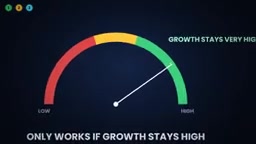
The price has not yet been announced, but investors are reportedly discussing a valuation range of $1.5 to $1.6 trillion. Based on annualizing last quarter's sales to about $68 billion, that is roughly 22 to 24 times annual sales — you pay about 22 rupees for every 1 rupee of sales. That price only holds if growth stays extremely high.
External risks also exist: US export rules once forced it to shut down new models for all consumers, and the company is still negotiating with the US government over supply chain risk labels.
Dual-class structure and special trusts: A dual-class structure means a company issues shares with different voting rights, typically with founders holding high-voting shares (e.g., 10 votes per share) and public investors holding low-voting shares (1 vote per share). A special trust may lock in board seats through agreements or charter provisions, making it difficult for outside shareholders to replace directors. This governance arrangement is common in tech IPOs, intended to let founding teams retain strategic control after going public, but the cost is that public shareholders have very little influence over company decisions. Investors need to assess: when the company needs to correct course or adjust strategy, does the governance structure allow outside forces to intervene?
Three Numbers to Watch After the IPO
Ketan sums up the essence of this IPO as: it's not a question of whether Claude is good, but a race between growth and the bill. After the IPO, watch three metrics every quarter —
- Growth rate: Is it staying strong or continuing to cool?
- Spending per $100 of revenue: 100 is the watershed; only below 100 is there operating profit.
- Customer concentration: Is the share of top customers declining?
If all three improve, the story gets stronger; if growth cools while spending remains above 100, that valuation will be very hard to sustain. For ordinary investors, this is a high-growth company paired with an extremely demanding price and very little say — real growth, extreme bills, a harsh price.
One-line Summary
Anthropic's growth is real, but its loss mainly comes from accounting treatment; huge compute contracts and governance structure are core risks.
Paragraph Summary
Anthropic is pursuing a trillion-dollar IPO. Its S1 filing shows sales surging from $386 million in 2024 to $33 billion in the first 9 months of 2026, with real growth. Of the $104 billion loss, about $94 billion comes from fair value changes on Amazon's convertible loan — not cash outflow; the business itself lost only $1.3 billion and generated $6.6 billion in cash flow. But operating spending has exceeded revenue, with cost per $100 of revenue rising from $92 to $103, mainly due to premium compute purchases. Signed compute contracts total about $895 billion, far exceeding annual sales — the bill is certain while revenue is not. Growth has slowed to 47%, customer concentration is high, and more than 40% of revenue flows through competitors like Amazon, Google, and Microsoft. On governance, the founding team holds 50.1% of voting power, so public shareholders share profits but not control. At a $1.5–1.6 trillion valuation, that is about 22–24x annual sales. After the IPO, track three metrics: growth rate, spending per $100 of revenue, and customer concentration.
Related articles

The Complete GPT Plus Subscription Guide: From Sign-Up to Picking the Right Tier in One Go
A complete ChatGPT Plus subscription guide based on a Bilibili tutorial: register from scratch, compare Go/Plus/Pro tiers, and complete payment quickly—avoiding the three big pitfalls of failed registration, wrong tier choice, and payment snags, so you find the plan that fits you best.

GPT-6.2 Sol/Astra Released: ChatGPT Plus Subscription Guide and Plan Comparison
After GPT-6.2 Sol/Astra's release, how should you choose a ChatGPT membership? This article distills a Bilibili tutorial's key points, explaining the differences between Go, Plus, and Pro tiers and who each suits, plus practical steps for account registration and quick subscription—helping you pick the right plan without wasting money.
GPT 6.2 Astra/Sol Community Use Cases and In-Depth Review
GPT 6.2 Astra/Sol review: strong in 3D modeling and Computer Use, but weak in aesthetic alignment and intent understanding. Benchmarks vs Claude Fable 5.2 and value analysis.