Anthropic IPO Prospectus: The Profitability Paradox Behind 47% Revenue Growth
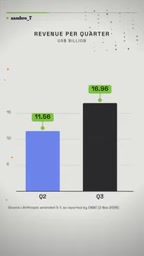
Anthropic's quarterly revenue rose 47% but profit turned negative, while $895 billion in commitments reveal hidden risks of heavy AI investment.
Anthropic's IPO filing shows quarterly revenue up 47% quarter-over-quarter, but operating profit swung from positive to negative, a clear divergence between revenue growth and profitability. The filing also discloses long-term spending commitments on the order of $895 billion, of which $213.8 billion will only actually occur after data centers are built. The article distills the constraints on AI scaling into a triple bottleneck of money, permits, and power, noting that permit uncertainty is the highest. On the AI bubble debate, it argues that Anthropic presents a "three-high" structure of high growth, high investment, and high uncertainty, and that its financial condition reveals the tension between AI commercialization's real cost structure and the pace of the physical world.
Anthropic's IPO filing presents a set of contradictory numbers: revenue surged substantially within a single quarter, yet profit flipped from positive to negative. The financial details of this AI star company reveal the deep tension across the industry between commercialization and infrastructure investment.
Revenue Soars, But Profit Suddenly Turns
According to the disclosed documents, Anthropic achieved a significant jump in revenue within a single quarter, with quarter-over-quarter growth reaching 47%. That figure is impressive in any industry, especially for an AI company still in a heavy-investment phase.
But the revenue curve and the profit curve diverged noticeably this quarter: operating profit turned from positive in the previous quarter to a loss. Revenue is rising, but net profit has "gone on vacation."
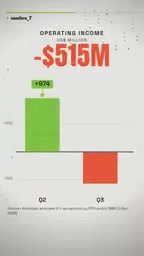
This divergence is not surprising. The marginal cost structure of AI services is fundamentally different from traditional software—every model inference and every API call consumes real compute. The faster revenue grows, the more the compute bill behind it swells in tandem. Using the source video's analogy, it's like a bubble tea shop: for every cup sold, you first need to stock two portions of ingredients.
What the Swing from Profit to Loss Tells Us
The flip in operating profit is a signal worth unpacking. Positive last quarter, negative this quarter—this indicates that costs are expanding faster than revenue. For a company like Anthropic, whose revenue comes mainly from APIs and enterprise partnerships, inference costs and data center leasing fees are the two thickest cost pillars. As model scale expands and customer call volumes rise, these two expenses are realized before revenue.
Operating profit is a key metric for measuring the profitability of a company's core business. It equals gross profit minus operating expenses such as sales, administrative, and R&D costs, but excludes interest and taxes. Unlike net profit, operating profit strips out the effects of financing structure and tax rate fluctuations, making it a better reflection of the core business's ability to make money. For a high-R&D AI company like Anthropic, a negative operating profit often means that R&D spending or compute costs surged during the quarter, exceeding the gross profit increment brought by revenue growth. Investors typically view the persistence and volatility of operating profit as an important signal for judging whether a company can achieve profitability at scale.
$895 Billion in Commitments: An Astronomical Figure on Paper
More noteworthy than the profit turning negative is the amount of long-term commitments disclosed in the filing. The scale of Anthropic's future spending commitments far exceeds its current revenue—according to the source video, the amount the company has "committed to spend" reaches the order of $895 billion.
The nature of this figure needs careful scrutiny. It is not money already spent, but future obligations under signed agreements. A considerable portion of it—$213.8 billion—will only actually occur once data centers are truly built and delivered.

In other words, the massive commitments in this prospectus essentially lock in future compute demand as contractual obligations ahead of time. Money flows out only when data centers are built; if data centers are delayed, the commitments remain on paper. This deeply binds Anthropic's financial risk to the pace of physical-world infrastructure construction.
The Scale Gap Between Commitments and Revenue
Put a single quarter's revenue next to commitments on the order of nearly $900 billion, and the ratio is so stark it makes you pause. This is not to say the company can't pay—commitments are fulfilled in installments over years and are tied to capacity—but it does outline the capital structure of leading AI companies: revenue is linear, investment is stepwise, and each step is far higher than the last.
Future obligations in a prospectus typically appear as signed but unperformed procurement contracts, lease agreements, or compute purchase commitments. They are off-balance-sheet or note-disclosed items rather than liabilities on the current balance sheet. These commitments are characterized by large amounts, long tenors, and often conditions—for example, payment is triggered only after a data center is built and delivered. Investors need to distinguish "committed" from "incurred": only the latter affects cash flow, while the former reflects more the degree to which the company has locked in future capacity and its strategic intent. If commitments far exceed current revenue, it means the company has strong confidence in future demand, but it also bears performance risk if demand falls short of expectations.
The Triple Bottleneck of AI Expansion: Money, Permits, Power
The source video distills the elements needed for AI scaling into three: money, permits, and power. This framework captures the core contradiction of the current industry.
On the money side, Anthropic's IPO itself is one answer—raising capital through public markets to support long-term commitments. On the permits side, data center siting, construction, and grid connection all require layers of approval; if any link gets stuck, commitments cannot convert into spending. On the power side, the electricity demand of large-scale GPU clusters is becoming a new hard constraint, and grid connection schedules in some regions are already affecting project timelines.

Among the three, the source video calls "whether permits can be obtained" the "real problem." That judgment has merit: money can be solved through capital markets, power can be locked in through long-term procurement agreements, but permits involve local policy, community relations, and regulatory pace—the most uncertain and the hardest to accelerate with money.
Data center grid connection refers to the process by which a new data center connects to the public power grid. It involves transmission line expansion, substation construction, and power dispatch approval, and typically takes several years. The power density of large-scale GPU clusters far exceeds that of traditional data centers; a single AI park's electricity demand can reach hundreds of megawatts, approaching the load of a small-to-medium city. This makes grid connection scheduling a new bottleneck for AI infrastructure—even if funding and land are in place, whether the utility can provide sufficient capacity on time remains uncertain. In some regions, queues of several years for grid connection have already appeared, directly affecting the pace of bringing compute online and the timing of fulfilling committed spending.
What This Means for the "AI Bubble" Debate
Putting Anthropic's filing back into the AI bubble discussion, two directions of interpretation emerge.
The bulls would say: 47% quarter-over-quarter revenue growth proves demand is real, enterprise customers are willing to pay for model capabilities, and the commercialization path has been proven. The massive committed spending reflects confidence in demand, not blind expansion.
The bears would point out: negative profit shows the problem of diseconomies of scale remains unresolved, and revenue growth is accompanied by equal or even faster cost growth; and once data center construction falls short of expectations, the nearly $900 billion in commitments will become long-term pressure hanging over the balance sheet.
Both interpretations have factual support. A more accurate description might be: Anthropic's financial condition presents a "three-high" structure of high growth, high investment, and high uncertainty. It is neither a pure bubble nor a stable mature enterprise—but a company betting the next several years on whether infrastructure can be delivered on time.
For investors and practitioners watching the AI industry, the value of this filing lies not in any single number, but in the way it lays out the true cost structure of AI commercialization on the table: revenue can grow quickly, but the physical foundation supporting that revenue—data centers, power, permits—can only advance at the pace of the physical world. That pace gap is the biggest variable in the AI industry today.
(This article is compiled from publicly disclosed information and does not constitute investment advice.)
Related articles

No Coding Required: He Shipped an App Store App by 'Cutting Features' and Nitpicking with AI
A game designer with zero frontend/backend skills shipped a dual-platform App Store app with AI—not via one-click generation, but by cutting scope and nitpicking like a demanding client.
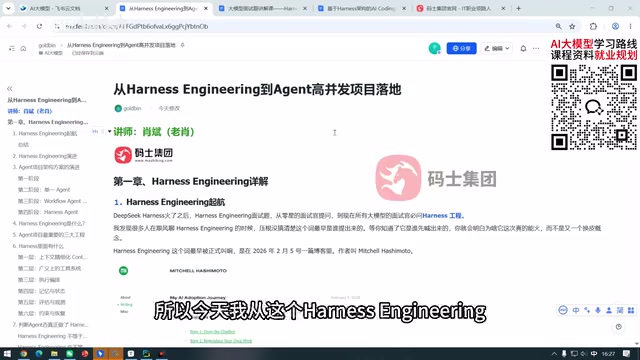
What Is Harness Engineering? From Concept Origins to Enterprise-Level Agent Implementation
What is Harness Engineering? This article traces the concept's origins and analyzes enterprise-level Agent requirements for tool call fault tolerance, data security, tenant isolation, and memory gaps.
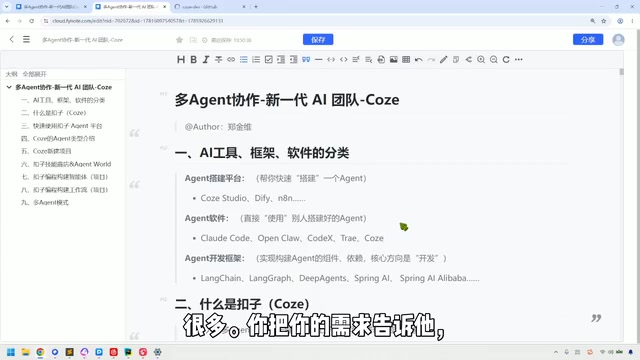
Coze in Practice: A Three-Tier Agent Classification and a Multi-Agent Collaboration Guide
A Bilibili tutorial breaks down the multi-agent collaboration toolchain into three categories: building platforms like Coze Studio and Dify, Agent software like Claude Code, and development frameworks like LangChain—plus a Coze demo of industry templates, three-platform interoperability, local Agent integration, and the trade-offs of credit consumption.