Anthropic IPO Valuation Mystery: The Trillion-Dollar Pricing and the Real Business Behind the S-1

Anthropic's IPO enters bargaining, revenue surges but valuation and massive compute commitments spark a tug-of-war.
Anthropic has filed its S-1 to list on Nasdaq, but valuation negotiations continue, with investors doubting the $1.5 trillion valuation and preferring $1-1.25 trillion. Revenue is growing rapidly, reaching $16.96 billion in Q3, up 1127% year-over-year, with a 55% enterprise API market share. However, quarter-over-quarter growth is slowing, and it faces $895.4 billion in compute commitments and a $104 billion net loss (mostly non-cash revaluation). The article analyzes product evolution, customer quality, financial truth, governance structure, and risks, concluding that $1 trillion corresponds to 15x price-to-sales, and recommends waiting for official pricing and considering a cautious small position.
Anthropic IPO Valuation Mystery: The Trillion-Dollar Pricing and the Real Business Behind the S-1
Anthropic's IPO process is entering a critical phase. The parent company of Claude has publicly filed its prospectus (S-1) and applied to list on the Nasdaq Global Select Market under the ticker ANT. Goldman Sachs and Morgan Stanley are leading the underwriting syndicate. However, the haggling over its valuation is far more complicated than a single prospectus.
From Frenzy to Bargaining: The Game Behind the IPO Timeline
According to public filings, Anthropic submitted its first S-1 amendment on November 2, supplementing third-quarter financial data. But the offering price, number of shares, and trading date remain undetermined. Earlier reports pointed to a listing in the week of November 16, and Reuters reported on November 6 that potential investors had doubts about whether the roadshow could start as scheduled in the week of November 9. Tech stocks fell, and buyers wanted a bigger discount. CNBC cited anonymous investors the same day saying that a $1.5 trillion valuation looked like a stretch, and $1 trillion to $1.25 trillion was more reasonable.
The negotiation is still ongoing, and Reuters did not report a formal withdrawal. For ordinary investors, this tug-of-war is itself a signal: even hot companies don't get a free pass on valuation. I'm happy to see the sell side sweat first.
S-1 and Roadshow: The S-1 is the registration statement a U.S. company files with the SEC for an IPO, containing core information on business, financials, and risks, and becoming effective after multiple amendments. The roadshow is the process where the underwriting syndicate leads management to pitch the stock to institutional investors, aiming to gauge subscription interest and set the offering price range. The start of a roadshow usually means the IPO is in its final sprint, but if market conditions are poor, investors may demand a lower valuation, leading to a reduced offering price or a delay.
Product Evolution: From Chat Window to Getting Work Done
If you only use Claude to write emails, summarize, or occasionally solve coding problems, you may be underestimating what Anthropic is doing. The November 2 prospectus highlights Claude Code: it can plan tasks, write code, and then test and debug. Claude Cowork extends this approach to other work—reading files, organizing information, and handling tasks across applications.
The difference is like a colleague telling you how to assemble furniture versus actually picking up the screwdriver and doing it. Business customers are willing to pay for reduced employee time and faster project delivery. Reliability and reduced rework win budgets. Is the product becoming a real business? The answer is yes, but you need to follow the money.
Revenue Growth and Customer Quality: The Truth Behind the Numbers
The amended prospectus shows full-year 2025 revenue of about $4.59 billion. In the first nine months of 2026, revenue reached $33.24 billion. Third-quarter revenue alone was $16.96 billion. Reuters reported year-over-year growth of about 1127% and quarter-over-quarter growth of 47%. At this scale, Claude has long moved beyond the novelty toy stage and is becoming part of daily work. Sometimes there is no chat window at all—other software calls the model in the background.
Run-rate revenue is also a common metric. Anthropic calculates it by taking the last 28 days of usage revenue times 13, plus monthly subscription billings times 12. A May 28 announcement said its run-rate revenue had exceeded $47 billion that month. For subsequent valuation comparisons, I use a simpler reference: third-quarter revenue times 4, or about $67.8 billion annualized.
What really interests me is the quality and retention of paying customers. The November 2 filing breaks down customers by organization size. As of September 30, more than 11,900 customers generated at least $100,000 in revenue over the past 12 months; more than 1,900 generated at least $1 million; and about 250 generated at least $10 million. These numbers are more convincing than flashy download counts.
Once enterprises integrate the model into internal systems, configure permissions, and build workflows around it, switching costs are high. That's valuable for Claude. Customers can still use multiple models, assigning hard tasks to the strongest model and routine work to the cheapest.
Run-rate revenue: A metric that annualizes the current revenue pace, often used for high-growth companies. Anthropic calculates it as the last 28 days of usage revenue times 13, plus monthly subscription billings times 12. This method assumes short-term trends continue and may overstate actual annual revenue, especially during a slowdown or seasonal fluctuations. Investors should judge sustainability by combining quarter-over-quarter growth and customer retention.
Enterprise API Market Share: What Does 55% Mean?
Menlo Ventures' Enterprise AI Report released on November 3 estimates that Anthropic accounts for 55% of enterprise large language model API spending, OpenAI 31%, and Google 9%. The study surveyed nearly 400 U.S. enterprise decision-makers and incorporated other information. Note that Menlo is also an Anthropic investor, and that relationship should be kept in mind. Even so, I take Claude's competitive position among enterprise developers seriously.
But growth is already slowing from an abnormal pace. Reuters reported on November 2 that third-quarter revenue grew 47% quarter-over-quarter, while first-quarter growth was 144% and second-quarter growth was 47%? To clarify, the original text mentions "third-quarter revenue growth of 1.5%" which may be a typo, but then explicitly states "first-quarter revenue grew 47% quarter-over-quarter, second-quarter grew 144%"? The original text is contradictory here, and actual data should prevail. TechCrunch cited RAMP sample data on November 6 saying that combined token spending in August and September grew only 1.5%, and from September 23 to October 23 grew another 8.9%. Customers are getting smarter about their bills. Models are getting cheaper, companies set budgets, and easier tasks move to cheaper models. Usage can keep climbing while bills barely change.
It's like mobile data: we use it like there's no tomorrow, but the monthly phone bill doesn't multiply with every extra video. For sellers, it's a tougher balance. I focus on Anthropic's cost efficiency. Price cuts can win customers, but every extra job needs to leave something for shareholders.
Financial Truth: Non-Cash Items in Massive Losses
Anthropic reported a net loss of about $104 billion in the first nine months of 2026. Yes, that's in billions. The November 2 filing attributes about $94.3 billion of that to fair value changes in convertible notes, derivative liabilities, and related financial instruments. Most of the massive loss is non-cash revaluation. Early financing included rights to convert into shares. As the company becomes more valuable, those rights also become more valuable, creating accounting losses. Conversion will dilute shareholders. I factor that economic cost into my thinking.
The business itself posted an operating loss of about $1.26 billion over those nine months. Reuters reported a $5.2 billion loss, including a $567 million operating loss in the third quarter, while the second quarter had a $974 million operating profit. Profitability is still swinging. As of September 30, cash, cash equivalents, and short-term investments totaled about $131.8 billion. That's a pretty thick buffer.
Convertible notes and derivative liabilities: Convertible notes are debt instruments convertible into equity, and their fair value increases as the company's valuation rises. In accounting, this appreciation must be recognized as a fair value change loss on liabilities, expanding the book net loss but not affecting cash flow. About $94.3 billion of Anthropic's $104 billion net loss stems from such non-cash revaluation, with actual operating losses only $1.26 billion. Investors should distinguish accounting losses from cash burn and focus on operating cash flow and dilution impact.
Sky-High Compute Commitments: The $895.4 Billion Bill
The amended prospectus lists about $895.4 billion in committed spending, involving signed purchase commitments, leases, and related arrangements. Almost all relate to compute and infrastructure. About $447.5 billion is expected to be paid by the end of 2030, including about $69.8 billion within 12 months after September 30, 2026. Most of the remainder falls between 2031 and 2045. It's a long payment calendar with contractual delivery conditions and cancellation arrangements.
I understand booking capacity in advance. If customers are lining up in your kitchen and the kitchen has no stove, dinner will be served next door. But the business must grow enough to match that capacity. The awkward period comes when payments start and the new compute isn't yet generating revenue. That's where cash planning comes in.
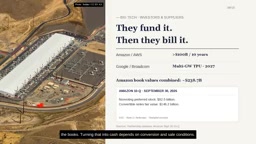
Look at the names on the other side of the contracts. On April 20, Anthropic expanded its partnership with Amazon, committing to add 5 gigawatts of capacity and invest more than $100 billion in AWS technologies (including Trainium) over 10 years. AWS remains its primary cloud and training partner. On April 6, Anthropic announced a partnership with Google and Broadcom to secure multi-gigawatt next-generation TPU capacity, expected to come online starting in 2027. An official announcement on November 18, 2025 also committed $30 billion in Azure compute. Nvidia and Microsoft each committed up to $10 billion and $5 billion in investment, subject to agreed timelines.
I like having multiple chips to choose from. Different tasks, different economics, more room to maneuver. But these relationships are like a dinner party: these companies invest in Anthropic, sell it compute, and sometimes compete for its customers. Ultimately, independent customers must keep paying enough to support the whole arrangement.
Amazon's September 30 quarterly report is particularly striking. The book value of Anthropic's non-voting preferred stock was $92.5 billion, plus the estimated fair value of convertible notes of $146.2 billion. Together that's about $238.7 billion. Converting that into cash depends on conversion and sale conditions. Google also wears multiple hats: investor, supplier, competitor. Big tech has strategic reasons to participate. My common stock must work for my wallet.
Valuation Comparison: Is 15x P/S Expensive or Cheap?
GIC confirmed a $30 billion round in February 2026, with a post-money valuation of $380 billion. Anthropic set its Series H funding at $65 billion in a May 28 announcement, with a post-money valuation of $965 billion, including some previously committed investments. Now the discussion is $1 trillion or $1.5 trillion, after earlier talk of $2 trillion. The discount caught my attention, but I still look at the price tag.
Using the $67.8 billion quarterly annualized revenue reference, a $1 trillion equity valuation is about 15x price-to-sales, and $1.5 trillion is about 22x. Once the offering terms are announced, I will update IPO cash and fully diluted share count to assess shareholder returns.
Competition is also baked into the price. OpenAI, Google, and cheaper open-source models all want the same enterprise budgets. Reuters reported on November 4 that OpenAI President Greg Brockman said enterprise customers now contribute most of revenue, and he expects the company to be ready for an IPO in 2027. OpenAI confirmed a confidential U.S. IPO filing in June. Specific offering terms remain to be determined. Large investors have alternatives, and so do we. I will compare Anthropic with OpenAI and listed tech companies with more mature cash flows. Loving the product doesn't turn off my bargaining radar.
Governance Structure: PBC and Dual-Class Shares
Anthropic is a Delaware public benefit corporation (PBC). Directors must balance shareholder financial interests, affected stakeholders, and the company's public benefit purpose. The November 2 prospectus says the Long-Term Benefit Trust generally has the right to appoint and remove designated directors constituting a majority of the board. The proposed founder Class F stock carries a combined 50.1% voting power on general shareholder matters. Certain board seats have separate arrangements.
In plain terms, ordinary shareholders have limited influence over the company's direction. You're helping fund the store, but someone else holds the keys. I support AI companies taking safety seriously, which can help enterprise customers feel confident using the product. But I also must accept that management may prioritize the long-term mission over short-term profits. That's part of what I'm buying.
Public benefit corporation (PBC) and dual-class shares: A PBC is a Delaware corporate form that requires directors to balance shareholder interests, stakeholder interests, and the company's public benefit mission, giving management flexibility to pursue long-term goals. A dual-class structure sets different voting rights for different share classes (e.g., founder Class F shares with multiple votes per share), allowing the founding team to retain control without a high ownership percentage. Anthropic's proposed Class F shares carry 50.1% of total voting power, meaning ordinary shareholders have limited influence over major decisions and must accept that management may prioritize the mission over short-term profits.
Risk Checklist: The Things I Worry About Most
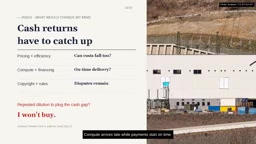
My biggest concern is: the business grows at full speed, but cash returns struggle to catch up with spending. Prices fall faster than costs. Customers use more but pay only a little more. Compute arrives late while payments start on time. Any one of these could make life difficult.
Reuters also reported on November 2 that some infrastructure partners rely on third-party financing. If financing stalls, Anthropic's booked capacity could be affected. Copyright remains on the watch list. On July 21, the Authors Guild announced that a court had approved the $1.5 billion Barts settlement the day before. This resolved related claims involving specific historical conduct. Future training, outputs, and other disputes could still lead to litigation. There are also regulatory, data center permitting, privacy and security incidents, and loss of key people. These could raise costs or make customers hesitate before handing important work to Claude.
If customer expansion continues to slow, cost efficiency deteriorates, and repeated share issuance fills payment gaps, I won't buy. Repeat purchases, on-time compute delivery, and better cash recovery would make me more willing to invest. These are the developments I'm watching.
My Investment Framework: Wait for the Price, Test the Waters with a Small Position
I like Anthropic's business. Claude has substantial revenue, and enterprises are paying to use it. That deserves serious attention. Looking 10 years out, I expect AI to take on more real work. Anthropic has a chance to be an important part of that.
For this IPO, I will wait for the official price range, use of proceeds, and diluted share count. If the valuation is too high and cash flow progress doesn't reassure me, I will wait for post-IPO earnings reports. Missing the opening day won't ruin my weekend. If the price and disclosures are reasonable, I will consider an initial position of no more than 1% of investable assets. That's my personal risk limit. No borrowing, no letting opening-day gains pull me along. I won't touch so-called Pre-IPO tokens. I want officially listed shares.
I'm willing to own this business. The price must be reasonable, and the position must let me sleep at night. To figure out that price, I like to stress-test expectations. $1 trillion sounds expensive. Say $900-something billion, and suddenly our brains start seeing a discount tag. Those zeros are very persuasive little creatures.
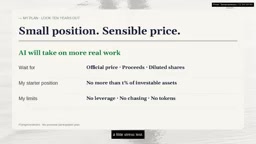
I will use the company DCF calculator on Rich2Fire to put some numbers under the feeling. Start with the sample company, lower the growth rate, raise the required return, and see whether your preferred price still holds. A small adjustment can move the valuation a surprising distance. The tool offers bull, base, and bear free cash flow scenarios. For Anthropic, first model the loss-to-profit transition outside the calculator: investments, leases, prepayments, and conversion dilution. Then establish a reasonable positive free cash flow base year, value a more mature business, and discount back to today. Revenue and net loss don't go directly into the free cash flow box. The calculator works from your inputs. Its buy and sell labels are mechanical price comparisons. You provide the financial analysis and cash flow assumptions.
That's the exercise I like: give your favorite future version a haircut and ask whether you'd still pay the asking price.
This is solely my personal opinion and information sharing, not investment advice. Investing involves risk, and reported offering timing and valuations may change. Make your own decisions based on your financial situation and the risk you can bear.
Will you wait for the price, wait for the first post-IPO earnings report, or buy a small position? If you could buy both Anthropic and OpenAI, which would you choose? What price or which operating metric would make you open your wallet?
One-line Summary
Anthropic's IPO enters the bargaining phase, with revenue surging but valuation and massive compute commitments sparking a tug-of-war.
Paragraph Summary
Anthropic has filed its S-1 to list on Nasdaq, but valuation negotiations continue, with investors doubting the $1.5 trillion valuation and preferring $1-1.25 trillion. Revenue is growing rapidly, reaching $16.96 billion in Q3, up 1127% year-over-year, with a 55% enterprise API market share. However, quarter-over-quarter growth is slowing, and it faces $895.4 billion in compute commitments and a $104 billion net loss (mostly non-cash revaluation). The article analyzes product evolution, customer quality, financial truth, governance structure, and risks, concluding that $1 trillion corresponds to 15x price-to-sales, and recommends waiting for official pricing and considering a cautious small position.
Related articles

No Coding Required: He Shipped an App Store App by 'Cutting Features' and Nitpicking with AI
A game designer with zero frontend/backend skills shipped a dual-platform App Store app with AI—not via one-click generation, but by cutting scope and nitpicking like a demanding client.
What Is Harness Engineering? From Concept Origins to Enterprise-Level Agent Implementation
What is Harness Engineering? This article traces the concept's origins and analyzes enterprise-level Agent requirements for tool call fault tolerance, data security, tenant isolation, and memory gaps.
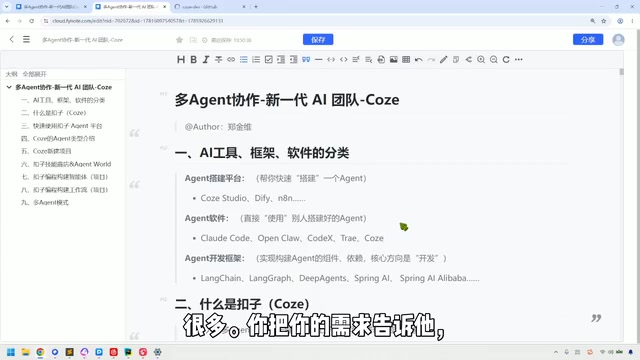
Coze in Practice: A Three-Tier Agent Classification and a Multi-Agent Collaboration Guide
A Bilibili tutorial breaks down the multi-agent collaboration toolchain into three categories: building platforms like Coze Studio and Dify, Agent software like Claude Code, and development frameworks like LangChain—plus a Coze demo of industry templates, three-platform interoperability, local Agent integration, and the trade-offs of credit consumption.