Anthropic Launches $150M Genesis Mission, Claude to Cover 15+ Federal Agencies

Anthropic invests $150 million to launch the Genesis Mission, with Claude covering 15+ federal agencies.
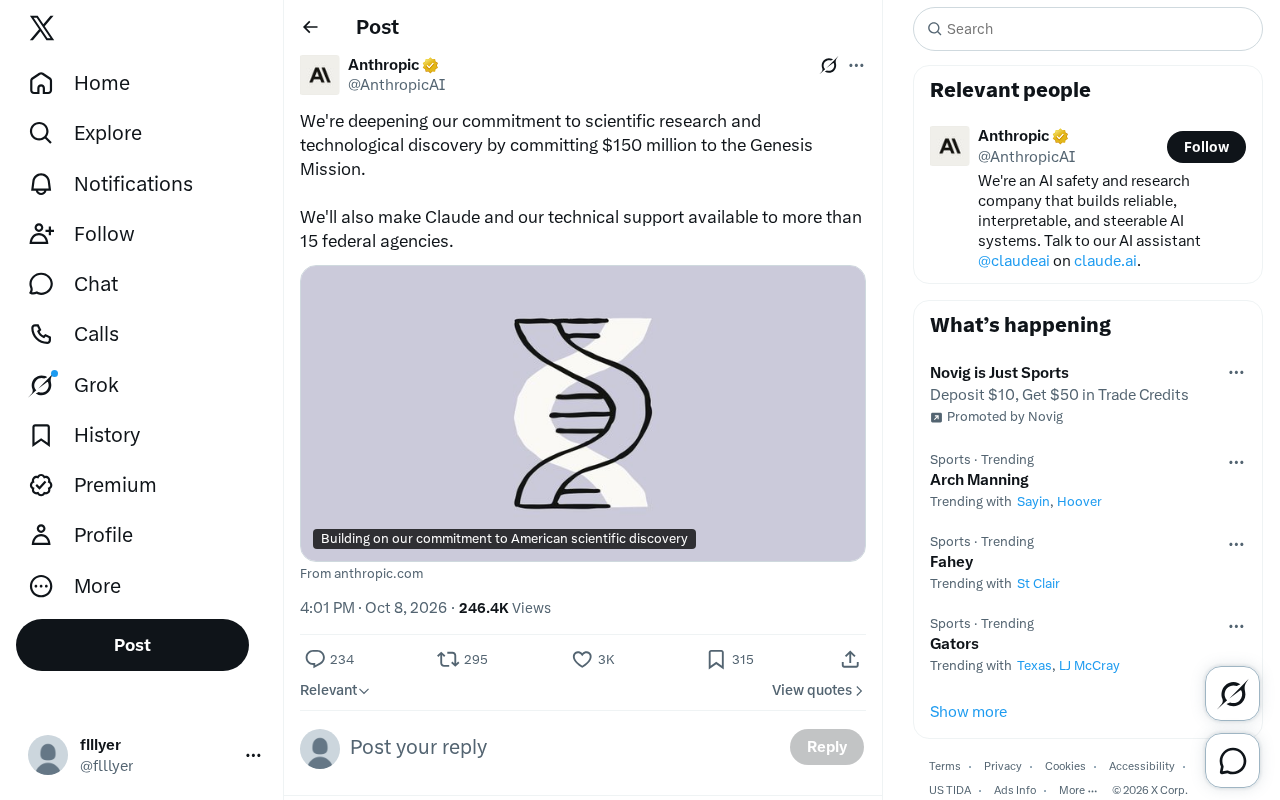
Anthropic announced on X that it will invest $150 million in the Genesis Mission and open Claude and technical support to more than 15 U.S. federal agencies. The Genesis Mission is not a single product but a project framework for scientific discovery, with funding, model capabilities, and engineering support injected into basic research and frontier technology exploration. More critical than the funding is the distribution channel: federal procurement compliance and security review thresholds far exceed those for commercial customers, and covering agencies at scale shows Anthropic has built a reusable enterprise-grade deployment path. The article argues this forms a two-track arrangement — funding to bind the research ecosystem plus federal deployment to lock in long-term revenue — that could become a template for model companies embedding themselves in national research infrastructure. Specific project lists and funding pace remain undisclosed.
Anthropic Launches $150M Genesis Mission, Claude to Cover 15+ Federal Agencies
Anthropic announced on X that it will invest $150 million in the "Genesis Mission" while simultaneously opening up the Claude model and technical support to more than 15 U.S. federal agencies. The move pushes the AI for Science competition from the laboratory to the level of national research infrastructure.
Where the $150 Million Goes: Positioning of the Genesis Mission
According to the official tweet, the funding is part of a commitment to "deepening our commitment to scientific research and technological discovery." The Genesis Mission is not a single product launch but a project framework oriented toward scientific discovery — Anthropic is injecting funding, model capabilities, and engineering support as a package, with the goal aimed at basic research and frontier technology exploration.
$150 million is a relatively high figure among single AI-company investments in scientific research. The signal it sends is that leading model vendors are no longer content to sell APIs to enterprises; they are directly participating in setting the research agenda, shifting from "tool providers" to "research collaborators."
AI for Science is the key backdrop for understanding this investment. It refers to using machine learning methods to accelerate scientific discovery, with typical directions including protein structure prediction (such as AlphaFold), materials genome screening, climate simulation, and drug molecule generation. Unlike traditional computational science, AI for Science emphasizes models learning patterns from large-scale experimental or observational data and then feeding back to guide experimental design, forming a "prediction—validation—iteration" loop. In recent years, agencies such as the U.S. Department of Energy and the NIH have made AI part of research infrastructure, and leading model companies have begun to intervene directly in the form of compute, models, and funding. Anthropic's move is an attempt to embed corporate resources into this research paradigm.
Claude Enters Federal Agencies: What 15+ Departments Really Means
More noteworthy than the size of the funding is the distribution channel. Anthropic explicitly stated that Claude and technical support will cover more than 15 federal agencies. This means model capabilities are entering government-level workflows — potentially involving scientific research data analysis, document processing, policy research support, and other scenarios.
The procurement thresholds, compliance requirements, and security reviews for federal agencies are far higher than those for commercial customers. Being able to pass this layer of screening and cover more than 15 departments at scale indicates that Anthropic has already accumulated a reusable path in enterprise-grade compliance and secure deployment. For competitors, this is a moat that is harder to replicate.
The AI procurement compliance system for federal agencies is an important reference for evaluating this progress. The U.S. federal government typically requires FedRAMP authorization, FISMA security requirements, the NIST AI Risk Management Framework, and other reviews to acquire AI tools, involving data residency, audit logs, supply chain security, and multiple other dimensions. In addition, different departments vary considerably in their requirements for handling sensitive data classifications (such as Controlled Unclassified Information, CUI). Being able to cover more than 15 agencies at scale usually means the vendor has established reusable authorization and deployment templates rather than negotiating case by case. This threshold is precisely the structural barrier beyond commercial customers that competitors will find difficult to cross in the short term.
A New Variable in the AI for Science Competition
Looking at research investment and government procurement together, Anthropic is making a "two-track move": on one hand, using funding and model capabilities to bind the research ecosystem; on the other, using federal deployment to lock in long-term revenue and policy influence.
Current participants in the AI for Science track each have different focuses, but there are few cases that directly link private funding, frontier models, and the government research system. If the Genesis Mission lands smoothly, it could become a template — model companies not merely selling tokens but becoming part of national research infrastructure.
At present, official disclosures are limited to the funding size and the scope of agency coverage; the specific project list, funding disbursement pace, and partner research institutions have not yet been made public. The link accompanying the tweet points to the full announcement, and subsequent details are worth continued tracking.
Frequently Asked Questions
What is the Genesis Mission? A project framework for scientific research and technological discovery that Anthropic has committed $150 million to support.
Which agencies will Claude be deployed to? Officials have only disclosed "more than 15 federal agencies" and have not provided a complete list.
Does this investment affect ordinary users? In the short term it does not directly change the product experience, but feedback from research scenarios may feed back into model capabilities.
One-line Summary
Anthropic invests $150 million to launch the Genesis Mission, with Claude covering 15+ federal agencies.
Paragraph Summary
Anthropic announced on X that it will invest $150 million in the Genesis Mission and simultaneously open up the Claude model and technical support to more than 15 U.S. federal agencies. The Genesis Mission is not a single product but a project framework oriented toward scientific discovery, with funding, model capabilities, and engineering support injected as a package into basic research and frontier technology exploration. More critical than the funding is the distribution channel: the compliance and security review thresholds for federal procurement are far higher than those for commercial customers, and covering agencies at scale shows that Anthropic has accumulated a reusable enterprise-grade deployment path. The article argues that this constitutes a two-track arrangement of "funding to bind the research ecosystem + federal deployment to lock in long-term revenue," and could become a template for model companies to embed themselves in national research infrastructure. The specific project list and funding pace have not yet been made public.
Related articles
2026 AI Coding Tools Comparison: Claude, ChatGPT, Gemini — Which Is the Best?
A 2026 comparison of five mainstream AI coding tools — Claude Code, ChatGPT Codex, Gemini, DeepSeek, and GitHub Copilot — on real projects, pricing, and code quality, to help you decide where that $20/month should go.

ChatGPT Codex Can Clone Any Software? Testing the Risks and the Truth
YouTube shorts claim ChatGPT Codex or Claude Code can clone Adobe, Excel, and Figma for lifelong free use. We break down the feasibility, legal risks, and DM-funnel tactics—and explain what AI coding tools are truly good for.

Kilo Code Is Free to Install but Charges for API: Cost Estimation and Configuration Guide
Kilo Code is free to install, but connected AI models are billed per token. This guide covers VS Code extension and CLI setup and shows how to estimate API costs.