Anthropic on the Eve of Its IPO: A Valuation Game Under $834 Billion in Payment Obligations
Anthropic's S-1 reveals $834B in rigid payment obligations, making the stock essentially a call option with a very high strike price.
A veteran bond trading analyst rereads Anthropic's S-1 through a credit lens, noting that the media-focused $80.7B loss is mostly accounting noise from convertible note fair-value changes, while the real risk is $834B in fixed and minimum payment obligations. Q2 revenue was $11.6B with a $46B annualized run rate and 19% operating margin, but 2028 payments peak at $163B, about 1.3x current revenue. Google, Amazon, and Microsoft simultaneously act as suppliers, shareholders, lenders, and billing channels—classic wrong-way risk. Base-case DCF is about $900B, while a $1.5T valuation requires 2036 revenue at 1.9x the base path. Conclusion: the stock is essentially a call option over the entire payment stack, with a strike price of $834B.
An analyst with 20 years of experience on institutional bond trading desks reread Anthropic's S-1 filing through a credit lens rather than a headline lens. The conclusion is straightforward: the media only seized on two numbers—the $80.7 billion loss and the trillion-dollar compute investment—but neither can answer a key question: as an investor, can you actually get a return?
This article breaks down the prospectus using four credit questions: How much does the business earn? How much does it owe? To whom does it owe? When must it pay? And, what must the share price believe for the valuation to hold?
1. Operating Level: Quarterly Revenue Doubles, First Operating Profit
Anthropic's Q1 revenue was $4.7 billion, jumping to $11.6 billion in Q2—more than doubling in 90 days. More importantly, the operating business turned a profit for the first time in Q2—$974 million in operating income, a 19% margin. First-half operating cash flow was positive at $3.9 billion.
Annualizing Q2 revenue gives an annualized revenue run rate of $46 billion. This is the baseline anchor for all calculations in this article.
Placing this revenue against the cost structure: compute and infrastructure costs were $8.9 billion, or 55 cents of every $1 of revenue. It is precisely this cost structure that gives rise to the $834 billion in payment obligations discussed later.
As for the $80.7 billion net loss, operating losses were only $690 million for the half-year. The remaining $81 billion comes from fair-value measurement of the company's own securities—$72 billion in convertible notes and $9 billion in note purchase agreements. As the company's valuation rises with funding rounds, the fair value of the liabilities rises accordingly, showing up as a book loss. This is essentially the same situation as any borrower holding convertible bonds when the stock price doubles. For equity investors and credit analysts alike, this $81 billion is noise.
Annualized Revenue Run Rate is a metric commonly used in SaaS and subscription business valuation, calculated by multiplying a quarter's (or month's) revenue by 4 (or 12), assuming the current revenue level remains constant throughout the year. It reflects the revenue scale "if current growth and volume were maintained for a full year," rather than actual realized annual revenue. For high-growth companies, the annualized run rate is often significantly higher than the most recent fiscal year's actual revenue, and thus can easily be misread as "the revenue level the company has already achieved." In Anthropic's case, Q2 revenue of $11.6 billion multiplied by 4 gives $46 billion, and this figure is used as the denominator for all debt-service coverage calculations in this article. Note, however, that if quarterly revenue is still doubling quarter-over-quarter, the annualized run rate will systematically understate actual year-end revenue; conversely, if growth slows, it will overstate it. Credit analysis uses it as a baseline anchor because payment obligations are rigid annual commitments and must be compared against a comparable annualized revenue measure to judge coverage multiples.
2. Debt Structure: $834 Billion in Minimum Payment Obligations
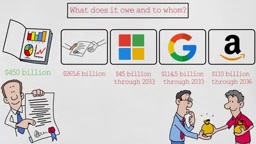
The pre-filing leaked figure was $450 billion in irrevocable commitments, but the prospectus notes give a higher floor.
Purchase commitments are $265.6 billion, corresponding to cloud service commitments: Microsoft at least $45 billion (through 2033), Google at least $114.5 billion (through 2033), and Amazon at least $110 billion (through 2036). Whether or not capacity is used, these minimum payments must be paid.
Leases signed but not yet started total $321 billion, up sharply from $50 billion at year-end. This includes $161 billion in Broadcom chip leases and approximately $160 billion in data center leases with terms up to 20 years. Newly signed minimum payments after June 30 add another $245 billion.
In total, fixed and minimum payments reach $834 billion. Adding the company's estimated off-balance-sheet variable commitments—more Google chips and an AMD purchase—the total approaches $1 trillion.
A metaphor helps: the company bought a house with a mortgage, the house price is $8 billion, the total mortgage is $834 billion, and the source of repayment is $46 billion a year—mostly, by the company's own account, revenue that is usage-based and settled monthly. The mortgage is fixed for 20 years, but the salary is uncertain. Divided one by the other, covering just the minimum payments requires about 18 years of the current revenue run rate.
What about the asset side? $132 billion in cash, $77 billion in undrawn note financing (from Google, Amazon, and Broadcom), $15 billion in revolving credit, plus primary IPO proceeds (the model assumes $60 billion). About $290 billion in funding sources against $834 billion in obligations—the gap is what the business must earn on its own.
The Four-Tier Creditor Structure
Ranked by degree of binding force, counterparties fall into four groups:
The first group is the three major cloud providers' minimum purchase commitments and the Broadcom leases—irrevocable, with under-spending triggering cross-default.
The second group is variable additional Google chip capacity and AMD purchases, paid on actual delivery.
The third group is new cloud providers N-scale and Lambda, charged only when capacity is accepted.
The fourth group is the biggest variable—SpaceX AI. Anthropic agreed to purchase up to $120.5 billion of NVIDIA GPU capacity from a direct competitor through 2029, roughly $3.1 billion per month at full delivery. After early 2026, either party can cancel with 90 days' notice. This is a two-way door: if demand disappoints, Anthropic can walk away from a $37 billion annual commitment—that's the bull case; if demand exceeds expectations, the competitor controls a quarter of next year's capacity and can reprice quarterly—that's the bear case. The same contract simultaneously constitutes two tail risks.
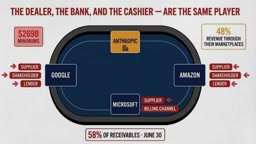
Wrong-Way Risk is a technical term in credit risk management referring to situations where a counterparty's probability of default is positively correlated with the exposure amount—i.e., "the more you need the counterparty to perform, the more likely they are to default." In derivatives and structured finance, wrong-way risk typically manifests as: you buy credit protection on a client from a bank, and that bank happens to be in trouble itself when the client defaults. In Anthropic's case, this risk manifests as: Google, Amazon, and Microsoft are simultaneously key suppliers of Anthropic's compute, its shareholders and lenders, and also collect 48% of Anthropic's revenue through cloud marketplaces while holding 58% of its accounts receivable. When Anthropic is under operating pressure and most needs suppliers to continue supplying and lenders to extend loans, these counterparties are precisely facing pressure from reduced revenue sharing and difficult receivables collection, so their willingness and ability to perform decline in tandem. This stacking of multiple roles defeats the traditional "diversify counterparties" risk control logic, because the superficially multiple counterparties are in substance the same set of entities.
What the Credit Analyst Circles in Red
Put Google, Amazon, and Microsoft at the same card table: they are suppliers, with combined minimum commitments of $269 billion; Google and Amazon are also shareholders; Google and Amazon are also lenders; and all three are simultaneously billing channels—48% of Anthropic's revenue is sold through their cloud marketplaces, which invoice customers, collect cash, and pass it on. As of June 30, these cloud marketplaces held 58% of Anthropic's accounts receivable.
The same set of players are the dealer, the bank, the counterparty, and the cashier. Credit has a term for this: wrong-way risk. The day Anthropic most needs its suppliers is precisely the day they are simultaneously its creditors and collection agents.
3. Payment Schedule: 2028 Peak of $163 Billion
The prospectus does not provide a year-by-year payment schedule, but the analyst constructed one from the contours disclosed in the S-1.
The peak year is 2028, with committed payments of $163 billion—against a current business size of $46 billion.
In the base case, revenue grows 65% next year, 42% the year after, then slows. In both years, committed payments exceed revenue, and in 2028 they are about 1.3x revenue. Cash bottoms out at about $26 billion in 2030, still positive and above the lenders' $5 billion minimum cash threshold, but quite thin. Over ten years, about $250 billion of committed capacity goes unused—paid for, not used.
Bear case: 30% growth, then 20%, then single-digit growth. 2028 payments reach twice revenue, cash turns negative in 2029, and by 2031 the gap reaches $218 billion, with financing tools covering about $97 billion and the rest requiring new equity or renegotiation.
Bull case: 100% growth, then 65%. Payments are covered from 2028 onward, and the cash low point is no lower than about $145 billion.
Two variables matter most for the base case. Removing the variable Google and AMD commitments from the floor raises the cash low from $26 billion to about $126 billion. Doubling primary IPO proceeds to $100 billion raises the low to $66 billion.
The second variable is crucial for all IPO subscribers: only primary market proceeds—newly issued shares—go into the funding pool. Secondary market proceeds—existing shareholders selling—belong to the shareholders. When the amended filing discloses the primary/secondary split, that is the first number to read. If most of it is a secondary offering, the IPO is providing liquidity for exits, not financing obligations.
The company itself writes in the filing: compute is procured and committed in advance, revenue recognition lags, and margins will be compressed as new capacity comes online. The Q2 19% margin is, by the company's own admission, a cyclical high. The company says it will repeat this margin, but the filing suggests otherwise.

Take-or-Pay Contract is a type of long-term supply agreement requiring the buyer to pay a specified minimum amount during the contract term regardless of whether goods or services are actually taken. It is common in LNG, power procurement, and large data center leases, and is essentially revenue assurance provided by the buyer to the seller so the seller can finance infrastructure construction. For the buyer, take-or-pay obligations may be disclosed only in the notes on the balance sheet, but the economic substance is equivalent to rigid debt—even if demand is insufficient and capacity sits idle, cash must still flow out. Anthropic's commitments to the three major cloud providers and Broadcom fall into this category: of the $265.6 billion in purchase commitments and $321 billion in signed leases, many terms specify that "minimum payments must be made regardless of whether capacity is used." This is precisely why credit analysts count them in the "minimum payment floor" rather than as ordinary operating expenses, and why about $250 billion of committed capacity goes unused over ten years yet still must be paid—paid for, not used, but the money is already spent.
4. Valuation Threshold: What the Share Price Must Believe
First, the threshold. The loan agreement states: the $15 billion revolving credit is secured by substantially all assets. When Anthropic obtains an investment-grade rating from two of Moody's, S&P, and Fitch, the collateral is released, covenants cease, and the debt basket opens. IPO, market cap, rating, cheaper capital—all of these are written into the loan documents.
Will the rating agencies grant it? In the base case, lease-adjusted leverage in 2028 is 8x—present value of payment obligations plus debt divided by earnings before rent. It falls to 3.4x in 2030. Investment grade typically requires below 3x. By this measure, that would likely only be reached around 2031. $132 billion in cash is investment-grade liquidity for almost any company, but it is measured against peak-year payments of $163 billion. Add a governance structure that is a public benefit corporation, with a board elected by a trust and founders holding 50.1% voting power but no economic interest, and rating agencies will rate the cash first, then notch down for structure. If a rating appears, expect high yield or crossover first.
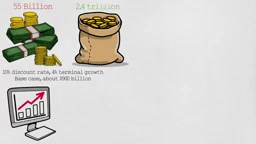
Run the same cash flows for the equity: 10% discount rate, 4% perpetual growth. Base case about $900 billion, bear case $550 billion, bull case $2.4 trillion. The number discussed at investor day was $1.5 trillion. To support a $1.5 trillion valuation, 2036 revenue must be 1.9x the base case path—i.e., the bull case is being priced as the base case.
5. Conclusion: A Call Option with an $834 Billion Strike Price
Standing ahead of shareholders is $830 billion in minimum payment obligations; this stock is essentially a call option over the entire payment stack. The wider the outcome distribution, the more valuable the option; the wider the outcome distribution, the wider the credit spread. This is why the stock and the bonds can both be right at the same time, and why a strong IPO should not reassure bond readers. A stock priced for the bull case is telling you dispersion is high—and dispersion is credit risk.
If you buy at the IPO price, you are buying a call option with an $834 billion strike price. Your winning condition is roughly quadrupling revenue by 2030, with margins holding through a cycle in which the company itself says capacity will compress them. If that doesn't happen, you get nothing. In the middle case, you are a subordinated slice in the largest take-or-pay contract in corporate history, behind Google, Amazon, Microsoft, Broadcom, and a competitor with a 90-day notice door.
Five key numbers: $46 billion annualized revenue run rate, $834 billion minimum payment floor, $163 billion 2028 peak, 8x peak leverage, and 1.9x—the business performance multiple required for the IPO price to hold.
Five things to watch in the amended filing: the primary-to-secondary offering ratio, the year-by-year payment schedule, Q3 margins (with the first SpaceX AI and Broadcom capacity coming online), Google's private placement, and the first rating.
One-line Summary
Anthropic's prospectus reveals $834 billion in rigid payment obligations; the stock is essentially a call option with a very high strike price.
Paragraph Summary
A veteran bond trading analyst rereads Anthropic's S-1 through a credit lens, noting that the media-focused $80.7 billion loss is mostly accounting noise from convertible note fair-value changes, while the real risk lies in $834 billion in fixed and minimum payment obligations. Q2 revenue was $11.6 billion with a $46 billion annualized run rate and a 19% operating margin, but 2028 payments peak at $163 billion, about 1.3x current revenue. Google, Amazon, and Microsoft simultaneously play four roles—suppliers, shareholders, lenders, and billing channels—constituting classic wrong-way risk. Base-case DCF valuation is about $900 billion, while a $1.5 trillion valuation requires 2036 revenue to be 1.9x the base path. Conclusion: the stock is essentially a call option over the entire payment stack, with a strike price of $834 billion.
Related articles

No Coding Required: He Shipped an App Store App by 'Cutting Features' and Nitpicking with AI
A game designer with zero frontend/backend skills shipped a dual-platform App Store app with AI—not via one-click generation, but by cutting scope and nitpicking like a demanding client.

What Is Harness Engineering? From Concept Origins to Enterprise-Level Agent Implementation
What is Harness Engineering? This article traces the concept's origins and analyzes enterprise-level Agent requirements for tool call fault tolerance, data security, tenant isolation, and memory gaps.

Coze in Practice: A Three-Tier Agent Classification and a Multi-Agent Collaboration Guide
A Bilibili tutorial breaks down the multi-agent collaboration toolchain into three categories: building platforms like Coze Studio and Dify, Agent software like Claude Code, and development frameworks like LangChain—plus a Coze demo of industry templates, three-platform interoperability, local Agent integration, and the trade-offs of credit consumption.