Anthropic Overhauls Subscriptions: Ultra Tier Drops Five-Hour Limit

Anthropic renames the $200 tier to Ultra and drops the five-hour limit for verified accounts, involving compute scheduling and anti-distillation controls.
Anthropic recently renamed the former $200 Claude subscription tier to Ultra at an unchanged price, changed the weekly limit wording to 10x that of Pro, and removed the five-hour limit for verified accounts. The five-hour limit originally smoothed compute consumption and prevented peak crowding, and could only be relaxed after compute expansion. The verification mechanism is opaque but aims to prevent distillation abuse. In addition, third-party applications connected via the Agent SDK consume about 1.8 times the five-hour quota of the CLI, and t3 code works around this by modifying its entry point identifier. Overall, the strategy reflects trading compute for relaxation, guarding boundaries with verification, and making rules transparent.
Subscription System Restructuring: From Max 20x to Ultra
Anthropic has recently been rolling out moves that developers appreciate across model releases, pricing adjustments, and product experience. The latest change lands on the subscription system: the former $200 tier has been renamed Ultra, and the five-hour limit has been removed for verified accounts. This change looks like just a name change, but behind it lies a chain reaction involving compute scheduling, anti-distillation risk controls, and the third-party tool ecosystem.
Subscription System Restructuring: From Max 20x to Ultra
Anthropic currently offers four tiers of Claude subscriptions: Free, Pro, Max, and Ultra. Ultra corresponds to the former $200 monthly tier; the price hasn't increased, but the naming logic has been thoroughly cleaned up. The old names Max 5x and Max 20x easily led people to assume the multipliers applied to all usage, when in fact they only described quota multipliers within the five-hour window. Mike, the Claude subscription product lead, acknowledged in a public statement that when weekly limits were first introduced, the multiplier relationship was expressed unclearly, leading users to mistakenly believe 20x also applied to weekly limits—for which he apologized.
The new naming states the limits more directly: the Ultra tier's weekly limit is 10x that of Pro, and the wording on the page is no longer ambiguous. According to analysis by a YouTube channel, this transparency itself is a sign of product maturity—when subscriptions move from an early "use it freely" welfare phase into a phase of refined operations, making the rules clear matters more than maintaining vague generosity.

Why the Five-Hour Limit Exists, and Why It's Being Removed
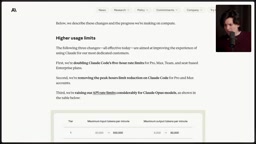
To understand this change, you first need to see clearly the two layers of limits in Claude subscriptions. The weekly limit determines how much you can use in a week; beyond that, you're billed at API prices. The five-hour limit prevents users from burning through an entire week's quota in a short period. The latter isn't Anthropic trying to shortchange users—it's a real constraint of compute availability.
According to the channel's analysis of its own t3 code data, weekday prompting volume fluctuates noticeably: it starts climbing in the early morning, peaks between 7 and 9 a.m. Pacific Time, and bottoms out from evening to midnight, with the gap between high and low approaching two times. If users were allowed to concentrate their weekly quota consumption during the daily peak periods, the inference compute Anthropic can sell to enterprises would be squeezed, and ultimately everyone would face "insufficient compute" errors. The five-hour window design caps a single user's consumption in any window to a smaller proportion of the weekly limit.
In other words, the five-hour limit protects the stability of the shared compute pool. Only after Anthropic secured more GPUs through external compute partnerships and doubled Claude Code's five-hour limit did it have the confidence to remove this limit for the Ultra tier.
Compute availability and inference scheduling: Large model inference services rely on GPU clusters, and resources are not uniformly available over time. Anthropic needs to reserve compute quotas for different subscription tiers while also handling peak demand from enterprise customers. The five-hour window is essentially a rate limiting mechanism that smooths a single user's burst traffic onto a longer time scale, preventing a few users from exhausting the shared pool during peak periods. Similar scheduling strategies are common in cloud services—for example, AWS burstable performance instances control short-term high loads through CPU credits. Only after Anthropic expands capacity through external compute partnerships (such as GPU agreements with cloud providers) is it possible to relax window limits for high-value tiers, because the buffer space in the total pool has increased.
Verification Mechanism: A Reluctant Anti-Distillation Measure
The removal of the five-hour limit only applies to "verified" Ultra accounts; new accounts must wait for verification to pass. Anthropic's explanation of the verification process is rather brief: the system automatically removes the limit, and verifying a phone number is a separate step that does not lift the restriction. If users don't see the current session bar on the usage page in settings, that means the account has passed verification.
This opacity has drawn quite a few complaints, but the motivation behind it is understandable. Distillation requires large numbers of real requests and responses, and subscription tiers are far cheaper than the API, naturally making them a target for quota arbitrage. Removing the five-hour limit would further lower the time cost of distillation, so Anthropic chose to use verification to filter out mass-registered abusive accounts. The cost is that honest users also have to go through an uncertain waiting period—a typical trade-off between risk control and experience.
Model distillation and subscription arbitrage: Distillation refers to training a small model on the inputs and outputs of a large model so that it imitates the large model's capabilities. Attackers typically mass-register low-cost accounts and obtain large amounts of high-quality responses through API or subscription interfaces as training data. Subscription tiers provide a unit token cost far lower than API pay-as-you-go pricing for a fixed monthly fee, thus becoming an arbitrage target. Phone number verification can raise the barrier to mass registration but cannot completely stop organized abuse. Anthropic's choice to attach verification to Ultra accounts that have the five-hour limit removed is to retain a risk-control gate while relaxing the experience. This "verification for quota" model is gradually becoming popular in AI products—for example, some API services require enterprise authentication before opening high-concurrency quotas.
Quota Consumption Controversy with Third-Party Tools
Theo, the author of t3 code, disclosed a more technical issue in the video: third-party applications connected to Claude subscriptions via the Agent SDK consume the five-hour window noticeably faster than the interactive CLI. He cited user feedback that t3 code consumes about 1.8 times the five-hour quota per token compared with the CLI, and the same phenomenon occurs in -p mode.
This problem has automatically disappeared for Ultra users, but Pro and Max tier users are actually affected more: their five-hour limits were already tight, and with the extra consumption from the Agent SDK path, usability drops further. Theo said he had communicated with Anthropic about this but made limited progress, and ultimately worked around it by modifying the claude code entry point field to point to t3 code's own identifier. During recording he obtained permission to merge that change, meaning t3 code users can expect quota consumption consistent with Claude Code.

Agent SDK and entry point identifiers: The Agent SDK is a programming interface Anthropic provides for developers to embed Claude capabilities into their own applications, allowing programmatic calls to the model to complete multi-step tasks. Unlike the interactive CLI, requests through the SDK path tend to be denser, have longer contexts, and may trigger different billing or rate-limiting logic. The entry point field identifies the source of a request, and Anthropic may adjust quota calculation coefficients based on it. By pointing the entry point to its own identifier, t3 code makes the system recognize it as an independent tool rather than a generic SDK call, thereby matching the CLI's consumption rate. This reflects the tension between the subscription quota system and the third-party ecosystem: the platform wants to encourage integration but needs to prevent quotas from being indirectly abused.
Practical Impact on Developers
For most daily development scenarios, the Ultra tier's quota is already quite generous. Theo mentioned that after turning off all high-load tasks, he could barely use up even half an account's quota. What really deserves attention are three groups: Pro and Max tier users, whose five-hour limits still exist and whose third-party tools consume faster; application developers on the Agent SDK path, who need to confirm whether the entry point configuration is correct; and quota arbitrageurs with compliance risks, for whom the verification mechanism is intended.
From a broader perspective, this adjustment continues Anthropic's recent strategic orientation: exchange compute expansion for relaxed limits, use verification mechanisms to guard commercial boundaries, and make naming and rules more transparent. A subscription product lead publicly apologizing and admitting a communication failure is not common among AI companies—that itself is worth noting. As for whether a competitor will be the next to announce subscription changes, Theo already teased Codex-related content at the end of the video. The subscription war is clearly not over yet.
One-line Summary
Anthropic renamed the $200 tier to Ultra and removed the five-hour limit for verified accounts, involving compute scheduling and anti-distillation risk controls.
Paragraph Summary
Anthropic recently renamed the former $200 Claude subscription tier to Ultra at an unchanged price, changed the weekly limit wording to 10x that of Pro, and removed the five-hour limit for verified accounts. The five-hour limit originally smoothed compute consumption and prevented peak crowding, and could only be relaxed after compute expansion. The verification mechanism is opaque but aims to prevent distillation abuse. In addition, third-party applications connected via the Agent SDK consume about 1.8 times the five-hour quota of the CLI, and t3 code works around this by modifying its entry point identifier. Overall, the strategy reflects an orientation of trading compute for relaxation, guarding boundaries with verification, and making rules transparent.
Related articles

9 AI Subscription Plans Compared: The Real Cost Per 100M Tokens Revealed
Bilibili creator tests 9 AI subscription plans from Volcano, Alibaba, Tencent, Baidu, Zhipu, Xiaomi, MiniMax and more, converting them all to real cost per 100M tokens, breaking down fixed-quota vs. three-tier coefficient billing and how caching, time-of-day discounts, and window limits affect actual quota.

Vibe Coding for Beginners: Expressing Intent Instead of Handwriting Code
What is Vibe Coding? A 137-episode Bilibili course defines it: the core is expressing intent, not writing code. This article analyzes Vibe Coding's productivity logic, target audience, and entry expectations to help beginners decide if it's worth learning.

LangChain Beginner's Guide: An Agent Development Roadmap from LangGraph to Deep Agents
Clarify the encapsulation relationship among LangChain, LangGraph, and Deep Agents, and master the learning path and selection logic for agent development frameworks—suitable for beginners in large model development.