Anthropic Partners with Six Pharma Companies: How Claude Is Reshaping Drug Discovery Workflows

Anthropic partners with six pharma companies and launches its own drug discovery project to expand into life sciences.
Anthropic has disclosed that its scientist team has established deep research partnerships with six drug discovery organizations while launching an internal drug discovery project, forming a dual-track strategy of external partnership and internal R&D. The tweet states these efforts clarified how Claude can support multiple stages of drug development, though specific technical details and performance data were not disclosed. Analysis suggests Claude's role may cover target discovery, literature research, and preclinical studies, focusing on assisting R&D decisions and knowledge integration rather than directly generating molecules. The work aligns with Anthropic's broader life science ambitions and may carry dual considerations of capability validation and biosecurity governance.
Anthropic recently revealed on its official Twitter that its team of scientists has established deep research partnerships with six drug discovery organizations over the past few months, while also launching its own internal drug discovery project. This move signals that the AI company is transitioning from a general-purpose model provider to a deep participant in the life sciences.
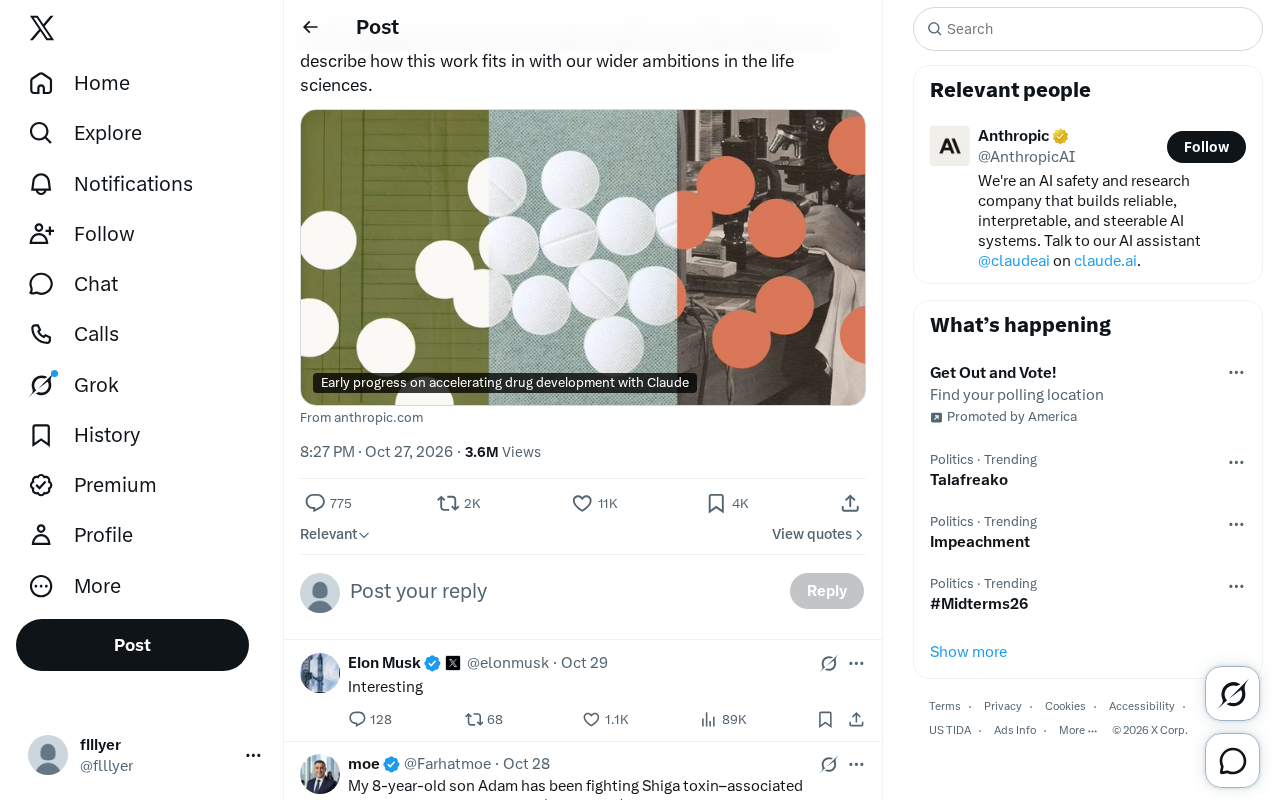
From Partnership to In-House Development: Anthropic's Dual-Track Strategy
According to Anthropic's official tweet, its scientists have launched deep research collaborations with six organizations developing new drugs, while the company has also initiated internal drug discovery work. This "external partnership + internal R&D" dual-track strategy is uncommon among AI companies. Most AI firms prefer to empower pharmaceutical companies through APIs or platforms, whereas Anthropic has chosen to directly participate in drug discovery, indicating high expectations for Claude's capabilities in life science scenarios.
The tweet noted that through these efforts, the team has gained a deeper understanding of how Claude can support multiple stages of drug development. Although the official blog has not yet disclosed specific technical details, the phrase "multiple stages" suggests that Claude's involvement may cover everything from target discovery and literature research to preclinical studies.
The prevailing model in AI drug discovery has been "AI companies provide algorithm platforms, pharma companies provide data and experimental capabilities"—for example, using graph neural networks or generative models for molecule generation and property prediction. These approaches center on structured chemical data, with model outputs typically being candidate molecular structures. Anthropic's path, by contrast, leans toward natural language interfaces that assist R&D personnel with literature reviews, target research, experimental protocol writing, and cross-stage knowledge integration—functioning as "R&D decision support" rather than "molecule generation." The two approaches are not mutually exclusive, but the latter's effectiveness is harder to measure with a single metric and depends more heavily on deep collaboration with domain experts.
What Claude Can Do in Drug Discovery
Drug discovery is a long-cycle, high-failure-rate field. The preclinical research stage involves extensive literature review, molecular property prediction, experimental design, and similar tasks—precisely the kind of information processing that large language models excel at. Anthropic emphasized in its tweet that the partnerships have clarified how Claude can support various stages of drug development.
As a caveat, the original source material does not provide specific performance data or case details, so Claude's actual contribution to drug discovery cannot be quantified. However, Anthropic's willingness to invest in its own drug discovery project suggests a certain level of confidence in the model's performance on biomedical reasoning. This approach differs from that of some AI drug discovery companies that use machine learning models to screen compounds—it leans more toward using language models to assist with R&D decisions and knowledge integration.
Preclinical research is a critical stage in the drug discovery pipeline for validating the safety and efficacy of candidate compounds. It typically includes target identification and validation, lead compound screening and optimization, and pharmacokinetic and toxicological evaluation. This stage averages 3–6 years and has an extremely high failure rate—about 90% of drug candidates entering clinical trials ultimately fail to reach the market. Traditionally, this stage relies heavily on expert experience and the integration of vast amounts of literature, patents, and experimental data, with information overload being a prominent problem. The potential value of large language models here lies mainly in accelerating knowledge acquisition, assisting experimental design, generating hypotheses, and linking information across databases—but they cannot replace wet-lab validation.
A Signal of Life Science Ambitions
The tweet concluded by noting that this work aligns with Anthropic's broader ambitions in the life sciences. This means the drug discovery partnership is not an isolated experiment but part of its life science strategy. Combined with Anthropic's previous public positions on biosecurity and AI safety, its entry into drug discovery may carry dual considerations of capability validation and safety governance.
For the industry, a leading AI company directly participating in drug discovery could push AI's role in the pharmaceutical pipeline from "assistive tool" to "R&D participant." However, publicly available information remains at the stage of partnership announcements and early result sharing; actual outcomes will require more technical blogs or papers to be disclosed.
Biosecurity is an important topic in AI safety governance, focusing on risks that AI technology could be misused to enhance pathogens or circumvent biosafety controls. Anthropic has previously published policy recommendations and model evaluation frameworks regarding AI biological risks, advocating for early warning and access control mechanisms alongside model capability improvements. Entering the drug discovery field can be seen, on one hand, as testing the boundaries of the model's biomedical reasoning capabilities in controlled, verifiable real-world scenarios; on the other hand, drug discovery involves large amounts of sensitive data and dual-use knowledge, so implementing safety reviews in both partnerships and internal R&D is a practical extension of its biosecurity stance.
Summary
Anthropic's deep collaboration with six pharmaceutical companies and its in-house drug discovery project are clear signals of its expansion into the life sciences. Claude's ability to support multiple stages of drug development is being validated, but specific results await further official disclosure. For those following AI drug discovery, this development is worth tracking closely.
One-line Summary
Anthropic partners with six pharma companies and launches its own drug discovery project, expanding deeper into life sciences.
Paragraph Summary
Anthropic has disclosed that its scientist team has established deep research partnerships with six drug discovery organizations while launching an internal drug discovery project, forming a "external partnership + internal R&D" dual-track strategy. The tweet states that these efforts have clarified how Claude can support multiple stages of drug development, but no specific technical details or performance data were disclosed. Analysis suggests Claude's involvement may cover target discovery, literature research, and preclinical studies, with an approach focused on using language models to assist R&D decisions and knowledge integration rather than directly generating molecules. This work aligns with Anthropic's broader life science ambitions and may carry dual considerations of capability validation and biosecurity governance.
Related articles

9 AI Subscription Plans Compared: The Real Cost Per 100M Tokens Revealed
Bilibili creator tests 9 AI subscription plans from Volcano, Alibaba, Tencent, Baidu, Zhipu, Xiaomi, MiniMax and more, converting them all to real cost per 100M tokens, breaking down fixed-quota vs. three-tier coefficient billing and how caching, time-of-day discounts, and window limits affect actual quota.

Vibe Coding for Beginners: Expressing Intent Instead of Handwriting Code
What is Vibe Coding? A 137-episode Bilibili course defines it: the core is expressing intent, not writing code. This article analyzes Vibe Coding's productivity logic, target audience, and entry expectations to help beginners decide if it's worth learning.

LangChain Beginner's Guide: An Agent Development Roadmap from LangGraph to Deep Agents
Clarify the encapsulation relationship among LangChain, LangGraph, and Deep Agents, and master the learning path and selection logic for agent development frameworks—suitable for beginners in large model development.