Anthropic Quietly Files S-1: Don't Guess the IPO Price—Read the Risk Factors First
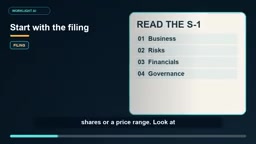
Anthropic's S-1 filing only starts the disclosure process, not an IPO; read risk factors alongside the business description.
Anthropic's public S-1 is often misread as "about to go public," but it's only a preliminary prospectus with no share count or price range set. Filing, effectiveness, pricing, and the first trading day are four independent events, and the NASDAQ ticker is only an intent. Read the original SEC documents, focus on risk factors and the business description: treat risk factors not as a probability ranking but as transmission paths to revenue, costs, competition, and compute access, and compare them with the business description to separate industry-wide from company-specific risks. Before pricing, the S-1's value is what it discloses and what it leaves blank.
Anthropic has publicly filed its S-1, and the news is easily reduced to "Anthropic is going public." But between filing an S-1 and a stock actually trading, there are several independent events. Equating a filing with an IPO is like saying "I submitted my application" means "I've been admitted"—there are still steps like effectiveness, pricing, and the first trading day in between.
This article is based on a YouTube channel's breakdown of this S-1 filing, and outlines the two sections ordinary readers should look at first: risk factors and business description, and how to distinguish "document disclosure" from "market speculation."
1. An S-1 is only the start of the disclosure process, not the start of trading
According to the YouTube channel's analysis, Anthropic's public S-1 filing means it has initiated a disclosure process, but it does not mean the stock is ready to trade.
Specifically, this document is currently only a preliminary prospectus, and its contents may still change. More importantly, Anthropic has not yet set the number of shares offered or a price range—and those two numbers are precisely the entire source of valuation speculation. Without them, any discussion of "how much Anthropic is worth" is merely inference based on outside information, not an answer provided by the document itself.
The channel's recommended approach is straightforward: open the original document on SEC and find the risk factors section, rather than working backward from news headlines.
The relationship between an S-1 and a preliminary prospectus
The S-1 is the securities registration statement form that U.S. companies file with the SEC under the Securities Act of 1933, applicable to initial public offerings. When a company files an S-1, the prospectus it contains is called a "preliminary prospectus," commonly known as a "red herring." It is "preliminary" because the SEC has not completed its review, and key terms such as the offering price and number of shares are usually left blank, to be determined after market bookbuilding in the form of a supplement (such as Form 424B). Although the financial data, risk factors, and business description investors see in an S-1 carry legal disclosure obligations, they may all change in response to SEC comments and subsequent amendments. Therefore, the legal significance of an S-1 is to initiate the disclosure and review process, not to declare that the offering has been finalized.
2. Keep the four events separate—don't conflate them
The analysis specifically emphasizes that the following four milestones must be treated separately:
- Filing: The company submits its registration statement to the SEC, and disclosure begins.
- Effective: The SEC completes its review, and the registration statement officially goes effective.
- Pricing: The offering price and number of shares are determined.
- First trading day: The stock actually begins trading on the exchange.
An S-1 only completes the first step. The NASDAQ ticker (proposed symbol) that appears in the document is merely an expression of intent and cannot be taken as evidence that trading has begun. Before stating any date or price, one should check subsequent amendments and official announcements.
This caution is especially important in tech IPO coverage—media often package "files S-1" as "about to go public," when in reality pricing may be delayed, the range may be adjusted, or the listing plan may even be shelved.
What it means for a registration statement to be "effective"
A registration statement becoming effective means the SEC has completed its review of the S-1 and the company has responded to all comment letters, after which the registration statement automatically or by declaration becomes effective under law. Only after effectiveness may the company legally sell securities to the public, but effectiveness itself does not mean a sale has occurred. Before effectiveness, the company may conduct a roadshow to market to institutional investors but cannot accept binding subscriptions. Effectiveness and pricing are usually closely linked, but they remain two separate legal milestones: effectiveness addresses "whether it can be sold," while pricing addresses "at what price." In practice, companies often ask the SEC to declare the registration statement effective the night before pricing, then immediately price and sign the underwriting agreement.
The legal status of a "proposed symbol"
The cover of an S-1 usually lists a "proposed symbol," such as the ticker to be used for trading on NASDAQ or the NYSE. This symbol is merely a placeholder expressing the company's listing intent; the exchange has not approved the listing on that basis, and the symbol may change in later amendments. A ticker is formally assigned and takes effect only after the listing application is approved by the exchange and the registration statement becomes effective. So seeing a ticker on an S-1 and concluding "the stock can already trade" is a common misreading. What truly marks the start of trading is the opening bell on the first trading day; all prior milestones are merely procedural progress.
3. How to read risk factors: focus on four transmission paths
The channel's core methodology is: when reading risk factors, don't treat them as a probability ranking—instead ask which risks could change revenue, costs, the competitive landscape, or access to computing resources.
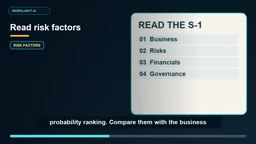
For an AI company like Anthropic, these four transmission paths are especially critical:
- Revenue side: the pace of model capability iteration, enterprise customers' willingness to renew, the sustainability of API call volume;
- Cost side: compute spending for training and inference, data center capital expenditure;
- Competition: price wars among comparable foundation model vendors, substitution pressure from open-source models;
- Access to computing resources: the degree of dependence on cloud providers and chip supply, and whether this constitutes a single bottleneck.
These are risks the company proactively discloses; they do not mean they will necessarily occur, but they form the starting point for assessing the resilience of its business model.
The legal disclosure logic of risk factors
Risk Factors are the longest section of an S-1 and the one with the most specific legal requirements. Under Item 105 of SEC Regulation S-K, a company must disclose the significant factors that make an investment speculative or high-risk, organized by materiality. The wording of these disclosures is repeatedly deliberated by company counsel and underwriters and is often broad to cover various scenarios, so it cannot be taken directly as the company's judgment of the probability that a risk will occur. For AI companies, the passages in risk factors about compute supply, customer concentration, model safety, and regulation usually correspond one-to-one with the growth assumptions in the business description. Comparing the two can help identify which growth narratives depend on conditions not yet locked in, and which risks are structural to the industry rather than the result of company mismanagement.
4. Read risk factors alongside the business description
The channel also cautions against reading only headlines or summaries. Risk factors should be read alongside the business description section—the business description explains how the company makes money, who its customers are, and what drives growth; the risk factors explain under what conditions that logic breaks down.
Only by comparing the two can you judge which risks are "industry-wide" (such as fluctuations in compute costs) and which are "company-specific" (such as dependence on a particular partner). Reading either section alone easily leads to one-sided conclusions.
5. What information is actually useful at this stage
Before the pricing and number of shares are announced, the value of this S-1 lies in two things: what it discloses, and what it still leaves blank.
According to the channel, they will update this series of analyses when the original document is supplemented with material facts. That means the current analysis is itself dynamic—as amendment filings appear, both the risk factors and the business description may be updated.
For readers following Anthropic's IPO progress, a practical approach is:
- Track the original documents and amendments directly on SEC EDGAR;
- Follow official announcements rather than timelines in secondhand reports;
- Do not draw conclusions about valuation before a price range is announced.
The channel also mentions another common misconception at the end: treating the Fed's dot plot projections as a commitment. This is exactly the same logic as treating an S-1 as confirmation of a listing—a disclosure document is information, not a promise.

For tech industry observers, Anthropic's S-1 is a rare piece of firsthand material, but the right way to use it is to ask better questions, not to get faster answers.
One-line Summary
Anthropic's S-1 filing only starts the disclosure process and does not mean an IPO; read the risk factors alongside the business description.
Paragraph Summary
Anthropic's public S-1 filing is often misread as "about to go public," but an S-1 is only a preliminary prospectus, and the company has not yet set the number of shares offered or a price range. Filing, effectiveness, pricing, and the first trading day are four independent events, and the NASDAQ ticker is only an intent. The article advises readers to go directly to the original SEC documents and focus on the risk factors and business description: risk factors should not be treated as a probability ranking but examined for their transmission paths to revenue, costs, competition, and compute access; they should also be compared with the business description to distinguish industry-wide from company-specific risks. Before pricing is announced, the value of the S-1 lies in what it discloses and what it leaves blank, not in providing valuation answers.
Related articles

No Coding Required: He Shipped an App Store App by 'Cutting Features' and Nitpicking with AI
A game designer with zero frontend/backend skills shipped a dual-platform App Store app with AI—not via one-click generation, but by cutting scope and nitpicking like a demanding client.
What Is Harness Engineering? From Concept Origins to Enterprise-Level Agent Implementation
What is Harness Engineering? This article traces the concept's origins and analyzes enterprise-level Agent requirements for tool call fault tolerance, data security, tenant isolation, and memory gaps.
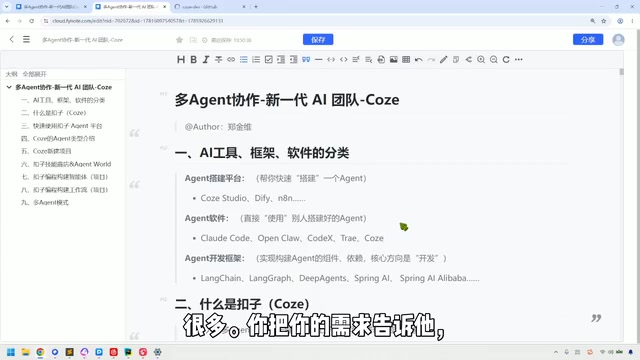
Coze in Practice: A Three-Tier Agent Classification and a Multi-Agent Collaboration Guide
A Bilibili tutorial breaks down the multi-agent collaboration toolchain into three categories: building platforms like Coze Studio and Dify, Agent software like Claude Code, and development frameworks like LangChain—plus a Coze demo of industry templates, three-platform interoperability, local Agent integration, and the trade-offs of credit consumption.