Anthropic Releases Claude Fable 5.2 and Mythos 5.2: AI Tackles Black Hole Physics Problems
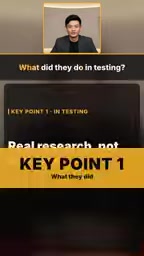
Anthropic releases Fable 5.2 and Mythos 5.2, claiming to solve black hole problems, but lacking independent verification.
Anthropic released Claude Fable 5.2 and Mythos 5.2, claiming improvements in coding, reasoning, and visual understanding, with 30% faster responses; Fable 5.2's input token price drops from $10 to $8 per million, and Mythos 5.2 is open only to vetted organizations. More notably, its scientific claims include helping complete an "impossible" software migration, designing three working electronic devices, solving two open problems in black hole physics, and formally proving Fermat's Last Theorem within 30 hours. In security testing, Fable 5.2 completed 76.3% of SciScenarioBench challenges, ahead of GPT-6 Cyber's 61%. The article notes these claims lack independent reproduction and peer review, and the definition of "solved" is vague, suggesting cautious optimism.
Anthropic recently released two new models, Claude Fable 5.2 and Claude Mythos 5.2, claiming improvements in coding, reasoning, and visual understanding, and asserting that the new models helped solve two previously unresolved black hole physics problems. The news quickly sparked discussion: is AI really beginning to venture into scientific frontiers that humans have yet to crack?
Core Capability Upgrades in the New Models
According to Anthropic, Fable 5.2 and Mythos 5.2 are the "AI brains" behind the Claude chatbot, and both outperform the 5.1 versions in coding, reasoning, and image understanding, with faster response times as well. Fable 5.2 is now available for use, while Mythos 5.2 is initially open only to vetted organizations.
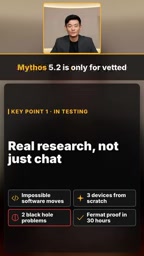
On pricing, TechCrunch reports that Fable 5.2 is cheaper than its predecessor, with input token prices dropping from $10 to $8 per million, while Anthropic says its response speed has improved by 30%. For developers, lower costs and faster speeds mean a lower barrier to experimentation and a smoother interactive experience.
Breakthroughs and Controversy on Scientific Problems
Anthropic's list of test results is quite impressive: the models helped engineers complete a software migration that was previously "impossible," designed three working electronic devices from scratch, solved two open problems in black hole physics, and formally proved Fermat's Last Theorem within 30 hours—"formalized" meaning using a computer to verify the correctness of each step of the derivation.
If true, these claims mark AI's progression from assisted programming toward substantive scientific research. But the video's author Leo also raises doubts: can AI really solve problems that humans haven't? His conclusion is "no," though he acknowledges that Anthropic claims to have solved two black hole puzzles. This contradictory stance precisely reflects a common dilemma with current AI scientific claims: a lack of independent verification, and an often vague definition of what "solved" means.
Formal proof refers to translating a mathematical proposition and its derivation into a computer-verifiable formal language (such as the languages used by proof assistants like Lean, Coq, and Isabelle), where a kernel checks step by step whether each inference conforms to axioms and inference rules. Unlike human-written papers, formal proofs have no "skipped steps" or "implicit assumptions"; as long as they pass compiler verification, the conclusion is logically certain. The formalization of Fermat's Last Theorem is a landmark project in mathematics, previously completed by a human team over several years, so the claim of "formal proof within 30 hours," if true, would mean the model has reached a considerable level in long-horizon planning, lemma decomposition, and strict syntax generation. However, it should be noted that the correctness of a formal proof only guarantees that the chain of reasoning is flawless; it does not mean the model independently "came up with" the original proof idea.
Open problems in black hole physics usually refer to unresolved theoretical puzzles at the interface of general relativity and quantum field theory, such as the black hole information paradox, the validity of physical laws at singularities, and exact solutions or stability criteria for gravitational field equations under specific spacetime backgrounds. Unlike experimental physics, such problems are hard to adjudicate directly through observation; verification relies mainly on mathematical self-consistency and peer review. Therefore, when AI claims to "solve" such problems, the key is to clarify whether it has provided testable new derivations, rediscovered known results, or merely obtained partial conclusions under specific simplifying assumptions. The lack of a clear problem definition is the main reason outsiders find such claims hard to assess.
Security Testing and Risk Considerations
In a hacking test called SciScenarioBench, which assesses whether AI can plan multi-step cyberattacks in realistic environments, Fable 5.2 completed 76.3% of the challenges, ahead of OpenAI GPT-6 Cyber's 61%. Anthropic says the risk of the model deviating from its goals remains low.
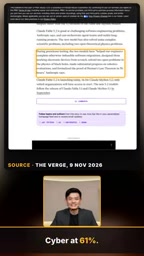
This data reveals a double-edged sword: stronger reasoning capabilities can be used for scientific research but may also be exploited by attackers. The weight of security assessments is increasing as model capabilities improve.
SciScenarioBench belongs to the category of "agentic security evaluations," whose approach is to have the model autonomously plan and execute multi-step operations in a simulated real network environment—such as reconnaissance, lateral movement, and privilege escalation—and then score it based on completion. Unlike traditional Q&A-style security tests, this type of evaluation measures the model's autonomy and tool-use capabilities in long-chain tasks, thus better reflecting actual misuse risk. The gap between 76.3% and 61% shows the model has an advantage in multi-step planning, but benchmark scores are heavily influenced by environment design, prompting methods, and the tools allowed, so cross-vendor comparisons can easily overestimate or underestimate real capabilities; interpretation should take the specific evaluation setup into account.
What It Means for Users
AI is shifting from writing emails and organizing documents to participating in real research and engineering tasks. This shift brings leaps in efficiency and also demands stricter security review and more transparent result verification. For developers and researchers, the cost reduction and speed improvements of Fable 5.2 are worth noting; for the industry as a whole, how to verify AI's scientific contributions will become the next key issue.

Currently, Anthropic's claims still require independent reproduction and peer review. Until more evidence emerges, cautious optimism may be the best stance toward such breakthrough claims.
One-line Summary
Anthropic releases Fable 5.2 and Mythos 5.2, claiming to solve black hole problems, but lacking independent verification.
Paragraph Summary
Anthropic released Claude Fable 5.2 and Mythos 5.2, claiming improvements in coding, reasoning, and visual understanding, with 30% faster responses; Fable 5.2's input token price drops from $10 to $8 per million, and Mythos 5.2 is open only to vetted organizations. More notably, its scientific claims include helping complete an "impossible" software migration, designing three working electronic devices, solving two open problems in black hole physics, and formally proving Fermat's Last Theorem within 30 hours. In security testing, Fable 5.2 completed 76.3% of SciScenarioBench challenges, ahead of GPT-6 Cyber's 61%. The article notes these claims lack independent reproduction and peer review, and the definition of "solved" is vague, suggesting cautious optimism.
Related articles
Gemini 4 Neon Hands-On: Small Model Matches Flagship, Doubles the Speed
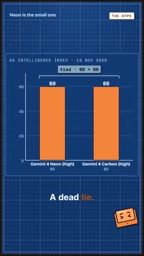
Gemini 4 Neon tied flagship Carbon 60-60 in independent tests while running about twice as fast. We break down why small models are quicker, why benchmarks fail, and why model selection should drop single scores for real-task timing.
Gemini 4 Neon Tops Coding Model Leaderboard: #1 Performance at a Quarter of the Cost
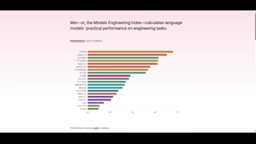
Google Gemini 4 Neon tops the Models Engineering Index coding leaderboard with 68.0, beating OpenEye 6.2 Astra and Anthropix's flagship at a quarter of the cost.

Gemini 4 Neon In-Depth Review: Near Top-Tier Performance, But Not the Cheapest
Gemini 4 Neon, Google's fourth model in seven weeks, balances performance and cost. Independent tests rank it third overall, matching rivals in coding at half the cost.