Anthropic Releases Claude Fable and Mythos 5.2: Comprehensive Upgrades in Coding Reasoning
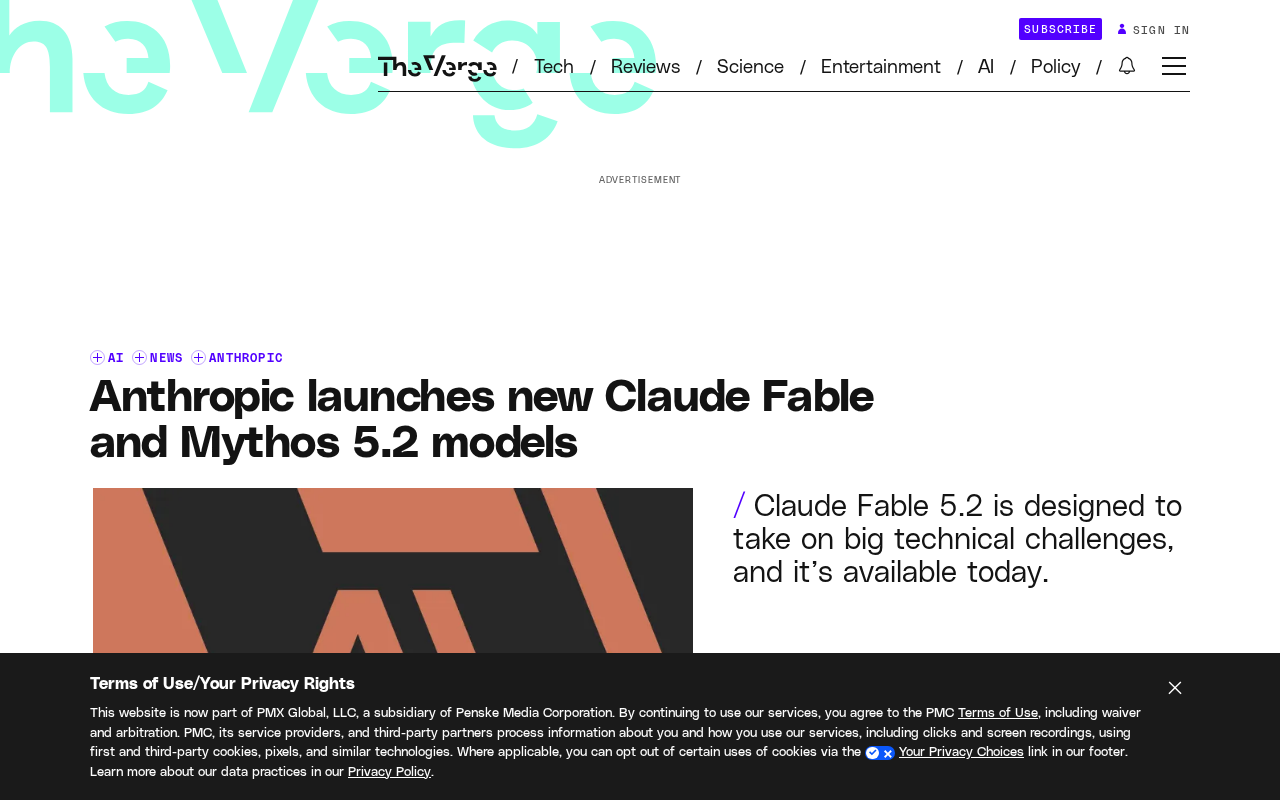
Anthropic releases Claude Fable 5.2 and Mythos 5.2, strengthening coding, reasoning, and vision while speeding up output.
Anthropic has simultaneously released new versions of its two parallel product lines, Claude Fable 5.2 and Claude Mythos 5.2. The company says they target "daunting" high-difficulty technical challenges, with improvements in coding, reasoning, and vision capabilities, and faster output than version 5.1. The article reviews the dual-model product strategy, the deployment significance of speed as an explicit metric, and the multimodal investment reflected in strengthened vision capabilities. It also notes that this disclosure focuses mainly on capability direction and lacks key information such as parameter scale, context length, pricing, and benchmark results, recommending that teams wait for official documentation and third-party evaluations before deciding on migration or upgrades.
Anthropic today released two new models, Claude Fable 5.2 and Claude Mythos 5.2, which the company says target "daunting" technical challenges, with improvements in coding, reasoning, and vision capabilities, and faster output than version 5.1.
Dual Models in Parallel: The Division of Labor Between Fable and Mythos
Claude Fable and Claude Mythos are two parallel product lines within the Anthropic ecosystem, and this time both have been upgraded to version 5.2 simultaneously. The company did not detail the differences in positioning between the two in its release information, but based on naming and historical version cadence, the two lines together cover needs ranging from general conversation to high-difficulty technical tasks.
The core selling points of this update center on three dimensions: coding, reasoning, and vision. For developers, improved coding capability means more reliable output in scenarios such as code generation, debugging, and refactoring; enhanced reasoning relates to the quality of completing complex multi-step tasks; and improved vision allows the models to more accurately handle image inputs such as charts and interface screenshots.
Speed Becomes an Explicit Metric
In addition to capability improvements, Anthropic specifically emphasized that the new models output faster than version 5.1. In the practical deployment of large models, response speed directly affects developers' iteration efficiency and end-user experience—this improvement is especially important for high-frequency invocation scenarios.
What It Means to Target "Daunting" Technical Challenges
Anthropic uses the word "daunting" to describe the types of tasks the new models target, a positioning that suggests its goal is not just everyday Q&A but more complex, higher-threshold engineering and reasoning problems. Combined with simultaneous improvements in both coding and reasoning, it can be inferred that the new models will perform better on tasks requiring long chains of logic, cross-file code understanding, and multimodal information integration.
However, the information disclosed so far is still mainly about capability direction, with no specific benchmark data or comparison details yet. For teams focused on actual performance, independent evaluations to come will be more informative than release statements.
When evaluating such capability claims, the industry typically refers to several categories of public benchmarks: for coding, SWE-bench (real GitHub issue fixes) and HumanEval; for reasoning, GPQA, MATH, and ARC-AGI; and for multimodal, MMMU, ChartQA, and others. The value of these benchmarks lies in breaking down "coding," "reasoning," and "vision" into reproducible task sets, allowing models from different vendors to be compared on the same yardstick. In the absence of such data, vendors' capability descriptions can only be treated as directional signals rather than verifiable performance commitments.
Practical Impact on Developers and Enterprises
With model versions iterating to 5.2, Anthropic is maintaining a fast update cadence on the 5.x series. For teams already using the Claude series API, the speed and capability improvements of the new versions may mean lower per-task time and higher automation coverage; for teams evaluating model selection, the dual-line strategy of Fable and Mythos also offers room to choose based on task type.
One signal worth noting is the emphasis on vision capabilities. As multimodal demand grows, whether a model can accurately understand screenshots, charts, and document images is becoming an important consideration for enterprise applications. Anthropic listing vision as one of the three major directions of this upgrade indicates its continued investment in the multimodal track.
Context window and pricing are dimensions as important as capability in model selection. The context window determines the scale of codebase or document length a single request can accommodate, directly affecting the feasibility of scenarios such as cross-file code understanding and long-document analysis; pricing is typically billed separately for input and output tokens, with output token unit prices often significantly higher than input, so the cost significance of "faster output" depends on the combination of throughput per unit time and billing method. Enterprise deployment also needs to consider rate limits, data residency, and compliance terms—information that likewise awaits completion in official documentation.
Information Gaps to Watch
The content disclosed in this release is relatively brief, lacking key information such as model parameter scale, context length, pricing strategy, and specific benchmark results. These details often determine a model's usability in real projects. For teams intending to migrate or upgrade, it is advisable to wait for official documentation updates and third-party evaluations before making decisions.
Overall, the release of Claude Fable 5.2 and Mythos 5.2 continues Anthropic's technical direction in coding and reasoning, while the speed optimization responds to efficiency demands in actual deployment. Whether the two models can deliver on the promise of "daunting" challenges still needs to be tested in real-world scenarios.
Independent evaluations typically consist of LMSYS Chatbot Arena (Elo rankings based on crowdsourced preference voting), Artificial Analysis (aggregating multiple benchmarks with latency and cost metrics), and community reproduction experiments in various vertical domains. They can provide cross-validation beyond vendors' self-reported data—especially on tasks like coding, where there is often a notable gap between real repository-level success rates and benchmark scores. Therefore, in the absence of official benchmarks, third-party evaluations and self-built small-scale evaluation sets are more reliable bases for decision-making.
One-line Summary
Anthropic releases Claude Fable 5.2 and Mythos 5.2, strengthening coding, reasoning, and vision while speeding up output.
Paragraph Summary
Anthropic has simultaneously released new versions of its two parallel product lines, Claude Fable 5.2 and Claude Mythos 5.2. The company says they target "daunting" high-difficulty technical challenges, with improvements in coding, reasoning, and vision capabilities, and faster output than version 5.1. The article reviews the dual-model product strategy, the deployment significance of speed as an explicit metric, and the multimodal investment reflected in strengthened vision capabilities. It also notes that this disclosure focuses mainly on capability direction and lacks key information such as parameter scale, context length, pricing, and benchmark results, recommending that teams wait for official documentation and third-party evaluations before deciding on migration or upgrades.
Related articles

How Do Cursor, Devin, TRAE, and Copilot Compare on Price? Calculate Your Credits Before You Compare Monthly Fees
Side-by-side comparison of individual and team pricing for Cursor, Devin Desktop, TRAE, and Copilot, breaking down credit rules, third-party model inclusion, overage billing, and practical methods for measuring usage before paying, setting spending caps, and choosing the right tool.

Copilot Retires Three Models: Pro Users Left With Only One Alternative
GitHub Copilot retires Claude Opus 4.8, Claude Opus 5, and GPT-5.6 Tera on Nov 16 across Chat, code completion, and Agent mode. Pro users have only GPT-6 Luna left; Legacy annual plans miss Opus 5.5; admins must enable replacements manually.
Gemini 4 Carbon Arrives: The LLM Race Enters the Era of Million-Token Context and Trillion-Parameter Open Source
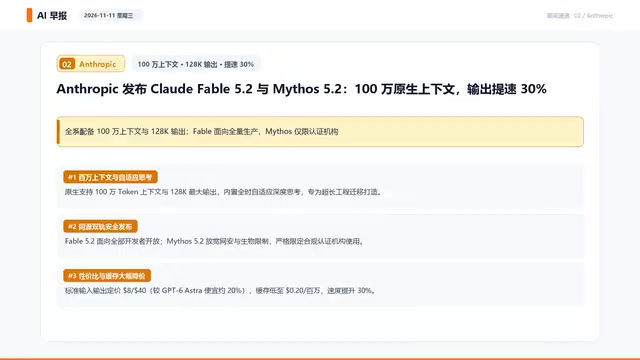
Google launches Gemini 4 Carbon and multi-agent tool Swarm; Anthropic debuts million-context Fable 5.2 and Mythos 5.2; OpenAI releases security-focused GPT-6 Cyber; Mistral and Kimi open-source trillion-parameter models — the LLM race accelerates across the board.