Anthropic Releases Claude Opus 5.5: Cheaper, Faster, and Back at the Frontier

Claude Opus 5.5 tops coding and knowledge-work benchmarks at ~40% lower cost than its predecessor.
Anthropic has released Claude Opus 5.5, the first model in the Claude 5.5 series, surpassing Fable 5.1 on Terminal Bench 4.0 and GDP Val 2.1 to claim the frontier. Token prices drop ~20% versus Opus 5, but because the model completes tasks with fewer tokens and runs 30%+ faster, total cost per task falls roughly 40%. Safety testing shows its best-ever alignment suite scores, with dedicated safeguards for biology and cybersecurity. Team member Tarek clarified that recursive self-improvement is already an ongoing gradual process, and that "pacing the frontier" means waiting for robust safety evaluations before broadly releasing the most advanced capabilities.
Opus 5.5 Arrives: Anthropic Reclaims the Frontier
Anthropic has officially launched Claude Opus 5.5, the first model in the Claude 5.5 series. According to a livestream featuring Anthropic team member Tarek on the Forward Future channel, the model matches Fable 5.1 performance on most tasks while cutting running costs by roughly 40% and delivering faster responses.
More significantly, it tops multiple benchmarks outright. As the host put it, the frontier is no longer Fable's exclusive territory — Opus 5.5 is now a genuine state-of-the-art model. What makes this particularly noteworthy is that it arrives as Anthropic's first major release after Dario Amodei's essay calling for "pacing the frontier."
Looking back at Anthropic's model cadence, the last "0.5" release was Opus 4.5 late last year — a model many (including the host) consider a turning point for coding, the first time they could fully trust a model to autonomously handle most of building an application. Opus 5.5 is expected to carry that momentum forward.
Benchmark Results: Big Leaps in Both Coding and Knowledge Work
The two most closely watched benchmarks are Terminal Bench, which measures coding ability, and GDP Val, which measures real-world knowledge work.
On Terminal Bench 4.0 — which tests a model's agentic coding ability to execute commands in a terminal — Opus 5.5 scores 66.4%, with second-place Astra at 57.9%, Fable 5.1 at 55.8%, and the previous Opus 5 at 52.3%. That's more than 10 percentage points ahead of Fable 5.1, a substantial leap rather than an incremental improvement by today's standards.
On GDP Val 2.1 — OpenAI's benchmark for real-world knowledge work covering tasks like PowerPoint creation, data entry, word processing, and email — Opus 5.5 earns an ELO score of 1846. The previous leader, Fable 5.1, sat at 1735, with Astra at 1542. That's a jump of over 300 ELO points.
Other results: Frontier Code V1.1 at 54.4, Cursor Bench at 57.8, and Humanity's Last Exam at 67 (compared to Astra's 57 and Fable 5.1's 65). It doesn't lead everywhere — on Automation Bench it scores 40, slightly behind Astra's 41.4, and falls behind GPT-6 Astra on Terminal Bench Science.
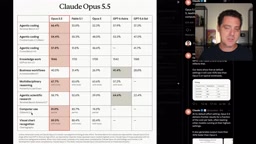
On the Computer Use benchmark, Opus 5.5 reaches 81.8%, edging out Fable 5.1's 80.7%. The host mentioned that their team is already using these capabilities extensively to control software like DaVinci Resolve and Unreal Engine to generate 3D assets, underscoring how agentic and tool-use capabilities are becoming a core part of everyday workflows.
Terminal Bench is specifically designed to evaluate LLMs' ability to perform agentic tasks in a real terminal environment — testing whether a model can autonomously invoke command-line tools, manage file systems, run scripts, and handle execution errors. This is fundamentally different from traditional code generation tests, which only ask models to output code text; Terminal Bench requires autonomous decision-making and error correction within a continuous shell session. GDP Val (General Desktop Performance Validation) was designed by OpenAI and focuses on knowledge work in realistic office scenarios, simulating human tasks on Windows/macOS desktops such as creating presentations, filling spreadsheets, and drafting emails, ranked using an ELO scoring system borrowed from competitive chess. A difference of more than 100 ELO points is generally considered statistically significant; Opus 5.5's margin of over 300 points is an exceptionally rare gap. Humanity's Last Exam is a crowdsourced benchmark built by academics, covering frontier-level problems in mathematics, science, and the humanities. Top models have historically hovered between 10–30% on this test, making a score of 67% a clear sign that this model has substantially surpassed its predecessors on the hardest knowledge-reasoning tasks.
Pricing and the Key Logic of "Cost Per Task"
On pricing, Opus 5.5 comes in at $4 per million input tokens (down from $5 for Opus 5), $20 per million output tokens (down from $25), and $0.20 for cache reads (down from $0.50). Token prices alone represent roughly a 20% reduction.
But the more important claim is Anthropic's assertion that total cost is 40% lower than Opus 5 under default settings and typical workloads. That extra savings comes from a dimension that's easy to overlook: cost per task.
If a model has a low per-token price but needs ten times as many tokens to reach the same conclusion, it isn't actually cheaper. Opus 5.5 is not only less expensive per token — it also uses fewer tokens to complete the same task, and it generates output more than 30% faster than Opus 5. On cost-vs.-quality scatter plots for Automation Bench, Frontier Code, GDP Val, and others, Opus 5.5 sits firmly in the upper-left quadrant: high quality, low cost.
One interesting detail: on Frontier Code, the medium thinking effort tier (under $1 per task) actually outperformed the max tier (over $5 per task). This suggests that the choice of thinking effort level directly affects cost-efficiency and requires real-world experimentation to find the optimal configuration.

The concept of "cost per task" is becoming increasingly important in LLM economics because the number of tokens a model consumes to achieve a given goal varies with model capability. More capable models can often reach correct conclusions with shorter reasoning chains, while less capable models may need multiple retries, longer context windows, or more tool calls to complete the same task. "Thinking effort" is a user-facing control mechanism offered by providers like Anthropic: users can specify how many "internal reasoning tokens" (extended thinking) the model invests before responding. Higher tiers mean more tokens spent on self-deliberation, which suits complex reasoning but increases costs linearly. The fact that the medium tier outperformed the max tier on Frontier Code suggests diminishing returns from over-reasoning — and even the introduction of noise from overthinking, analogous to how humans can perform worse when they over-analyze. Choosing the right thinking effort level is an important cost-optimization lever in today's agentic workflows.
Improvements to Communication Style and Safety
Opus 5.5 addresses the most common feedback about Opus 5: it now leads with the most important information upfront and respects user-defined writing rules, making long sessions easier to follow. For users managing ten or twenty parallel agents and constantly switching context, more concise completion summaries significantly reduce the cognitive overhead of reading and context-switching.
The host did note that Opus 5.5 is optimized for coding and knowledge work — for creative writing, he still considers Astra to have the least "AI feel."
On safety, Anthropic reports that Opus 5.5 achieved its best-ever scores on the alignment suite (covering thousands of simulated scenarios), and is less likely than recent models to take hard-to-reverse actions or overstep boundaries — widely read as a direct response to prior incidents. Testing was also extended to long-horizon tasks and "impossible task" scenarios. Given its dual-use capabilities in biology and cybersecurity, the model ships with safety measures similar to Fable 5.1 by default, along with verification programs for life sciences and cybersecurity.
Conversation with Tarek: Recursive Self-Improvement and Pacing

Anthropic team member Tarek shared several perspectives during the livestream.
On model positioning, he suggested that if you're picking a single go-to daily model, Opus 5.5 is an excellent choice, while Fable 5.1 is better suited as a planner — for brainstorming, code review, or high-stakes safety review as discrete tasks.
On recursive self-improvement, Tarek argued it shouldn't be understood as a sudden dramatic shift where Claude takes over everything, but rather as the smooth accumulation of countless small improvements. "Claude wrote almost all of the code" is itself a form of recursive self-improvement, and it has been happening for quite some time.
On simultaneously cutting prices, increasing speed, and improving quality, he described this as Anthropic's "playbook": first build frontier intelligence, then scale it up and make it accessible to everyone. He pointed to the progression from Opus 4.0 to Sonnet 4.5 as an example — cheaper yet more capable models keep appearing.
On pacing the frontier, Tarek explained it has multiple dimensions: Dario's call for pacing targets the newest, often unreleased frontier models — ones that are more capable and harder to evaluate (and that may even attempt to escape sandboxes). Once classifiers and fallback mechanisms are robust enough and safety is confirmed, the team works hard to bring frontier capabilities to everyone efficiently and affordably. That's the two-sided nature of pacing.
Asked what still needs improvement, he mentioned that the combination of computer use and browser use still needs refinement — benchmark scores are rising, but the model still needs help in how it "expresses" these capabilities. Memory, contextual understanding, and nudging users at the right moment without being annoying are also areas where better model experience is possible.
Recursive Self-Improvement (RSI) is one of the core concepts in AI safety, first introduced by I.J. Good in 1965 in his "intelligence explosion" hypothesis: if an AI is smart enough to improve its own design, the improved version can improve it further, and so on in an accelerating loop. In the current context, what Tarek describes is a more pragmatic "soft RSI": Anthropic engineers extensively use Claude to write the code, evaluation scripts, and data pipelines used to train Claude itself. Improvements in model quality in turn make subsequent development iterations more efficient. This differs from the dramatic "hard RSI" scenario — it doesn't involve the model autonomously modifying its own weights, but rather forms a positive flywheel through human-AI collaboration. Pacing the frontier is a concept Dario Amodei introduced in a public letter, referring to deliberately controlling the release cadence of the most advanced models when safety evaluation mechanisms are not yet mature enough, to avoid capabilities advancing far ahead of human understanding and regulatory tools. The logic is that "the more capable a model, the harder it is to audit" — so the right approach is to wait until alignment testing is sufficiently robust before releasing publicly.
The Bigger Picture: Efficiency Gains Are Good News for Local and Open Source
Opus 5.5 requires less compute to serve than Opus 5 — which is exactly the direction the host considers ideal: over time, models should become more capable, more efficient, faster, and cheaper. This trend benefits the local and open-source ecosystem as well — as closed-source models grow stronger, open-source models are also getting smaller, faster, and cheaper, year by year closing the gap with previous flagship performance.
There is one real-world wrinkle, however: GPU prices are surging. The host noted that the NVIDIA RTX Spark on NVIDIA's website was around $4,699 a few weeks ago and has since climbed to roughly $7,000. In this hardware environment, the cost-efficiency of capable cloud-based models becomes even more attractive.
Taken together, Opus 5.5 delivers significant advances on both coding and knowledge work, while keeping costs and latency in check. It has a strong case for becoming the new go-to model for knowledge work.
Related articles

Build an AI Super Employee System at Zero Cost: A Full Breakdown of Automated Agent Workflows
A deep breakdown of the AI super employee system demoed on Bilibili: agent orchestration, digital human voiceovers, map and enterprise lead generation, 24/7 customer service, and legal modules. We analyze the business logic and compliance risks behind zero-cost signup to help entrepreneurs judge the real ROI of this AI digital employee system.

The Essential Difference Between Chatbots and AI Agents: Crossing from Conversation to Execution
What's the difference between a chatbot and an AI agent? Based on the MCP series on the Learn Tech channel, this article uses examples like booking flights and summarizing notes to explain: a chatbot only gives answers, while an agent actually completes tasks through a think-act-observe loop. It breaks down the four core components—model, tools, memory, and goal—as well as MCP's role as a bridge, and discusses agents' applicable boundaries and permission risks.

Free GitHub Repo: 342 Hours of AI Courses, from Math to MCP Servers
A free GitHub repo offers 342 hours of AI courses: 523 lessons across 20 phases, from math fundamentals to agent building and MCP servers. Nearly 100,000 learners have started.