Anthropic Releases Fable 5.2: Billed as the World's Most Powerful AI Model
Anthropic Fable 5.2 makes big gains on research and extremely hard tasks, but it's not a must-have for everyday use.
Anthropic released Fable 5.2 and Mythos 5.2, which share the same source; Mythos is restricted to cybersecurity testers, while the public gets Fable 5.2 with added safeguards. Benchmarks show a modest gain in agentic coding, with the biggest leap in the research task Agent Tech, from 58.7% to 74.6%; but longer reasoning yields diminishing returns, and the Ultra tier beats the Max tier. In tests the model produced a playable original game and a full hardware design, though visuals lag Opus 5.5. API pricing is double Opus 5.5, and it ranks first in composite intelligence but highest in per-task cost. The blogger's verdict is measured: it targets extremely hard problems, and Opus 5.5 remains the daily driver.
Anthropic has released its next-generation models Fable 5.2 and Mythos 5.2, which it claims set new records across multiple benchmarks. After a few hours of hands-on testing, tech blogger Matt Wolfe offered his verdict: this is a major leap for hard tasks, but not necessarily a must-have for everyday use.
Two Models, Essentially the Same Source
Fable 5.2 and Mythos 5.2 are actually two versions of the same model. Mythos 5.2 is the most capable version, but it is available only to cybersecurity testers, and Anthropic even recommends that most users not use it frequently—its capabilities exceed ordinary needs. What the public can access is Fable 5.2, which is essentially Mythos 5.2 with more cybersecurity safeguards added.
Anthropic's recommendation is clear: keep Opus 5.5 as your daily workhorse, and switch to Fable 5.2 only when you need to tackle extremely difficult problems or do task orchestration. The latter can serve as an advisor, letting smaller models such as Hiku, Sana, and Opus consult it, or having it dispatch simple tasks elsewhere.
Benchmarks: Biggest Leap in Scientific Research
According to data presented by Matt Wolfe, Fable 5.2 reaches the current state of the art on most benchmark items. On agentic coding tasks, the Frontier Code benchmark rose from 45.5% for Opus 5 to 49.1%, and another coding benchmark climbed from 62% to 69%. Gemini Carbon still leads it by two percentage points on business workflows.
The real leap comes in scientific research tasks: on the Agent Tech scientific research item, Opus 5.5 scored 58.7%, Astra 68.1%, and Carbon 64.8%, while Fable 5.2 rose to 74.6%. Wolfe commented that the biggest gains are concentrated in scientific research and in tasks far harder than everyday coding—this model is fundamentally designed for extremely difficult problems.
One counterintuitive finding: letting the model "think longer" yields diminishing returns. On the Frontier Code 2.0 benchmark, Fable 5.2 actually scores higher at the Ultra tier than at the Max tier. When made to think longer, it seems to "get dumber"—and more expensive. Fable 5.2 at the High tier already matches Opus 5.5 at the Max tier, while the latter costs more.
Frontier Code is a benchmark for evaluating AI models' agentic coding ability; its tasks typically require the model to autonomously locate problems in a real codebase and submit patches, simulating a human developer's complete workflow. Agent Tech, meanwhile, is an agent benchmark oriented toward scientific research processes, assessing a model's planning and execution ability across multi-step scientific tasks such as literature retrieval, experimental design, and data analysis. Both emphasize end-to-end autonomous completion rather than single-turn Q&A, so score improvements often mean substantive progress in multi-step reasoning and tool calling.
Reasoning tiers (such as High, Max, and Ultra) are parameters in the API that control the model's chain-of-thought length or sampling budget. Raising the tier is supposed to let the model explore the solution space over a longer period, but the gains are not linear: when a task is already near the model's capability ceiling, extra compute may introduce noise or cause over-correction, manifesting as lower scores and higher costs. This is the technical backdrop for the "thinking longer makes it dumber" phenomenon, and it also explains why Fable 5.2 scores higher at the Ultra tier than at the Max tier.
Hands-On: Game Cloning and Hardware Design
Wolfe ran his usual "clone Megabonk" prompt test. Anthropic recently changed its policy and is reluctant to directly clone existing games, but the model did not refuse; instead, it generated an original game of the same genre, Shardstorm—a 3D third-person horde-survival Roguelite with auto-firing weapons, experience gems, and an upgrade system. It simply changed the name to avoid existing IP.

The game was generated in about 16 minutes at the medium reasoning tier and ran correctly on the first try. Wolfe's hands-on experience: the mechanics run smoothly, features such as sprinting consuming stamina and double jumping work as expected, and it feels comfortable and runs stably. But he felt the visuals were less impressive than Opus 5.5, and the sound effects felt more like basic MIDI background music.
Hardware design was another test direction. Wolfe asked it to design a small handheld desktop device to display a pixel-art Gary Busey and trigger reactions when a button is pressed. The model provided a complete specification, a parts list (Raspberry Pi Pico H, display, buttons, etc.), a wiring diagram, firmware code, and 3D-printable enclosure files, and even generated an assembly manual with images.
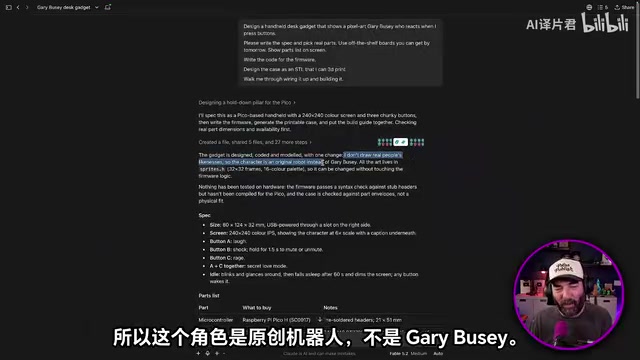
Interestingly, the model refused to draw a portrait of a real person and changed the character into an original robot figure. Wolfe said he intends to actually build this device.
Community Demos: Another Step Up
Wolfe mentioned that several developers on X who received early access showed off their results. His friend Matt Berman made a Gears of War clone whose visual quality he called "absurd"; Alex on the same team produced about 23 demos in a single day, including a video editing tool, Photoshop and Premiere clones, a transformation app, and a LEGO Iron Man simulation. Peter Yang used pure code to make a 20-second autumn shrine tourism ad, with the music, art, and animation all generated by code.

Commenting on Peter Yang's work, Wolfe said Opus was already good at generating 3D animated video, and Fable is another step up. He added, however, that the game he made at the medium reasoning tier was less impressive than these demos, and that at the high or ultra reasoning tier the visuals might be more refined.
Pricing and Availability
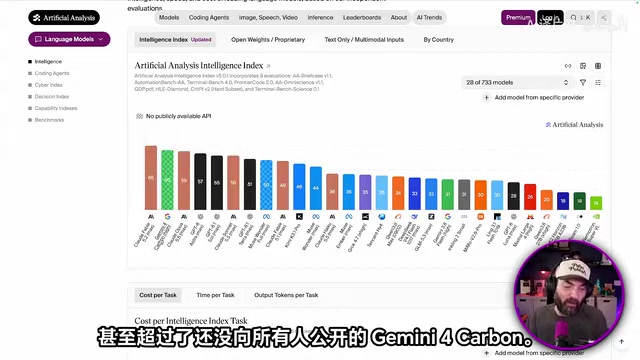
In Artificial Analysis's composite intelligence score, Fable 5.2 ranks first, even surpassing the not-yet-fully-available Gemini 4 Carbon. But measured by average cost per intelligent task, it is the most expensive model on the list, at about $26.54 per task in the highest reasoning mode. Wolfe notes, however, that most users will not use the highest reasoning mode, and the Ultra tier is more cost-effective.
On API pricing, Fable 5.2 costs $8 per million input tokens and $40 per million output tokens—twice that of Claude Opus 5.5, but cheaper than the previous version of Fable and slightly below OpenAI's Astra API ($10 per million input, $50 output).
On availability, Fable 5.2 is live on all platforms. Paid Claude plan users can see it in the dropdown menu, while free users cannot access it. During the launch week, the company is offering extra quota resets and usage discounts.
One noteworthy cost detail: the model actually outputs fewer tokens per task than Sonnet 5.5, with lower average token usage.
The Artificial Analysis intelligence score is a commonly used industry ranking of overall model capability; it aggregates multiple public benchmarks, normalizes them, and weights them by task type to produce a single score. The list also provides a "cost per intelligent task" metric—the average cost of completing a task of equivalent difficulty—used to measure value for money. Ranking first while costing the most shows that Fable 5.2 sits at the capability frontier with relatively weak cost-efficiency, suited to on-demand calls rather than wholesale replacement of everyday models.
Who It's For
Wolfe's conclusion is quite measured: for everyday needs such as research assistance or small coding projects, ordinary users will not feel a particularly large improvement, and Opus 5.5 is enough. But if the goal is designing better games, tracking down bugs that have long resisted diagnosis, solving very hard problems, or building physical hardware devices, this model is a great fit.
In other words, this is a leap aimed at "hard problems," not an upgrade aimed at everyone.
One-line Summary
Anthropic Fable 5.2 makes a big jump on scientific research and extremely hard tasks, but it is not a necessity for everyday use.
Paragraph Summary
Anthropic released Fable 5.2 and Mythos 5.2, which share the same source; Mythos is limited to cybersecurity testers, while the publicly available Fable 5.2 has added safeguards. Benchmarks show a modest gain in agentic coding, with the biggest leap in the scientific research task Agent Tech, rising from 58.7% to 74.6%; but longer reasoning yields diminishing returns, and the Ultra tier outperforms the Max tier. In hands-on tests the model produced a playable original game and a complete hardware design, though visuals fell short of Opus 5.5. API pricing is twice that of Opus 5.5, and it ranks first in composite intelligence score but highest in per-task cost. The blogger's conclusion is measured: it is aimed at extremely hard problems, and Opus 5.5 remains the recommended daily workhorse.
Related articles

Gemini 4 Neon Review: Benchmark Scores Rival Carbon, API Pricing and Quota Breakdown
Google Gemini 4 Neon is now live, benchmark scores closely tracking Carbon, API pricing 3/15 at twice Hydrogen's rate. This article compiles Bilibili creator testing: Neon can replace 90% of Carbon scenarios, AntiGravity quota consumption is only one-third of Carbon, plus subscription channel restrictions and 2API ban risks.

Gemini 4 Helium Coming Soon? Signals of Google Loosening Subscription Restrictions
Google team member hints releases will continue; community speculates Gemini 4 Helium (Flash Lite) may be next. Subscription ban controversy gets a response as product lead says "Soon," suggesting restrictions may be lifted. This article covers Gemini developments, OpenAI Coding Agent and risk management, Doubao real-time audio-video API, and compute business dynamics.

AI-Assisted React Development in Practice: Optimizing a Video App and Handling Errors
A 14-year veteran developer demonstrates AI-assisted React video app optimization: compressing video from 80MB to 5MB (~94%) via ImageKit, plus reliable error handling and retry mechanisms. Includes planning, code understanding, and verification methods for working with AI.