Anthropic S-1 Deep Dive: Is the $80 Billion Loss a Fraud or Accounting Wizardry?

Anthropic's massive loss is mainly non-cash accounting adjustments, with real growth alongside huge infrastructure commitments.
Anthropic's S-1 filing confused observers with the contrast between an $80B net loss and $16B quarterly revenue. About 90% of the loss comes from non-cash accounting adjustments for convertible notes and SAFE valuation changes, not actual cash outflows. Revenue growth is real, reaching $16.3B in H1 2026 with positive operating cash flow. Cloud marketplace revenue on a gross basis drew OpenAI's criticism, but that is a competitor's claim. The roughly $895.4B in compute commitments equals about 20x current annual revenue but spans years and partly carries termination rights. Governance leaves Class A shareholders with a mismatch between economic rights and control. The filing is not a fraud, but investors must judge whether future demand can support the massive infrastructure strategy.
An S-1 That Confused Everyone
Anthropic filed its S-1 with the SEC, preparing to list on Nasdaq under the ticker "ANT," with Goldman Sachs and Morgan Stanley leading the underwriting. The document contains a set of numbers that sent financial media into a frenzy: $4.6 billion in revenue last year, $16 billion in the first quarter alone, and even its first quarterly operating profit. Yet the same filing reported a net loss of $80 billion for six months—for every $1 earned, it lost nearly $5.
The contrast is enough to make you wonder if you misread the decimal point. Is the company's finance in serious trouble, or did accounting rules play a massive joke? Page 23 of the prospectus provides the answer, but believe it or not is up to you.
Then on November 2, Anthropic filed an amended S-1: nine-month revenue reached $33.2 billion, reported net loss exceeded $104 billion, and disclosed compute commitments approached $900 billion. These figures come from the amended filing, and the S-1 is the document a company must file before selling shares to the public—it is a sales brochure that must also disclose the uncomfortable parts.
The question is whether those uncomfortable parts reveal fundamental problems. This article examines revenue, accounting adjustments, cloud partnerships, future obligations, and shareholder control one by one, because the most misleading reading of this filing may be exactly the scariest headline.
Where the Money Comes From: Real Revenue, Not a Pitch Deck
First, let's be clear about what Anthropic sells. Claude models generate revenue through subscriptions and usage-based services. Customers either pay for access or pay based on the amount of compute activity consumed. According to the prospectus, consumption-based services generated about $3.8 billion in revenue in 2025, with subscriptions contributing another $789 million. This is a real business with paying customers, not just an impressive investor presentation.
The growth is staggering. Setting aside circulating numbers and reading the filing directly: revenue was $386 million in 2024, jumping to $4.6 billion in 2025. In the first half of 2026, revenue reached $16.3 billion—about three and a half times the prior full year's sales, compressed into six months. By the third quarter, quarterly revenue climbed to nearly $17 billion.
The customer spending story is similar. The filing reports that customers generating at least $100,000 per month, or $1 million in annualized revenue over the past twelve months, grew from fewer than 1,000 to more than 11,900 within a year. Net revenue retention is near 900%—in plain terms, the same customer cohort's spending has soared. Rapid adoption explains part of it, but whether this expansion can continue is another question.
The Secret on Page 23: How Much of the $80 Billion Loss Is Paper
Back to that scary $80 billion. According to the original S-1, Anthropic lost $80.7 billion in the first half of 2026. But $72.4 billion of that came from valuation changes in convertible notes, derivatives, and SAFEs. These are financing instruments that give investors future ownership or related financial rights, and their accounting value rises as the company becomes more valuable.
The bizarre consequence: the company's valuation grew so dramatically that certain obligations to investors became more expensive on paper. Accounting standards require the company to recognize that increase as a loss. About 90% of the reported first-half net loss came from this non-cash adjustment. No corresponding $72.4 billion actual payment occurred during those six months. The company became more valuable, and the income statement became dramatically uglier. Accounting does have a sense of humor sometimes.
This doesn't mean the remaining loss is unworthy of attention—the remaining roughly $8.4 billion reflects cash burned in operations. But to understand operating performance, look at another line. The original filing reported an operating loss of $693 million for the first half, and more importantly, GAAP operating profit of $974 million in the second quarter—the only profitable quarter among the six presented.
The amended prospectus also shows positive operating cash flow of $6.6 billion for the first nine months of 2026. Cash flow measures money moving through the business, not paper value changes, so the simplistic claim that "Anthropic burns $80 billion in cash every six months" has no basis. The real financial picture is far more complex.
The Accounting Logic of SAFEs and Convertible Notes
A SAFE (Simple Agreement for Future Equity) is a financing instrument commonly used by startups: investors put in money now, and it converts to equity under agreed terms upon a specific trigger event (such as an IPO or the next funding round). Convertible notes are similar but carry debt characteristics. Both are typically classified in accounting as financial liabilities or derivatives measured at fair value. When a company's valuation rises rapidly, the fair value of these instruments rises too, and accounting standards require the company to recognize the increase in fair value as a current-period loss—even though no cash is paid. This is exactly the source of Anthropic's $72.4 billion non-cash loss in the first half: the more valuable the company, the "more expensive" its obligations to investors on paper, and the uglier the income statement. Understanding this mechanism is essential to separating paper losses from real cash consumption.
The Adjusted Profit Controversy: Same Quarter, Two Answers
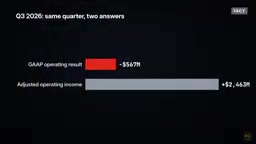
The third quarter brought new complexity. On October 14, the Financial Times first reported, followed by Reuters, that Anthropic told investors it had achieved profitability. The November amended filing then disclosed a GAAP operating loss of $567 million for the quarter, while also reporting adjusted operating profit of $2.46 billion. Same company, same quarter, two answers about $3 billion apart.
According to the amended filing, nearly $2 billion of that came from non-cash expenses related to an employee donation matching program, with another large portion reflecting stock-based compensation. Anthropic excludes these items from its adjusted operating metric, explaining that charitable expenses are tied to employee equity awards rather than ordinary cash operating expenses. The distinction matters, but shareholders should also remember that non-cash expenses can still have economic consequences.
Adjusted profitability is not inherently misleading. Companies use them to separate unusual expenses from ongoing operating performance. However, excluding costs doesn't make them disappear. When an adjustment turns an operating loss into billions in operating profit, investors should scrutinize every line in the reconciliation. The filing provides that reconciliation; reading it is the responsibility of those buying the stock.
Cloud Marketplace Revenue Recognition: The Gross vs. Net Debate
The second issue is how revenue generated through cloud marketplaces is recognized. Amazon and Google are both major technology partners and distribution channels. According to Reuters' report on the prospectus, their marketplaces contributed nearly half of Anthropic's revenue in 2025. The amended filing shows cloud marketplace revenue still accounted for over 40% in the first nine months.
This raises an important accounting question: who actually controls the service being sold? Anthropic records these marketplace transactions on a gross basis. Suppose a customer pays $100 through a marketplace, and the platform retains a fee. Under the gross method, the seller can record the full amount paid by the customer as revenue while separately recognizing related expenses; under the net method, acting as an agent, it records only its retained portion. Which treatment applies depends on the contractual arrangement and who controls the promised service.
Anthropic says it acts as principal because it controls the intelligence service delivered to customers—that is its accounting position in the SEC filing. GAAP permits gross recognition when the principal criteria are met, and the mere fact that another company might present differently is not evidence of wrongdoing. But it does make direct revenue comparisons surprisingly difficult.
Someone has already challenged that comparison. According to The Implicator and Gizmodo, OpenAI's revenue head argued in an internal memo that Anthropic's gross presentation inflates the previously discussed $30 billion annualized revenue figure by about $8 billion relative to her preferred comparison basis. This is a competitor's claim, not an independent accounting determination. OpenAI competes directly with Anthropic and has its own financial interests; this criticism deserves scrutiny rather than automatic acceptance.
Criteria for Gross vs. Net Method
Under ASC 606 (the U.S. accounting standard for revenue recognition), the core test for gross versus net is whether the entity controls the service before transferring it to the customer. If the entity is the "principal," controlling the service and bearing inventory risk, pricing power, etc., it recognizes revenue at the full amount paid by the customer; if it is an "agent," merely facilitating the transaction, it recognizes only its retained commission. For cloud marketplaces, where the platform provides both infrastructure and distribution, determining who controls the delivered AI service is not always clear. Anthropic argues it controls delivery and therefore uses the gross method. This choice significantly amplifies revenue scale and makes revenue figures lack direct comparability with peers that use the net method (such as some AI companies that sell through cloud marketplaces but account as agents).
Run-Rate Revenue: A Headline Number Left Blank
The prospectus explains a concept called "run-rate revenue," but its headline figure is left blank. The metric annualizes recent consumption activity and subscription fees. Imagine a restaurant has an extraordinary weekend and then multiplies that weekend by a full year to project sales—it shows momentum but doesn't guarantee the next weekend will be as busy.
Anthropic's own risk disclosure says run-rate revenue may increase, but it is not a substitute for GAAP revenue and not a revenue forecast. The filing also warns that growth may slow, usage may fluctuate, and some revenue comes from customers later found to have violated usage policies. These are meaningful caveats. The company is explicitly telling investors not to treat a snapshot of recent demand as a promise about the future.
The Nature of Run-Rate Revenue
Run-rate revenue is not a GAAP metric but a non-standard operating metric, typically calculated by multiplying the most recent month's or quarter's revenue by 12 to annualize it. Its purpose is to show current business momentum, especially for high-growth companies, helping investors perceive what scale "if the current pace continued for a full year" would look like. But it has two key limitations: first, it assumes recent pace is constant, ignoring seasonality and volatility; second, it does not reflect recognized revenue and is not audited. The SEC allows companies to disclose such metrics in prospectuses but requires them to explain the limitations and caution that they are not a substitute for GAAP revenue. Anthropic's explicit warnings that growth may slow and usage may fluctuate are precisely to meet this disclosure requirement while preventing investors from misreading it as a revenue forecast.
The $900 Billion Commitment: A Scale Comparison, Not a Repayment Schedule
Now consider a number that may matter far more than any quarterly adjustment. According to the amended S-1, Anthropic has entered into approximately $895.4 billion in purchase commitments and lease arrangements, the vast majority related to compute and infrastructure. Disclosed arrangements include cloud capacity, specialized chips, and long-term infrastructure contracts—the machines needed to train and run increasingly powerful AI systems.
For comparison: annualizing the company's first nine months of revenue gives about $44 billion. Dividing the disclosed total commitments by that pace yields roughly 20 years of current annual revenue. This is a scale comparison, not a repayment schedule. Commitments span multiple years, and revenue may grow substantially. Still, it shows how much future growth the company's infrastructure strategy anticipates.
There are caveats. According to the amended filing, about $213.8 billion of the obligations involve termination rights or conditions the company must meet to keep certain arrangements moving forward. If counterparties fail to deliver, Anthropic may have options. Not all obligations are immediately payable, and not every obligation carries the same risk. Treating total commitments as debt due tomorrow is a serious misunderstanding.
Anthropic also reported about $131.8 billion in cash, equivalents, and short-term investments as of September 30, plus an undrawn $15 billion revolving credit facility—currently being finalized. This provides considerable financial flexibility. But cash on hand relative to disclosed commitments is still only about 15 cents per dollar. Again, these amounts span different time horizons. The comparison shows scale, not imminent insolvency.
The underlying concern is simpler: Anthropic must lock in enormous compute capacity before knowing exactly how much future customer demand will justify it. The filing acknowledges that short-term compute contracts can be much more expensive than long-term arrangements. According to the amended filing, third-quarter short-term compute purchases totaled about $5 billion. Investors need to understand not just revenue growth, but how much it costs to generate each additional dollar of revenue.
Analysts have already raised this. Violeta Todorova of Leverage Shares questioned the visibility of marginal revenue economics. Nick Patience of Futurum highlighted limited separation between spending to train new models and spending to serve existing customers—two different activities with different investment implications. Without that breakdown, identifying the long-term cost structure becomes more difficult.

Legal and Governance: Buy a Ticket, But Don't Expect to Choose the Driver
Legal and governance risks deserve separate consideration from the financial story. Anthropic agreed to pay a $1.5 billion settlement in the Barts copyright lawsuit without admitting liability. Separately, the company challenged the Pentagon's supply chain risk designation in federal court. These matters involve real business exposure, but none constitutes financial misrepresentation in an IPO prospectus.
Governance may have more consequences for ordinary shareholders. According to the S-1, a single special Class F share held by a founder entity carries 50.1% of ordinary shareholder voting power. Put another way, a long-term benefit trust holds special Class T rights that can elect a majority of board members. Anthropic says this arrangement supports its public interest mission and responsible AI development. That explanation deserves a fair hearing—the company wants to protect long-term safety decisions from short-term market pressure. But investors must understand the trade-off: buying Class A shares does not provide proportional practical control. Shareholders can participate in economic returns while key governance rights remain elsewhere. You can buy a seat on this particular train, but you shouldn't assume you can choose the driver.
Dual-Class Structure and the Long-Term Benefit Trust
Dual (or multiple) class structures are common in tech IPOs, giving founders or specific entities high-voting shares so management can retain control after listing. Anthropic's design is more unusual: Class F shares give the founder entity 50.1% voting power, ensuring veto power over major decisions; Class T shares, held by a long-term benefit trust, have the right to elect a majority of board members, aiming to institutionalize the public interest mission. This arrangement resembles Google's and Meta's dual-class structures but adds a "mission protection" dimension. For ordinary Class A shareholders, the separation of economic rights and voting rights means they can hardly influence company direction through voting. Disclosure is adequate, but investors must assess the agency costs of this governance structure themselves.
Valuation: Paying for Expectations
Valuation makes every uncertainty more expensive. According to Bloomberg Law, Anthropic was valued at about $965 billion in a private funding round in May 2026. Against third-quarter annualized revenue of about $68 billion, that is roughly 14 times annualized sales. The multiple is based on a single quarter, not guaranteed full-year revenue. Investors paying this valuation are buying both current operating results and expectations.
Conclusion: Not a Century Fraud, But Keep Your Eyes Open
So, is Anthropic's IPO filing a century fraud? Based on the evidence examined in this article, no. The startling net loss has a documented accounting explanation. Revenue growth is supported by disclosed financial statements. The company's adjustments, marketplace accounting, contractual commitments, and governance structure are all described in the prospectus. We found no evidence in this record of a scheme to deceive investors.
But transparent disclosure does not automatically make everything safe. The investment thesis comes down to one question: can future demand grow into an exceptionally large infrastructure strategy. Optimists argue that rising utilization can generate substantial revenue from committed compute resources over time. Skeptics point to opaque marginal economics, recurring adjustments, and shareholders' lack of practical control. Both sides have a point. The filing does not hide these tensions—it simply leaves the judgment to the reader.
One-line Summary
The massive loss in Anthropic's prospectus is mainly non-cash accounting adjustments, with real growth coexisting alongside enormous infrastructure commitments.
Paragraph Summary
Anthropic's S-1 filing confused observers with the contrast between an $80 billion net loss and $16 billion in quarterly revenue. Breaking it down, about 90% of the loss comes from non-cash accounting adjustments for convertible notes and SAFE valuation changes, not actual cash outflows; revenue growth is real and accelerating, reaching $16.3 billion in the first half of 2026 with positive operating cash flow. Cloud marketplace revenue recognized on a gross basis drew OpenAI's criticism, but that is a competitor's claim. The roughly $895.4 billion in compute commitments equals about 20 times current annual revenue, but spans multiple years and partly carries termination rights, so it should not be treated as immediate debt. On governance, the founder entity holds 50.1% voting power, leaving Class A shareholders with a severe mismatch between economic rights and control. The conclusion: the filing is not a fraud, but investors must judge for themselves whether future demand can support the massive infrastructure strategy.
Related articles

I Built an AI Skill That Edits Videos End to End
A YouTuber turned video post-production into an AI skill: automatic denoising, audio optimization, retake removal, transcription, subtitles, plus YouTube titles/descriptions and Instagram captions and covers. This article breaks down the seven-step human-AI division of labor and how to replicate it.
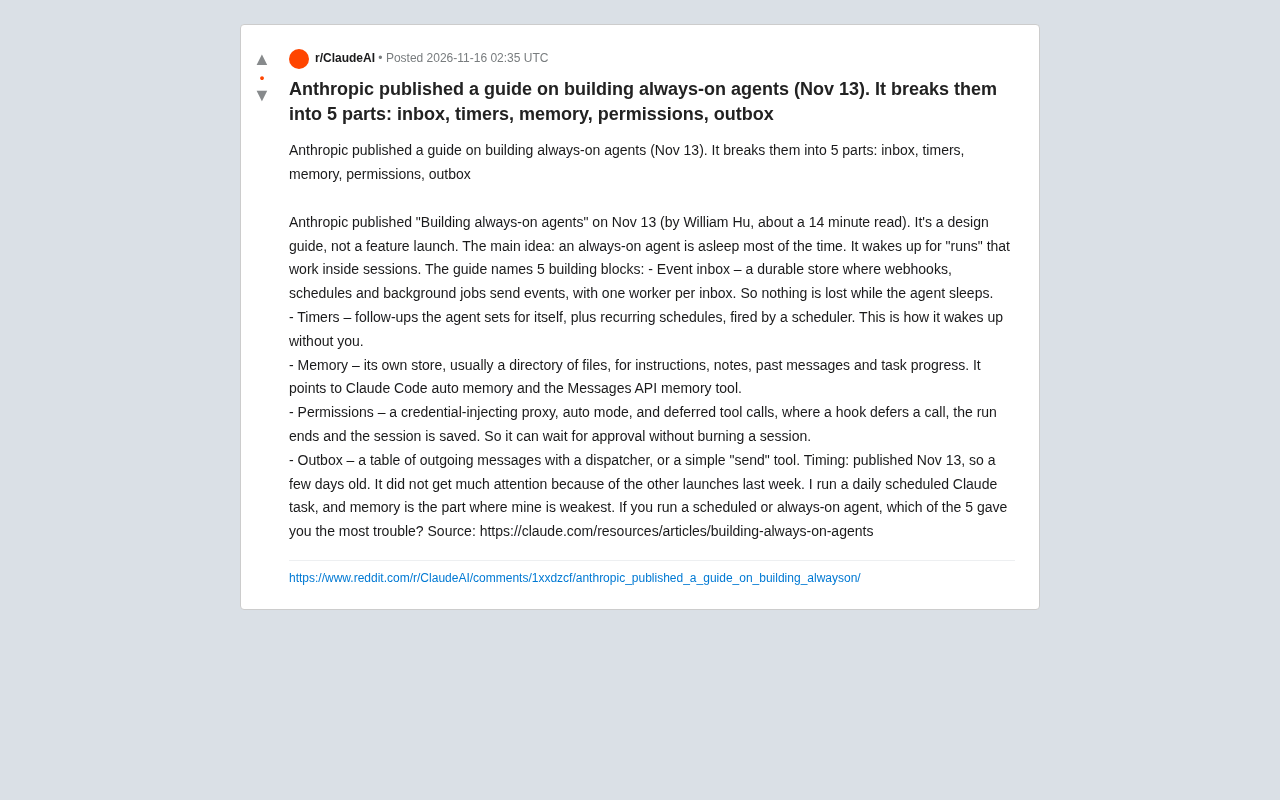
Anthropic's Always-On Agent Design Guide: Breaking Down the Five Core Modules
Anthropic's *Building always-on agents* design guide breaks always-on agents into five modules: event inbox, timers, memory, permissions, and outbox. Here's a module-by-module breakdown of their roles and engineering trade-offs, plus why developer feedback on Reddit points to memory as the weakest link.
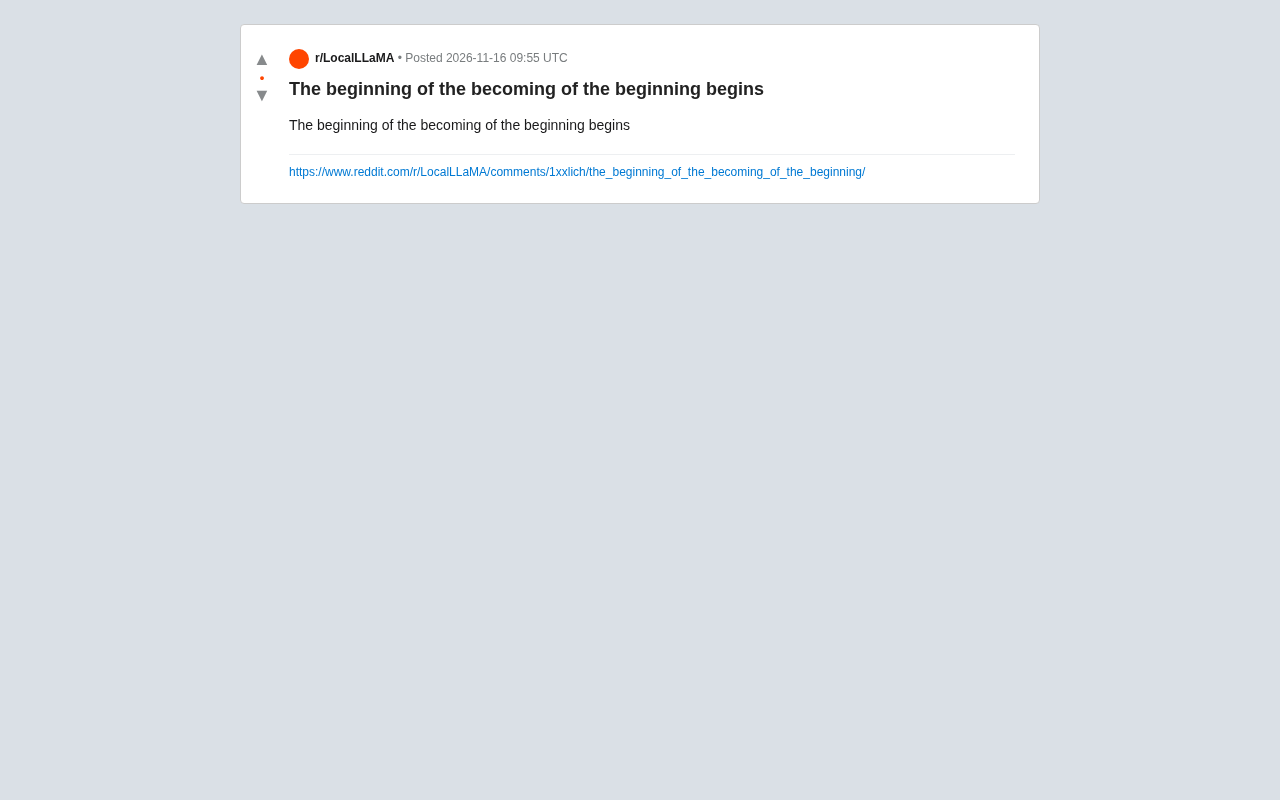
The AI Era: A Recursive Starting Point
Starting from a popular Reddit thread title, this article explores the recursive loop paradigm in AI development, analyzing self-reference in data, code, and evaluation, and discussing consensus and divergence across perspectives.