Anthropic's Attention to Detail: What Training Rigor Actually Looks Like

A Reddit post on Anthropic's training rigor reveals how detail-orientation is safety-first philosophy made product.
Starting from a Reddit post praising Anthropic for "taking even small details seriously during training," this article explores how AI competition is shifting from benchmark scores toward nuanced user experience. It examines three dimensions where training detail shows up — annotation rigor, edge-case robustness, and conversational coherence — and explains how Anthropic's Constitutional AI method systematizes these concerns. The piece argues that detail-orientation is not about pleasing users, but a natural expression of a safety-first product philosophy, and offers practical guidance for developers on evaluating models beyond standard leaderboards.
A Reddit Thread That Sparked a Conversation
A discussion thread recently appeared in the Reddit AI community with a telling title: "This is proving how Anthropic was taking even small details seriously during the training phase."
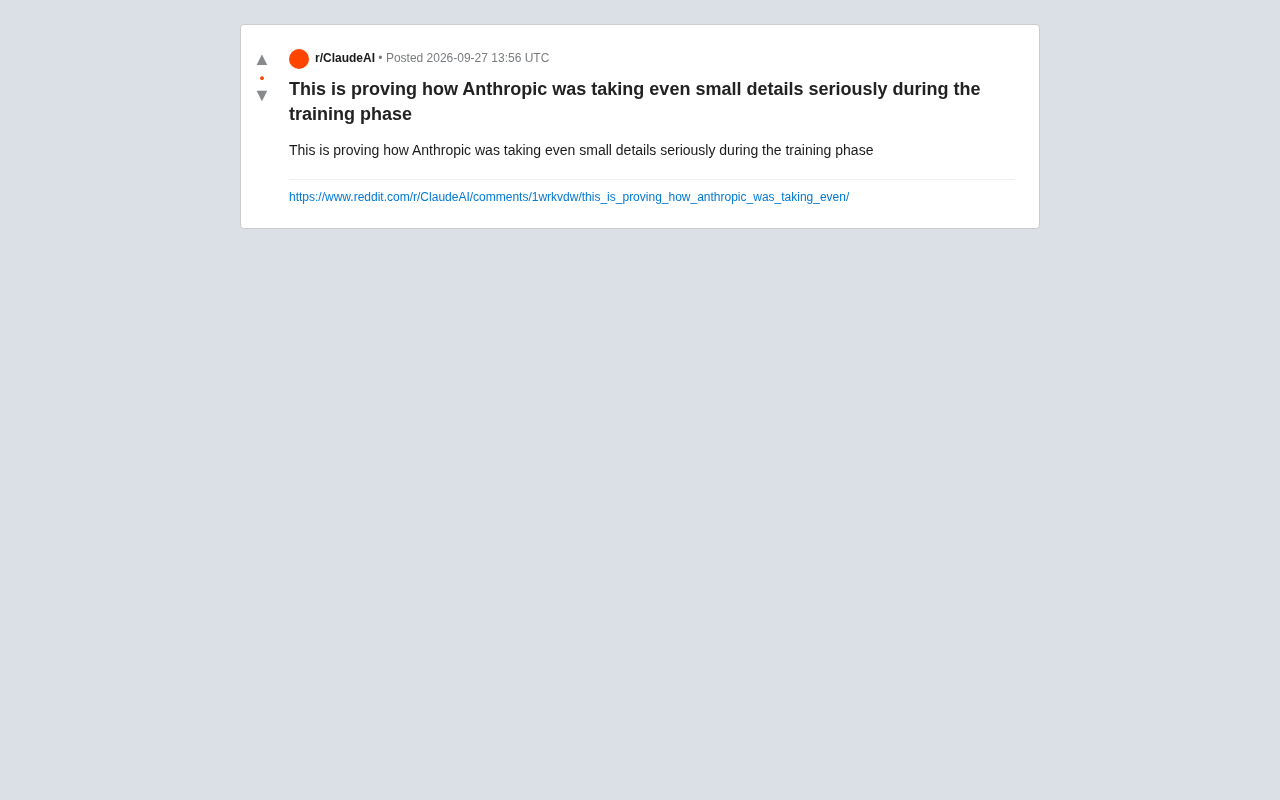
This kind of conversation isn't unusual in AI circles, but it reflects a meaningful industry signal: as the raw capabilities of large language models converge, users and developers are shifting their attention from benchmark scores toward subtler, harder-to-quantify dimensions of the experience. Anthropic's Claude models have built a loyal following largely because of how they handle these kinds of details.
It's worth noting upfront that the original post itself is light on specifics — it's a single summarizing observation from the community, without concrete supporting examples. This article therefore takes a broader industry perspective to explore what "attention to detail during training" actually means in practice.
Why Training Details Have Become a Talking Point
Training a large language model is an enormously complex endeavor, spanning data cleaning, annotation, alignment, safety fine-tuning, and more. When people talk about "sweating the small stuff," they're usually pointing to a few specific dimensions:
First, data quality and annotation rigor. The style, tone, and refusal boundaries of a model's outputs are largely determined by the consistency and granularity of human annotation during the training and alignment phases. Anthropic has long emphasized its Constitutional AI approach — using an explicit set of principles to guide model behavior — which is itself a form of systematic detail management.
Second, performance in edge cases. The places where careful training truly shows aren't routine Q&A exchanges, but ambiguous, unclear, or ethically complex scenarios. A model that has been carefully refined for these situations tends to give more robust, more human-aligned responses when it matters most.
Third, conversational coherence. This includes how well the model tracks context, reads user intent, and follows formatting instructions. These seemingly minor capabilities are often what users notice most in everyday use.
Constitutional AI is an alignment training method Anthropic introduced in 2022. The core idea is this: rather than relying on large-scale human annotation to label outputs as good or bad, you give the model an explicit list of principles — the "constitution" — and have it learn to follow those principles through iterative self-critique and revision. The process has two stages: first, the model scores and rewrites its own outputs according to the principles (a supervised learning phase); then, a variant of reinforcement learning from human feedback (RLHF) called RLAIF (Reinforcement Learning from AI Feedback) is used to further optimize behavior. The advantage is reduced dependence on annotation at scale, while making the value judgments underlying model behavior more transparent and auditable. For end users, the practical effect is that Claude tends to give reasons when it declines a sensitive or ambiguous request — rather than a black-box refusal with no explanation.
The Product Philosophy Behind Detail-Orientation
Since its founding, Anthropic has placed AI safety at the center of its narrative. That positioning means the team must invest considerably more effort than pure-performance-focused labs in handling edge cases and alignment challenges at training time.
From a product philosophy standpoint, caring about details isn't simply about delighting users — it's a natural extension of the safety-first ethos. A model that behaves consistently and predictably on small things is also, by definition, more controllable and less prone to unexpected deviations. That aligns directly with Anthropic's stated goals of building systems that are reliable, interpretable, and harmless.
In other words, the "meticulous detail" that the community has noticed is really the training methodology and company values expressing themselves at the product level. Every small moment of thoughtfulness a user experiences corresponds to a specific design decision made during training.
What This Means for Developers and Users
For developers choosing a model, this discussion is a useful reminder: don't evaluate large language models solely by benchmark scores. Test them in your actual business scenarios, especially around edge-case handling. In domains like customer service, legal, and healthcare — where accuracy and robustness are critical — how a model behaves at the boundaries often matters more than its average performance.
For everyday users, detail-oriented behavior translates directly into trust. When a model consistently "gets it right" on small things, users naturally become more comfortable handing it important tasks.
That said, keep perspective: a single Reddit thread isn't a comprehensive verdict on model quality. Real validation requires large-scale, multi-scenario usage data. This discussion is better treated as an observation window than as conclusive evidence.
For developers doing practical evaluations, common detail-focused tests include: jailbreak robustness testing (using rephrased or disguised prompts to see whether the model still recognizes the intent), instruction-following consistency testing (changing formatting requirements repeatedly over a long conversation to check execution stability), and ambiguity resolution testing (deliberately providing underspecified questions to see whether the model asks for clarification or makes assumptions). These dimensions rarely show up on standard benchmark leaderboards like MMLU or HumanEval, yet they often determine whether a model is actually usable in production. For teams with limited budgets, building a private test set from your own "high-risk edge cases" will typically tell you more about model-task fit than any public leaderboard.
Closing Thoughts
Starting from a brief community observation, we can see that AI competition is entering a new phase — one where parameter counts and benchmark rankings are no longer the only battlefield. The care invested in training details is becoming an invisible threshold that separates good models from great ones. Anthropic's reputation in this area is both a product of its safety-first philosophy and a reference point for the broader industry: genuine technical depth is often hidden in the details that no one immediately notices.
Related articles

Frontend to AI Agent Development: A Frontline Architect Explains Career Paths and Opportunities
A frontline AI architect explains the industry changes and practical paths for frontend developers transitioning to AI Agent development: why pure frontend jobs are disappearing, why Agent + full-stack has become mainstream in hiring, and three transformation routes—Agent development engineer, FDE, and remote contracting—along with corresponding learning strategies.

How to Choose an AI Agent Development Course: Five Pitfall-Avoidance Guidelines
A mechanical-engineering career changer's two-year pitfall-tested checklist for screening AI Agent development courses: complete delivery pipeline, resume-worthy projects, real development perspective, update frequency, and coaching feedback—with concrete judgment methods and pitfall-avoidance tips.

Coze AI Agent Building for Beginners: A Zero-Code AI Agent Development Guide
Coze, ByteDance's one-stop AI application development platform, supports zero-code drag-and-drop AI agent building. This article outlines Coze's core concepts, three advantages, differences between the domestic and international versions, and the distinction between agents and apps, helping beginners quickly get started with AI Agent development.