Anthropic's Burn-to-Revenue Gamble: Will the Free Ride End After IPO?

Reddit debate over Anthropic's burn rate exposes the looming reckoning between AI hype and real profitability.
A Reddit post comparing Anthropic's alleged ~$42B in costs against ~$4.2B in revenue has sparked debate about the sustainability of generative AI business models. While private investors tolerate losses for growth stories, an IPO shifts the equation — public markets demand profitability, potentially ending free-tier perks. The article urges caution with the raw numbers, noting that operating losses, cumulative funding, and committed cloud spend are often conflated. The deeper signal: AI investment is shifting from unconditional bets on technical leadership toward scrutiny of unit economics, margin improvement, and clear paths to profitability.
A Number That Sparked a Debate
A Reddit thread about Anthropic's finances has been making the rounds lately. The core argument hinges on a striking contrast: the AI company allegedly burned through roughly $42 billion in costs while generating only about $4.2 billion in revenue. The poster's take was blunt — "A loss model ten times your revenue only works in startup land. The moment Anthropic goes public, the free ride is over."
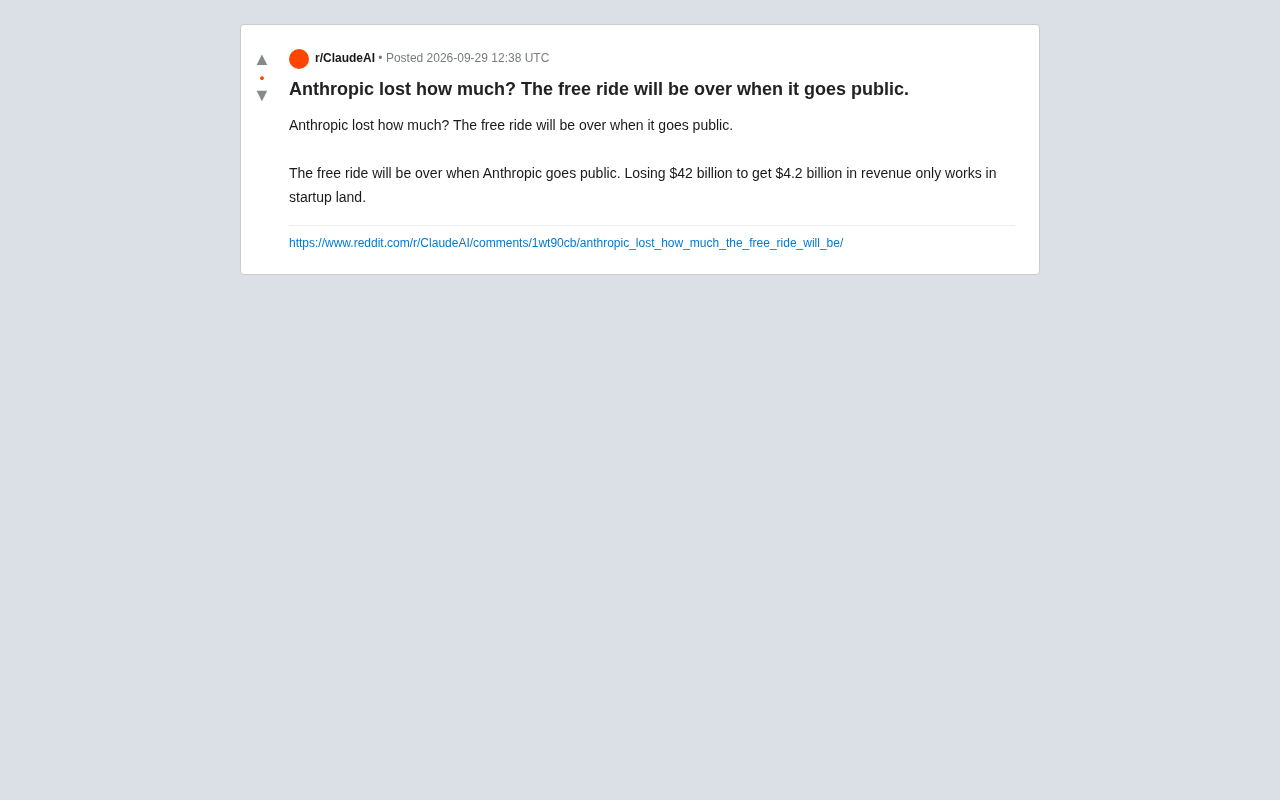
To be clear, these figures come from community discussion, not official financial statements, so the exact methodology is questionable. But setting aside the precise numbers, the thread touches on a very real and widespread pain point in the generative AI industry: the chasm between massive investment and actual revenue, and how long capital markets can tolerate it.
Burning Cash for Growth: Where the Startup Logic Breaks Down
The poster's argument rests on a classic business principle — during the private funding stage, investors are willing to back a growth story and absorb heavy losses because they're betting on future market share and technological moats. This logic fueled the early expansion of many tech giants.
But an IPO is a watershed moment. The investor base, disclosure requirements, and profitability expectations in public markets are fundamentally different from the private stage. Secondary markets tend to have little patience for sustained, massive losses — especially when the loss-to-revenue ratio reaches a factor of ten. When the poster says "the free ride ends," they mean exactly this shift in expectations: once Anthropic faces quarterly earnings scrutiny from public markets, the room to spin a growth narrative shrinks, and the path to profitability gets questioned relentlessly.
For frontier model companies like Anthropic, cost pressure comes from two primary sources: the enormous compute and chip procurement needed to train models, and the high salaries demanded by top research talent. Neither of these is easy to cut significantly in the short term.
Unit Economics is the key framework for understanding this pressure. It measures a company's profitability at the level of a single customer or transaction, with core metrics including Customer Acquisition Cost (CAC), Customer Lifetime Value (LTV), and gross margin. For large model companies, every API call involves real inference compute costs — and at this stage, many companies' inference costs still exceed what they charge users, meaning they haven't broken even at the unit level. Private investors can accept a "burn cash to acquire users" phase, but public markets will demand a clear improvement curve — showing that as scale grows and model efficiency improves, unit costs systematically decline and gross margins gradually approach the 70–80% range typical of mature SaaS companies. Whether this improvement curve exists, and whether it's steep enough, is one of the most scrutinized narratives in any IPO prospectus.
How to Read This Number
The $42 billion in losses against $4.2 billion in revenue claim deserves skepticism. In community discussions, "losses" often conflate several distinct concepts: actual operating losses, cumulative capital raised, and committed compute purchase contracts (such as long-term agreements with cloud providers). These are entirely different in nature and shouldn't be simply added together.
A more reasonable interpretation is this: capital expenditure for AI foundation model companies is inherently "front-loaded" — you pour in massive investment to build compute capacity and R&D capability upfront, while revenue materializes later. This is radically different from the asset-light model of traditional software companies. Judging commercial viability purely by a single year's loss-to-revenue ratio can therefore be misleading. That said, if this ratio fails to converge over time, it will absolutely become a major obstacle at IPO.
Understanding AI company finances requires distinguishing between several concepts that are often conflated. Operating Loss refers to the negative value of revenue minus operating costs within a single accounting period, reflecting current business performance. Cumulative Funding Raised is the total capital a company has collected from investors over its history — a balance sheet item, not an income statement item. Committed Cloud Spend refers to long-term purchase agreements with cloud providers, typically structured as minimum spend commitments — these are off-balance-sheet or contingent liabilities disclosed in financial statement footnotes. Anthropic has signed such long-term agreements with both Google Cloud and Amazon AWS, with amounts reportedly in the tens of billions of dollars. Lumping these three figures together drastically overstates any single year's "losses" — but this also illustrates that even after stripping away the exaggeration, the capital requirements for frontier model companies are still orders of magnitude larger than those of traditional software startups.
What This Signals for the AI Industry
The value of this discussion isn't whether any specific number is accurate — it's that it reflects a subtle but meaningful shift in market sentiment. In the early days of the AI boom, capital chased any company with a technological edge, almost unconditionally. But as the industry enters a more rational phase, investors are increasingly focused on unit economics: the real cost behind every dollar of revenue, whether gross margins can improve with scale, and a clear timeline to profitability.
For the broader sector, the financial health of leading companies like Anthropic and OpenAI serves as a bellwether. If even the frontrunners struggle to demonstrate a closed commercial loop within a reasonable timeframe, capital markets may recalibrate their entire valuation framework for generative AI. For ordinary users, the "free ride ending" the poster alludes to is also worth noting: when companies need to prove profitability to public markets, tighter free tiers, subscription price increases, and accelerated enterprise monetization are all predictable directions.
Conclusion
This Reddit thread used a somewhat exaggerated numerical comparison to highlight the core paradox of AI startups: technological leadership does not equal commercial sustainability. In the private stage, you can keep the lights on by telling a compelling story. But an IPO puts a company under a spotlight and subjects it to far more sober scrutiny on profitability. Regardless of whether the specific numbers are accurate, the judgment that "burn-for-growth models have a finite runway" is a useful reality check for today's overheated AI investment environment.
Related articles

AI Digital Twin in Action: Using DOT to Automatically Track Bugs and User Feedback
DOTS engineers demonstrate how AI digital twin DOT collects cross-platform user feedback, categorizes issue themes, opens threads to investigate bug root causes, and submits PRs—showcasing a complete AI agent workflow for defect triage with auditable design.

Why Transistors Are No Longer Flat: The Evolution from Planar to Gate-All-Around
Transistor evolution from planar to FinFET to gate-all-around: why gates went from three-sided to four-sided wrapping to suppress short-channel effects and leakage current, extending Moore's Law.

Swarm Intelligence = a Single RL Agent? A Proof of Multi-Armed Bandit Equivalence
A paper proves that collective decision-making through local imitation in swarms is mathematically equivalent to single-agent reinforcement learning: N blind imitators act as N parallel environment samples, with an effective learning rate of 1/N. This article explains the derivation and implications of the Maynard-Cross Learning algorithm.