Anthropic's New AI Cracks Black Hole Physics? Formalizes Fermat's Last Theorem in 30 Hours
Anthropic's new model reportedly solves black hole problems and formalizes Fermat's Last Theorem; authenticity pending verification.
The article reports that Anthropic's new-generation model is said to have solved two open black hole physics problems (one stuck for 23 years) and formalized Fermat's Last Theorem in 30 hours. Anthropic reportedly released Fable 5.2 (open) and Mythos 5.2 (restricted to cybersecurity and biomedical organizations); Fable 5.2 scored 74.6% on science benchmarks, up sharply from 52.6%, and topped Artificial Analysis at a lower price. The article stresses that the information comes only from a single YouTube short, lacks peer review and technical details, and that formal proofs reflect engineering capability more than scientific insight. Whether AI truly understands science and can do 'real science' remains disputed and needs reproducible verification.
Title
Anthropic's New AI Cracks Black Hole Physics? Formalizes Fermat's Last Theorem in 30 Hours
Meta Description
Anthropic claims its new AI models Fable 5.2 and Mythos 5.2 solved black hole physics problems and formalized Fermat's Last Theorem, with a science benchmark score of 74.6% topping the leaderboard. This article analyzes their performance, open strategy, and controversies.
Article Content
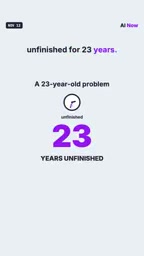
Anthropic recently claimed that its new-generation AI models achieved breakthroughs in fundamental science: solving two unresolved black hole physics problems, one of which had been stuck for 23 years; at the same time, it completed a formal proof of Fermat's Last Theorem within 30 hours. This news comes from a YouTube short report and has sparked discussion on whether "AI can do real science."
Two Major Scientific Breakthroughs: Black Hole Physics and Fermat's Last Theorem
According to the video description, Anthropic's new model solved two open black hole physics problems, one of which had remained unsolved for 23 years. More strikingly, the model formalized the proof of Fermat's Last Theorem in 30 hours—work that typically takes human experts months or even years. A formal proof means translating a mathematical proof into computer-verifiable code, an important milestone for AI in mathematical reasoning.
If true, these two achievements would mark a substantive leap for AI from "language understanding" to "scientific discovery." However, it should be noted that this information currently comes only from a single-source short video and lacks peer review or a detailed technical report; its authenticity remains to be verified.
A formal proof refers to writing out a mathematical proof completely in a formal language (such as Lean, Coq, or Isabelle) so that a computer can verify step by step whether each derivation conforms to logical rules. Unlike natural-language proofs, formal proofs require no ambiguity and no skipped steps, making them extremely time-consuming. The formalization of Fermat's Last Theorem is a landmark project in mathematical mechanization, requiring the prior formalization of a large number of prerequisite concepts (such as elliptic curves and modular forms) and then reconstructing the complex reasoning chain of Wiles's proof. If AI can greatly compress this process, it would indicate progress in long-horizon logical planning and code generation, but the results still require the mathematics community to review whether the definitions and theorem statements faithfully correspond to the original problem.
Model Details: Fable 5.2 and Mythos 5.2
The report states that Anthropic released two models: Fable 5.2 and Mythos 5.2. Fable 5.2 is open to everyone, while Mythos 5.2 is restricted to verified cybersecurity and biomedical organizations. This differentiated openness strategy may be due to security considerations, limiting model access in high-risk domains.
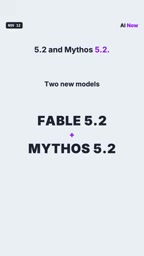
Fable 5.2's openness means more researchers and developers can test its scientific reasoning capabilities, but Mythos 5.2's restricted access also raises concerns about AI dual-use.
AI dual-use refers to the fact that the same model capability can be used for beneficial purposes or misused for malicious purposes. In the biomedical field, a model might assist in drug design or be used to enhance pathogens; in cybersecurity, a model can be used for vulnerability discovery and defense, or to find and exploit zero-day vulnerabilities. Therefore, frontier AI companies often adopt tiered openness strategies: providing ordinary users with capability-limited or safety-fine-tuned versions, and granting stronger capabilities to vetted professional organizations, accompanied by monitoring and access controls. While this reduces misuse risk, it also raises discussions about transparency, fair competition, and accountability.
Performance: Significant Improvement on Science Benchmarks
On science benchmarks, Fable 5.2 scored 74.6%, a significant increase from the previous 52.6%. This magnitude of improvement indicates enhanced capability on scientific reasoning tasks. In addition, the model ranked first on the Artificial Analysis leaderboard at a lower price, demonstrating a cost-effectiveness advantage.

The combination of performance improvement and price advantage may make Fable 5.2 a powerful tool in scientific research, but the specific content and difficulty of the benchmark tests have not been disclosed and should be viewed with caution.
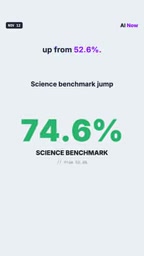
Artificial Analysis is an independent leaderboard that tracks large language model performance and pricing, typically aggregating multiple public benchmarks (such as reasoning, coding, and mathematics) and calculating performance per unit cost. Its rankings are often used to compare models' cost-effectiveness rather than scientific discovery capability. Science benchmarks (such as GPQA and MMLU science subsets) mainly evaluate models' accuracy on expert-level multiple-choice questions and cannot directly reflect whether a model can propose new hypotheses or complete original research. Therefore, the 74.6% score increase shows the model is stronger at knowledge-intensive reasoning, but there is still a methodological gap before it can "do real science."
Controversy and Doubts: Can AI Really Do Science?
The video ends by posing the question: "Can AI do real science?" This reflects the academic community's widespread skepticism about AI's scientific capabilities. Formal proofs and solving physics problems may appear to be scientific breakthroughs, but does AI truly understand the underlying physics and mathematics, or does it merely generate results through pattern matching? In addition, the lack of transparency in the release method (announced only through a short video) conflicts with the reproducibility required by the scientific community.
Some argue that AI's success in formal proofs is more a demonstration of engineering capability than scientific insight. Solving black hole physics problems also requires domain experts to verify their correctness and novelty. In the absence of detailed papers, the credibility of these claims is questionable.
Reproducibility is one of the core principles of the scientific method: a result must be reproducible by independent researchers based on a sufficient methodological description before it can be accepted as scientific knowledge. Releasing results only through a short video, without details such as model version, prompts, evaluation settings, and failure cases, makes external reproduction or verification impossible. The scientific community typically requires preprints or peer-reviewed papers to examine experimental design, statistical significance, and the boundaries of conclusions. For AI scientific discoveries, additional disclosure of training data contamination risk is needed—if benchmark questions or theorem proofs have appeared in the training corpus, model performance may be overestimated.
Industry Impact and Future Outlook
If Anthropic's claims are confirmed, this would be strong evidence of AI's potential for scientific applications and could accelerate AI adoption in fundamental sciences such as mathematics and physics. At the same time, Mythos 5.2's restricted openness model also provides a reference for AI safety governance.
However, what the scientific community needs is verifiable, reproducible results. Anthropic should release technical details as soon as possible and submit to peer review. For AI practitioners, this event reminds us that while celebrating breakthroughs, maintaining critical thinking is crucial.
(This article is based on a YouTube short report; some information has not yet been independently verified.)
One-line Summary
Anthropic's new model is said to solve black hole problems and formalize Fermat's Last Theorem; authenticity remains to be verified.
Paragraph Summary
The article reports that Anthropic's new-generation model is said to have solved two open black hole physics problems (one stuck for 23 years) and formalized the proof of Fermat's Last Theorem in 30 hours. It reports that Anthropic released two models, Fable 5.2 and Mythos 5.2; the former is open for use, while the latter is limited to cybersecurity and biomedical organizations. Fable 5.2 scored 74.6% on science benchmarks, a significant increase from the previous generation's 52.6%, and topped the Artificial Analysis leaderboard at a lower price. The article also emphasizes that this information comes only from a single YouTube short, lacks peer review and technical details, and that formal proofs reflect engineering capability more than scientific insight. Whether AI truly understands scientific principles and can do "real science" remains controversial and requires reproducible verification.
Related articles
Gemini 4 Neon Hands-On: Which $20 AI Subscription Should You Choose?
Bilibili creator tests Gemini 4 Neon: composite intelligence index 61, beating Claude Opus 5.5, with API 25% cheaper. With a $20 budget, how to choose between Google AI Pro, Claude Pro, and ChatGPT Plus? Includes three must-know pitfalls and recommendations by user type.
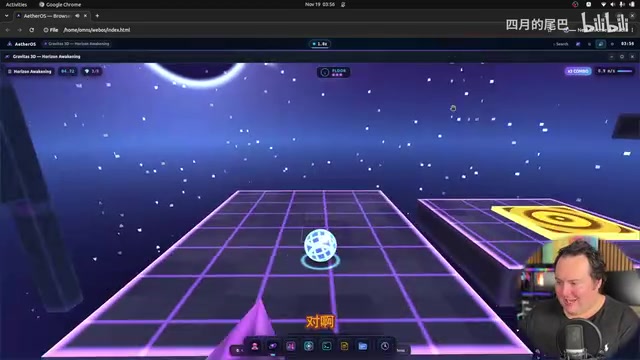
Gemini 4 Neon: Six Hands-On Tests — Wins Benchmarks, But Independent Leaderboards Aren't Convinced
Full record of six hands-on tests of Gemini 4 Neon: from BrowserOS, C++ games, and 3D printing to photo-to-fighting-game, visual-spatial ability stands out but doesn't top independent leaderboards. Analysis of Neon's positioning between Hydrogen and Carbon, pricing misalignment, and why benchmarks diverge from reputation.
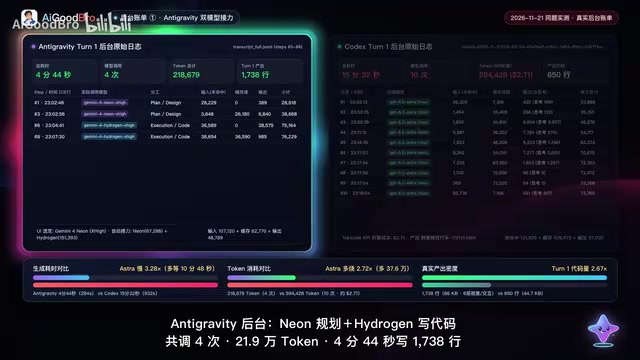
Hands-On Comparison: Astra 6.2 vs Neon — Which Is Stronger? A Full Breakdown of Token Consumption and Interaction Details
Bilibili host tests Astra 6.2 vs Neon generating a crocodile-riding-bicycle animation, comparing Token use, time, and interaction. Astra is 3.3x slower and burns 2.7x more Tokens; Neon wins on speed, cost, and playability, though Astra's picture-book style is more durable.