Hands-On Comparison: Astra 6.2 vs Neon — Which Is Stronger? A Full Breakdown of Token Consumption and Interaction Details
Hands-on test shows Gemini 4 Neon beats GPT 6.2 Astra on efficiency, cost, and interaction, though Astra's art style is more durable.
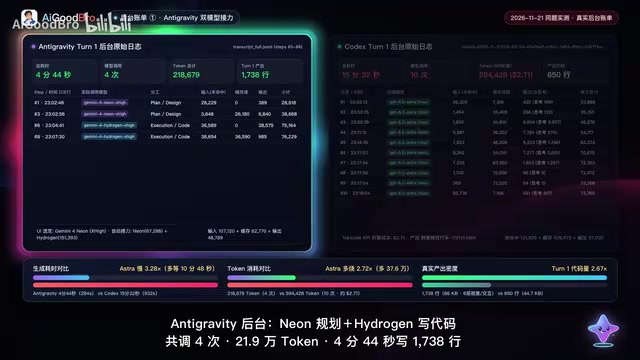
A Bilibili UP host used the same prompt to have AntiGravity (Gemini 4 Neon) and Codex (GPT 6.2 Astra) generate a crocodile-riding-bicycle web animation. Neon used a dual-model relay, producing 1,738 lines in 4:44 and consuming 219K Tokens; Astra ran solo, dropped the model 10 times, took 15:32, and burned 594K Tokens — 3.3x slower and 2.7x more Tokens. Astra's retro picture-book style is more durable but its interaction is conservative; Neon offers parallax, three-speed shifting, lighting switches, and a bell easter egg for more playability. The verdict: 'surpassing' depends on the dimension — Neon wins on efficiency and cost, Astra has merits in static art style.
A Hands-On Test of "Surpassing"
Recently, claims that "Astra 6.2 surpasses Neon" have been popping up frequently in the community. To verify this, Bilibili UP host AI Good Bro ran a direct comparison using the exact same prompt: having AntiGravity and Codex each generate a "crocodile riding a bicycle" web animation, with no testing, no tools, and just a single sentence. He then published the conversation screenshots and backend Token data, trying to let the evidence speak.
Although this "same task, different models" testing method is simple, it can reveal real differences in planning, generation speed, resource consumption, and interaction design. Below, we break down the performance of the two approaches based on the screenshots and data.
Test Setup: One Sentence, Two Platforms
The test was conducted at 11:02 PM on November 21, with the same prompt sent to AntiGravity and Codex respectively. The task itself isn't complex — generate a web animation — but the models were required to complete the entire workflow from planning to coding on their own.
In the AntiGravity panel, Gemini 4 Neon was selected, and an automatic dual-model relay was launched in the backend: first Neon handled two rounds of planning, consuming 67K Tokens, then Hydrogen handled two rounds of code generation, consuming 151K Tokens. The model was called 4 times in total, consuming 219K Tokens, taking 4 minutes 44 seconds, and producing 1,738 lines of code.
On the Codex side, GPT 6.2 Astra ran solo the entire time, with the highest 4-attempt tier continuously dropping the model 10 times, burning 594K Tokens — roughly $2.71 at API pricing — taking 15 minutes 32 seconds, and ultimately generating 650 lines of code.
Looking at the data, Astra's time was 3.3 times that of the Neon approach, and its Token consumption was 2.7 times higher. This is the first counter-evidence against the "surpassing" claim: on the efficiency dimension, Neon's division-of-labor relay strategy is clearly more economical.
Tokens and billing mechanics: A Token is the basic unit of text processed by large language models, roughly equivalent to one English word or half a Chinese character. Every time a model receives a prompt, generates a response, or performs internal reasoning (such as planning steps or self-correction), it consumes Tokens, and they are usually priced separately for input and output. The "219K Tokens" and "594K Tokens" mentioned in the article refer to the total Tokens consumed across the entire task. API unit prices vary greatly between models, so only by multiplying Token consumption by unit price can you arrive at the actual cost (e.g., the Codex side works out to about $2.71). Understanding this is essential to seeing why a 2.7x Token gap translates directly into cost pressure, and to understanding that "dropping the model 10 times" means extra reasoning rounds and a bigger bill.
The Token Bill: Where Does the 2.7x Gap Come From?
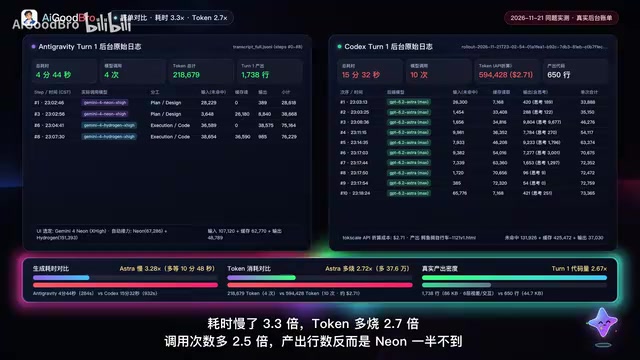
The gap in Token consumption is no accident. AntiGravity uses a dual-model relay: Neon only handles planning (two rounds), Hydrogen handles code writing (two rounds), responsibilities are clear, and each call has a well-defined goal. Codex's Astra, by contrast, handles both planning and coding with a single model throughout, dropping the model 10 times in a row — meaning it went through more rounds of internal attempts and corrections, each of which was added to the Token bill.
This reflects two engineering philosophies: one is a "specialized model for each job" pipeline, the other is a "single model, full stack" generalist route. The former is more precise in cost control; the latter may be more flexible, but the price is a multiplied resource consumption. For scenarios requiring batch generation or frequent calls, a 2.7x Token gap translates directly into cost pressure.
Dual-model relay vs. single-model full stack: Dual-model relay is an engineering strategy that splits a complex task into multiple stages, with different specialized models completing their parts. For example, AntiGravity in this article has Neon do only planning (analyzing requirements, determining the animation structure), then has Hydrogen focus on generating code. This way each model only handles what it's good at, each call has a clear goal, trial-and-error and redundant reasoning are reduced, and Token consumption is kept in check. Single-model full stack, on the other hand, has one model handle everything from planning to coding — flexible, but prone to repeated self-correction over a long chain, leading to more "model drops" and multiplied Tokens. Neither route is inherently superior, but their cost structures are completely different, which is the key background for understanding the results of this hands-on test.
Visuals and Interaction: The Durable vs. the Playful
Setting cost aside, the two versions take different directions visually.
The GPT Astra 6.2 Max version presents a retro mage picture-book style: the fingerprint grain, the Breton shirt, the seagulls, the lighthouse, and the knee-stretching texture are all spot-on, with a slower riding rhythm and restrained motion — overall as durable as a printed book.
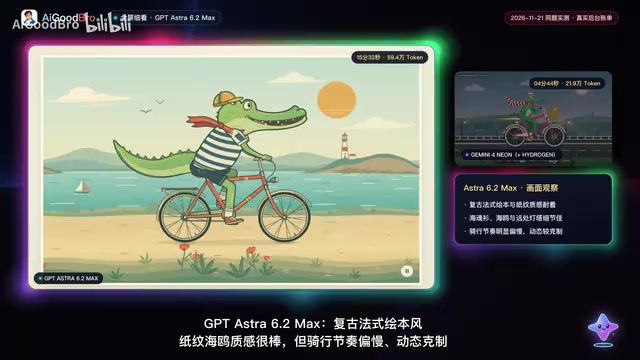
The Gemini 4 Neon version is noticeably more lively: six-layer parallax, a tight spring leather saddle, a basket stuffed with baguettes, daisies, and a little yellow bird, foot lights and wheels that fit together without slipping — smooth and full of life.

The interaction gap is the more critical differentiator. The Astra version has only a single pause button in the bottom-right corner of the screen, with no speed control and no sound. The Neon version is built as a playable toy: three-speed shifting, one-click switching between three lighting modes, and in gaze mode the vehicle, streetlights, and fireflies all light up; press the bell and the straw hat pops up with a metallic ring, and the little yellow bird in the front basket flaps along too, as if genuinely startled by the bell.
If you only look at the static image, Astra's picture-book texture does have its own appeal; but combining speed, cost, liveliness, and interaction easter eggs, Neon clearly comes out ahead in this round.
Parallax effects and interaction easter eggs: The article mentions that the Neon version has "six-layer parallax." Parallax is a front-end animation technique in which multiple background layers scroll at different speeds to create a sense of depth and dimensionality; it's commonly used in web pages and games. The more layers, the more refined the image, but the higher the demands on rendering and code organization. Interaction easter eggs refer to extra animations or sound feedback that appear after the user triggers an action (such as pressing the bell), significantly enhancing "playability." These details reflect not only how deeply the model understands the requirements, but also the completeness and creativity of the code it generates. The Astra version has only a pause button, indicating a conservative approach to interaction design, with its effort focused on the static art style.
Conclusion: Whether It Surpasses Depends on the Evaluation Dimension
Putting all the evidence together, the conclusion isn't absolute. Purely in terms of retro picture-book style, Astra 6.2 Max is as durable as a printed book and suits scenarios that pursue static texture; but it's more than three times slower, burns far more Tokens, and is conservative in interaction. Gemini 4 Neon, meanwhile, has the edge in speed, cost, and playability.
The word "surpass" needs a dimension qualifier. In efficiency, cost, and interaction richness, the Neon approach is more mature; in the expressiveness of a particular art style, Astra still has merits. For developers and content creators, which model to choose depends on whether you value "generating a good-looking image" or "delivering a playable experience."
(Note: The model names, Token data, times, and line counts in this article all come from the UP host's hands-on screenshots and narration, and have not been additionally verified.)
One-line Summary
Hands-on testing shows Gemini 4 Neon beats GPT 6.2 Astra on efficiency, cost, and interaction, but Astra's art style is more durable.
Paragraph Summary
A Bilibili UP host used the same prompt to have AntiGravity (Gemini 4 Neon) and Codex (GPT 6.2 Astra) each generate a "crocodile riding a bicycle" web animation. Results: Neon used a dual-model relay, generating 1,738 lines of code in 4 min 44 s and consuming 219K Tokens; Astra, running solo, dropped the model 10 times, took 15 min 32 s and consumed 594K Tokens — 3.3x slower and 2.7x more Tokens. Visually, Astra's retro picture-book style is durable but its interaction is conservative, while Neon offers multi-layer parallax, three-speed shifting, lighting switches, and a bell easter egg, making it more playable. The conclusion: "surpassing" depends on the dimension — Neon wins on efficiency and cost, Astra has merits in static art style.
Related articles
Gemini 4 Neon: Six Hands-On Tests — Wins Benchmarks, But Independent Leaderboards Aren't Convinced
Full record of six hands-on tests of Gemini 4 Neon: from BrowserOS, C++ games, and 3D printing to photo-to-fighting-game, visual-spatial ability stands out but doesn't top independent leaderboards. Analysis of Neon's positioning between Hydrogen and Carbon, pricing misalignment, and why benchmarks diverge from reputation.

Amy Poehler's Pizza Interview: From Cooking Fears to Healing Pizza Trauma
Amy Poehler and Geraldine Viswanathan make pizza on the New York Times Cooking channel, discussing cooking fears, hometown flavors, and kitchen confidence—from pizza peel trauma to sourdough starter.

Former Prisoner Exposes U.S. Prison System: How Solitary Confinement Destroys the Mind
Former inmate Larry Lawton reveals the psychological devastation, corruption, and injustice of the U.S. prison system on the Lex Fridman podcast, describing how solitary confinement destroys the mind and how he fought back through lawsuits.