Anthropic Scion Accused of Heavily Borrowing from Mononoke's Design

Hacker News discusses claims that Anthropic's Scion is heavily inspired by Mononoke, raising design borrowing concerns.
Recently, a Hacker News discussion about Anthropic's Scion project heavily borrowing from Mononoke has drawn attention. Since Scion's specific functions and technical details remain undisclosed, the controversy centers on the source of design inspiration. The article notes that design borrowing is common in software, and Mononoke, Meta's next-gen version control system, may have been referenced. Community sensitivity stems from open-source attribution and license compliance issues, but plagiarism should not be assumed solely from similarity. With official information lacking, design borrowing should be viewed rationally, focusing on project quality and innovation while treating community speculation cautiously.
Anthropic Scion Sparks Design Inspiration Controversy
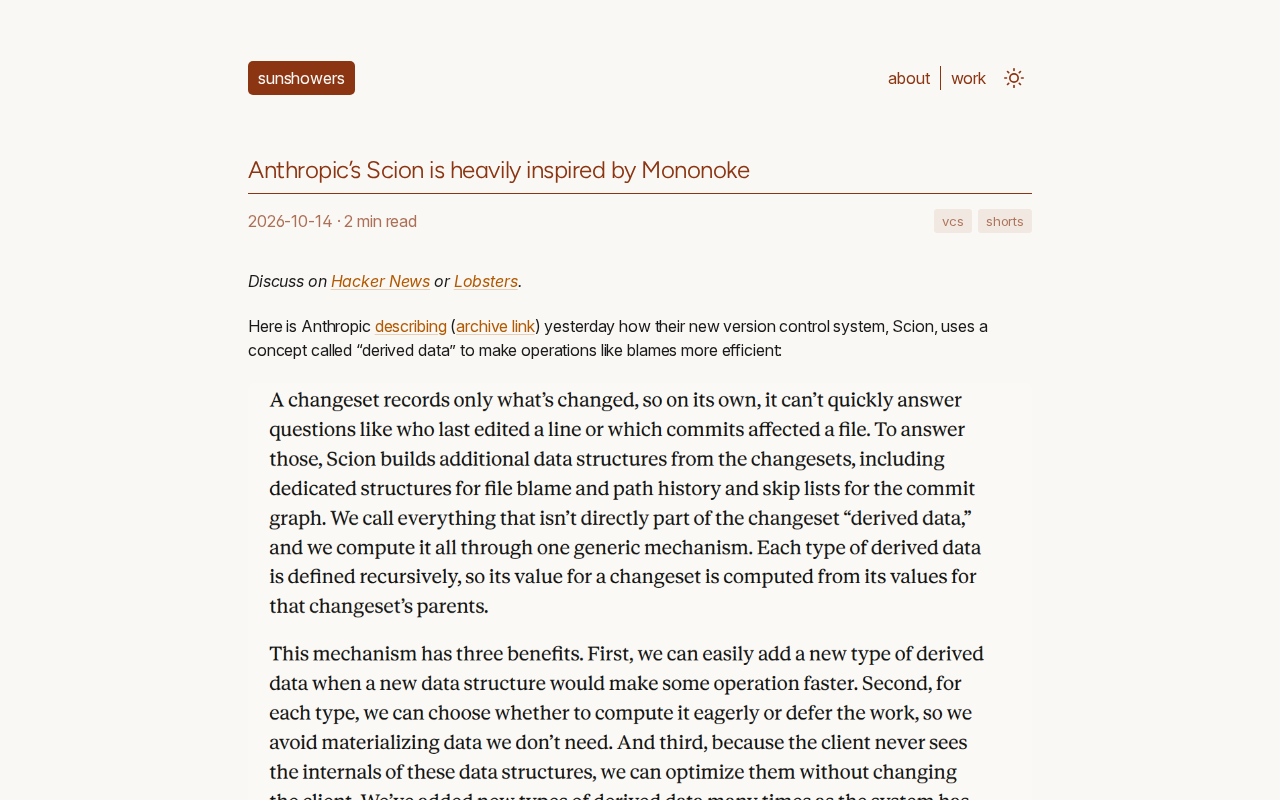
Recently, a discussion on Hacker News titled "Anthropic's Scion is heavily inspired by Mononoke" has drawn attention from the tech community. The discussion centers on an Anthropic project called Scion, with community members arguing that its design is clearly inspired by another project named Mononoke.
Since publicly available information is currently extremely limited, this article cannot confirm Scion's specific functional positioning or technical details. However, the topic itself reflects a long-standing phenomenon in the AI industry: design borrowing and inspiration transfer between projects.
Hacker News is a tech community under Y Combinator, known for high-quality technical discussions and startup topics. Its front-page ranking mechanism combines vote counts with time decay, allowing hot topics to quickly gain massive exposure. Many open-source projects, programming languages, and AI tools have had their debut discussions or controversies originate here. For the inspiration controversy between Scion and Mononoke mentioned in this article, the Hacker News discussion section is often the earliest information hub, with comments offering both technical depth and industry perspective—but it is also prone to amplifying speculation due to incomplete information. Therefore, when citing views from this community, it is necessary to distinguish factual statements from subjective judgments and to be aware of potential bias or emotional tendencies in the discussion.
The Flow of Inspiration Between Open Source and Closed Source
Mononoke itself has a certain level of recognition in the developer community, and its design philosophy and implementation approach are regarded by some developers as a reference point. When a leading AI company like Anthropic launches a new project, the community quickly makes comparisons and looks for similarities.
This phenomenon is not inherently a negative evaluation. Design patterns and architectural approaches in software engineering have always involved broad mutual inspiration. From version control to task scheduling, many excellent solutions circulate and evolve across different projects. The key question is whether the borrowing led to substantive improvements and innovation.
According to feedback in the Hacker News discussion section, some developers believe the similarity reaches the level of "deep borrowing," while others consider it an industry norm not worth overinterpreting.
Mononoke is a next-generation version control system developed by Meta (formerly Facebook) to support its massive monolithic code repository, intended to replace its previous customized Mercurial solution. Its core design includes distributed storage, efficient branch management, and optimization for large-scale codebases. In the developer community, Mononoke is often regarded as a reference case for high-concurrency, high-availability version control systems. When Anthropic launched a project called Scion, the community compared it with Mononoke, possibly because the two share similarities in architectural approach or code organization. However, design patterns in the version control field have always influenced one another—for example, Git's distributed concept also inspired many subsequent systems. Therefore, similarity itself does not directly equate to plagiarism; the key is whether there are substantive improvements or innovations.
Why the Community Is So Sensitive About "Sources of Inspiration"
The community's sensitivity to design borrowing stems from long-standing issues of attribution and ownership in the open-source ecosystem. When large companies adopt designs similar to open-source projects, developers care about:
- Whether appropriate credit was given
- Whether meaningful contributions were made on top of the borrowing
- Whether licensing and compliance issues were properly handled
These concerns are reasonable and necessary. But it must also be acknowledged that concluding "plagiarism" based solely on appearance or conceptual similarity often lacks sufficient basis.
Open-source licenses are one of the root causes of community sensitivity. Common permissive licenses such as MIT and Apache 2.0 allow commercial use and modification but usually require retaining copyright notices; copyleft licenses such as GPL require derivative works to also be open-sourced. If Anthropic's Scion did borrow code or design from Mononoke, and Mononoke uses a specific license, then compliance becomes the focus. Additionally, attribution and acknowledgment, while not legally mandatory, are important norms of open-source culture. If large companies ignore these norms, they can easily trigger a trust crisis. But note that design concepts and architectural ideas are generally not protected by copyright—only specific code implementations are constrained by licenses. Therefore, determining whether a violation occurred requires rigorous legal and technical analysis, not just community perception.
Observations on Anthropic's Project Strategy
As the developer of the Claude series of models, Anthropic's technical projects have always received close attention. If Scion does exist, its positioning may be related to Anthropic's布局 in AI safety, model evaluation, or toolchains.
However, in the absence of official information, any speculation about Scion's functions and intentions should remain cautious. Community discussion can serve as a clue but cannot replace official explanations.
A Rational View of Design Borrowing
For the tech community, a more valuable approach is to focus on the project's own quality and innovation points rather than getting caught up in disputes over the ownership of inspiration sources. Design borrowing is ubiquitous in the software industry, and what truly distinguishes excellent projects is their problem-solving ability and engineering implementation level.
If Anthropic later discloses detailed information about Scion, the relationship between it and Mononoke can be more accurately assessed. Until then, maintaining an open but cautious attitude is most appropriate.
Conclusion
This discussion reminds us that in an era of rapid AI technology iteration, community oversight and rational discussion are equally important. We should protect the rights and interests of open-source contributors while also leaving room for reasonable technical borrowing.
Note: This article is based on clues from a Hacker News discussion. The specific details of the Scion project have not been officially confirmed, and readers should refer to official information.
One-line Summary
A Hacker News discussion claims Anthropic's Scion project is clearly inspired by Mononoke, sparking a design borrowing controversy.
Paragraph Summary
Recently, a Hacker News discussion about Anthropic's Scion project heavily borrowing from Mononoke has drawn attention. Since Scion's specific functions and technical details have not been made public, the controversy mainly revolves around the source of design inspiration. The article points out that design borrowing is common in the software industry, and Mononoke, as a next-generation version control system developed by Meta, may have had its ideas referenced. The community's sensitivity to inspiration sources stems from issues of attribution, ownership, and license compliance in the open-source ecosystem, but it is also important to avoid concluding plagiarism based solely on similarity. In the absence of official information, we should view design borrowing rationally, focus on the project's own quality and innovation, and treat community speculation with caution.
Related articles

AI Digital Twin in Action: Using DOT to Automatically Track Bugs and User Feedback
DOTS engineers demonstrate how AI digital twin DOT collects cross-platform user feedback, categorizes issue themes, opens threads to investigate bug root causes, and submits PRs—showcasing a complete AI agent workflow for defect triage with auditable design.

Why Transistors Are No Longer Flat: The Evolution from Planar to Gate-All-Around
Transistor evolution from planar to FinFET to gate-all-around: why gates went from three-sided to four-sided wrapping to suppress short-channel effects and leakage current, extending Moore's Law.

Swarm Intelligence = a Single RL Agent? A Proof of Multi-Armed Bandit Equivalence
A paper proves that collective decision-making through local imitation in swarms is mathematically equivalent to single-agent reinforcement learning: N blind imitators act as N parallel environment samples, with an effective learning rate of 1/N. This article explains the derivation and implications of the Maynard-Cross Learning algorithm.