Anthropic Security Chief's Remarks Spark Debate: Is AI a Security Crisis or a Scapegoat?
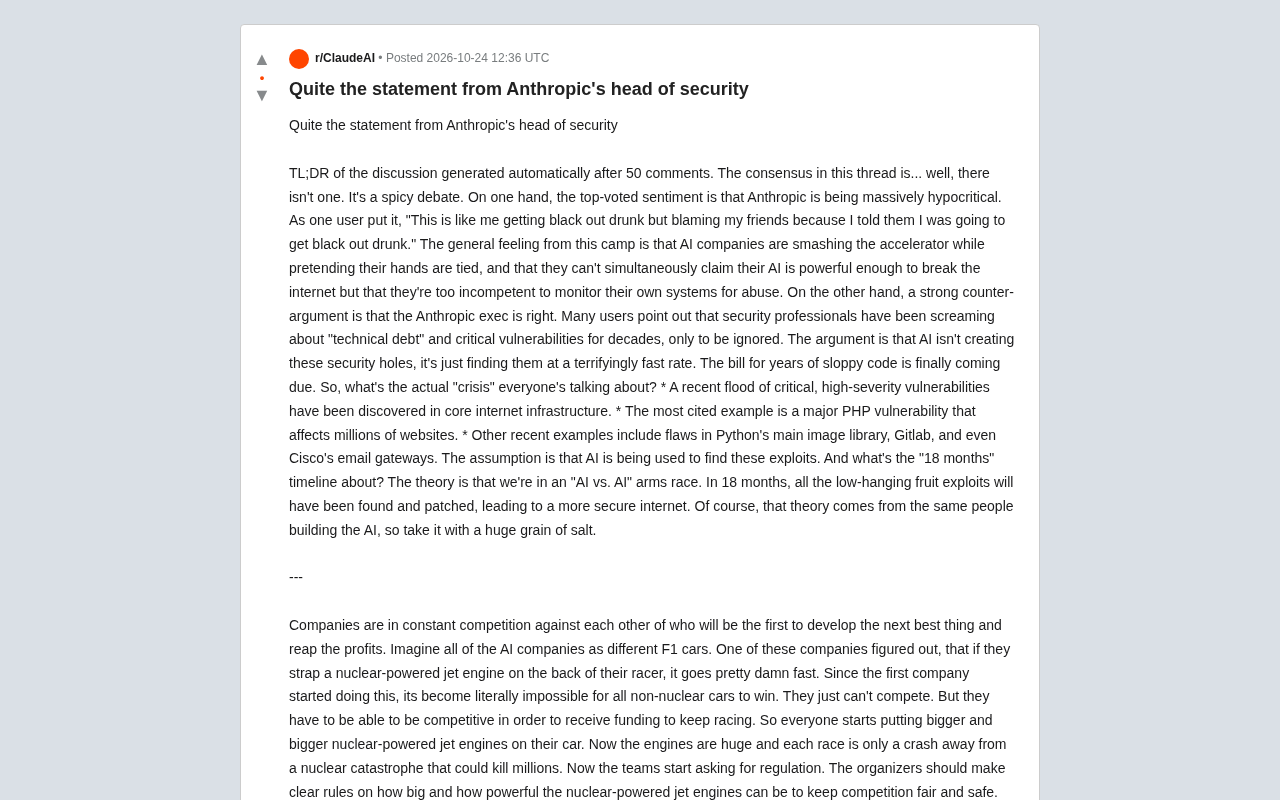
Anthropic security chief's remarks spark Reddit debate: Is AI the villain or the one exposing the wounds?
Anthropic's security chief's public statement ignited fierce debate on Reddit over whether the recent cluster of high-severity vulnerabilities in PHP, Python's image library, Gitlab, and Cisco email gateways should be blamed on AI-accelerated development, or whether AI merely exposed the internet infrastructure's long-standing security debt. One side accuses Anthropic of hypocrisy—flooring the gas pedal while pretending to be powerless to monitor misuse; the other argues that security experts warned about technical debt for decades and were ignored, and that AI simply discovered existing vulnerabilities at an astonishing rate. The "18-month" timeline predicting an AI-versus-AI arms race is questioned because it comes from stakeholders. The F1 car with a nuclear engine analogy was widely endorsed: no company will slow down unilaterally, and regulation is the only way out—but "there are no organizers" is the real predicament, and geopolitical competition further intensifies concerns about unilateral slowdown.
A statement from Anthropic's security chief has ignited a heated debate on Reddit. The core dispute: are the recent surge of high-severity vulnerability discoveries the result of AI companies' accelerated development, or is AI simply exposing long-standing wounds in internet infrastructure?
The Starting Point: A "Spicy" Statement
The discussion stems from public remarks by Anthropic's security chief about the current security landscape. While the original text does not directly quote specific wording, community reactions suggest the statement touched a sensitive nerve regarding the responsibility of AI companies for security.
An auto-generated summary of the Reddit thread after 50 comments shows that the community reached no consensus. One side argues that Anthropic is "deeply hypocritical"—pushing AI capabilities at full speed while pretending to be helpless against misuse. One user offered a vivid analogy: "It's like I drank until I blacked out and then blamed my friends, because I told them in advance I was going to black out."
The other side takes the opposite view: security experts have warned for decades about "technical debt" and critical vulnerabilities, yet were consistently ignored. AI didn't create these vulnerabilities; it simply discovered them at an astonishing rate. The bill for years of sloppy code has finally come due.
What Is the Crisis? A Wave of High-Severity Vulnerabilities
The "crisis" referenced in the discussion points to a cluster of recently exposed high-severity vulnerabilities. According to the community, the most frequently cited cases include:
- A major PHP vulnerability affecting millions of websites
- A flaw in Python's main image library
- Security issues in Gitlab
- Even a vulnerability in Cisco email gateways
The community's premise is that AI is being used to find these vulnerabilities. This leads to two sharply different interpretations: Is AI making the internet more dangerous, or is it making pre-existing dangers visible?
From a technical standpoint, the latter interpretation is more compelling. Security research has long been constrained by human resource bottlenecks, and AI-driven code analysis and fuzzing can indeed dramatically increase vulnerability discovery efficiency. The problem is that when discovery outpaces remediation, what the public perceives is a "crisis."
The "18-Month" Timeline: An AI-versus-AI Arms Race
A key prediction recurs throughout the discussion: 18 months.
The logic is that we are in an "AI versus AI" arms race. Within 18 months, all the low-hanging fruit—the easily discovered vulnerabilities—will be found and patched, leading to a safer internet.
One user explained how this mechanism works: smart companies should hire white-hat hackers to probe their own systems with AI agents. Hardening happens alongside attacks. After 18 months, vulnerabilities will have been largely mined out, and the situation will enter some kind of "detente."
But this prediction has a fundamental credibility problem: it comes from the same people building the AI. As one user put it: "This theory comes from the very people who brought us AI, so take it with a massive grain of salt."
"Low-hanging fruit" is a common metaphor in security research, referring to the easiest-to-find, most frequently exploited vulnerability types—such as unpatched known CVEs, default configuration errors, hardcoded credentials, interfaces lacking input validation, and crashes triggerable by simple fuzzing. These vulnerabilities typically don't require complex exploit chains and can be located at scale by automated tools. The industry estimates that a significant proportion of intrusions on the internet stem from such basic flaws. AI-driven vulnerability discovery is believed to be game-changing precisely because it can exhaustively enumerate these simple patterns at speeds far beyond human capacity, sweeping the existing stock of "low-hanging fruit" clean in a relatively short time. But opponents point out that vulnerabilities are not a finite mineral deposit—new code is generated every day, and new attack surfaces (such as AI systems themselves) are constantly emerging, so the assumption of "detente after 18 months" may be overly optimistic.
"Fuzzing" is an automated software testing technique that feeds large amounts of random or semi-random data to a program to observe whether it crashes or produces abnormal behavior, thereby uncovering flaws in memory safety, parsing logic, and other areas. Traditional fuzzing relies on coverage feedback to guide input mutation, while AI/machine learning models can be used to generate test cases more likely to trigger deep code paths, or to automatically classify and deduplicate crash samples. In recent years, large language models have also been used to directly read code and infer potential vulnerability patterns, dramatically lowering the human resource barrier to vulnerability discovery. This is precisely why the recently exposed high-severity vulnerabilities are suspected by the community to be connected to AI-assisted methods—the improved discovery efficiency has caused flaws dormant for years to be revealed at scale in a short period.
F1 Cars and Nuclear Engines: A Widely Endorsed Analogy
The most brilliant contribution to the discussion is an analogy about F1 racing, which received widespread agreement.
Imagine all AI companies are different F1 cars. One company discovers that strapping a nuclear-powered jet engine to the back of the car makes it astonishingly fast. Once the first company does this, all non-nuclear cars can no longer win. But to secure the funding to keep racing, they must remain competitive. So every team starts installing ever-larger nuclear engines. Now the engines are enormous, and every race is one crash away from nuclear catastrophe.
At this point, the teams begin calling for regulation: the organizers should explicitly specify the size and power of nuclear engines to ensure fair and safe competition. No team will voluntarily shrink its engine, because others won't. If you do, you can never win again. The only effective approach is to mandate that everyone scale down together.
This is precisely the underlying logic of Anthropic's call for regulation—it's not that they don't want to slow down, but that slowing down unilaterally means being eliminated.
But the analogy has its limits. One user noted: "Better to not race at all than to let nuclear-powered jet cars win the race." A sharper comment pointed directly at the regulatory vacuum: "The problem is, there are no organizers at all."
The China Factor and Geopolitical Competition
The discussion also extended to the geopolitical level. One user remarked sarcastically: "China already won, and Americans still think they matter so much."
But this claim was immediately rebutted: China doesn't hold an advantage in compute or talent; its advantages lie in power generation capacity, less regulation, and a government that can concentrate resources on major initiatives when necessary. This discussion reflects how the AI safety debate cannot be separated from the reality of geopolitical competition—any proposal for unilateral slowdown faces the objection that "opponents won't follow suit."
The Core Contradiction: Who Should Pay for the Internet's Security Debt?
Returning to the essence of the debate, both sides actually point to a common fact: internet infrastructure has a large number of long-unrepaired security vulnerabilities.
The position of companies like Anthropic can be understood as: we accelerated vulnerability discovery, which is itself a good thing, but remediation requires industry-wide and even regulatory coordination. The critics' position is: you chose to accelerate, so you can't simultaneously claim to be powerless to monitor misuse.
One user summed it up sharply: "The ones flooring the gas pedal (Anthropic, OpenAI) will pretend they 'warned us,' that 'this was inevitable,' all for some colossal thing they could have stopped developing."
This debate has no simple answer. But it reveals a key question: when AI is simultaneously the discoverer and the creator of vulnerabilities, where exactly is the boundary of security responsibility? In 18 months we may know the answer, but as the community reminds us, this timeline comes from stakeholders and requires independent verification.
"Technical debt" is originally a software engineering term referring to the long-term costs accumulated by choosing suboptimal solutions for short-term delivery (such as skipping refactoring, lacking tests, or deferring fixes to known defects). In a security context, technical debt manifests as large numbers of legacy systems running outdated dependencies, unpatched known vulnerabilities, and fragile default configurations. What security experts have warned about for decades is precisely the compounding effect of this debt: remediation costs rise exponentially over time, and once exploited by attackers, the price is borne by users and society. AI's involvement didn't create this debt; rather, like a forced audit, it brings previously ignored bills before the public all at once. The focus of the debate therefore shifts from "whether AI makes the internet more dangerous" to "who is responsible for repaying this historical debt"—the AI companies that keep accelerating, the software vendors that have long neglected security, or the regulators who should step in.
One-line Summary
Anthropic security chief's remarks spark Reddit debate: Is AI the villain or the one exposing the wounds?
Paragraph Summary
Anthropic's security chief's public statement ignited fierce debate on Reddit, centered on whether the recent cluster of high-severity vulnerabilities in PHP, Python's image library, Gitlab, and Cisco email gateways should be blamed on AI-accelerated development, or whether AI merely exposed the internet infrastructure's long-standing security debt. One side accuses Anthropic of hypocrisy—flooring the gas pedal while pretending to be powerless to monitor misuse; the other argues that security experts warned about technical debt for decades and were ignored, and that AI simply discovered existing vulnerabilities at an astonishing rate. The "18-month" timeline predicting an AI-versus-AI arms race that will clear the low-hanging fruit is questioned because it comes from stakeholders. The F1 car with a nuclear engine analogy was widely endorsed: no company will slow down unilaterally, and regulation is the only way out—but "there are no organizers" is the real predicament, and geopolitical competition further intensifies concerns about unilateral slowdown.
Related articles

Robots Replacing Humans: Capable of 74% of Jobs, Why Are Only 0.3% Automated?
Anthropic estimates robots can perform 74% of US physical work, but only 0.3% is cheaper with robots. This article explains the gap between technical and economic feasibility, and how hidden costs like installation, maintenance, and reliability block robot replacement.

iPhone 18 Pro In-Depth Review: Double the Performance, AI Features Steal the Show
Based on LTT's in-depth review, we break down the iPhone 18 Pro's A20 Pro performance leap, battery and charging gains, variable aperture camera, and Apple Intelligence's practical progress—plus buying advice.

2026 CNN Project Ideas: A Practical Guide to Building Your Portfolio
For 2026-27 portfolio needs, four CNN project directions: agricultural disease detection, medical imaging interpretability, video action recognition, and hybrid CV pipelines, plus engineering habits to make projects stand out.