Antigravity Deep Dive: The Agent Command Center After Gemini CLI's Retirement
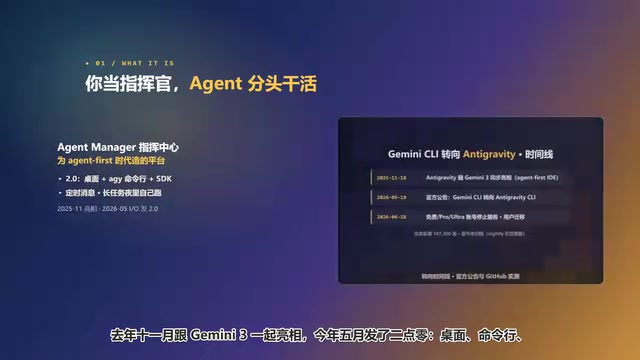
Gemini CLI stops service and pivots to Anti-Gravity, as Google bets on a multi-agent collaborative development platform
Google pivots its 107,000-star Gemini CLI project, stops service for free and professional accounts, and directs users to Anti-Gravity, sparking dissatisfaction in the developer community. The article outlines this "commander" platform: it covers desktop, command line, and SDK forms, with Agent Manager supporting multi-agent parallelism, project grouping, and scheduled tasks; browser collaboration and Artifacts give Agent deliveries built-in evidence chains like task lists, implementation plans, and screenshots, solving trust and acceptance issues. The free tier is usable but shrank after the quota system, and heavy parallelism needs a subscription. It also offers two migration pitfalls and three practical tips, noting technical leads and front-end developers are the best match, while individual developers who just want to write code quietly may not need it.
Title
Antigravity Deep Dive: The Agent Command Center After Gemini CLI's Retirement
Meta Description
Google pivots its 107k-star Gemini CLI, migrating users to the Anti-Gravity development platform. This article breaks down its Agent Manager multi-agent collaboration, browser self-verification and Artifacts evidence chain, quota-based pricing, and migration pitfalls, analyzing which developers it suits.
Article Content
Google has pivoted its 107,000-star Gemini CLI, stopped service for free and professional accounts, and redirected users to Anti-Gravity—a decision that set the developer community ablaze. Complaints aside, this development platform, officially positioned as a "commander," is worth examining closely to understand what problem it actually solves.
1. Gemini CLI's Curtain Call and Anti-Gravity's Entrance
According to a breakdown by Bilibili creator "Lao Jin" in the Agent Illustrated series, Google announced in May that it would pivot the 107,000-star Gemini CLI project, with free and professional accounts ceasing service from June 18, and all users directed to Anti-Gravity. This migration move sparked widespread dissatisfaction in the community, but from a product evolution perspective, it marks Google's shift in AI programming tools from a "single-point assistant" to "multi-agent collaboration."
Anti-Gravity was not a spur-of-the-moment idea. It debuted alongside Gemini 3 last November, released version 2.0 this May, and covers three forms: desktop, command line, and SDK. This all-form layout shows Google wants to build not a plugin, but a complete development workbench.
2. Agent Manager: From Writing Code to Managing a Code Army
Anti-Gravity's core positioning can be summed up in one sentence: you are the commander, and a group of Agents work separately. Its flagship feature is Agent Manager, which supports opening multiple Agents simultaneously, each taking its own task, grouping by project, and even scheduling tasks regularly. This is fundamentally different from the traditional AI programming assistant's "question-and-answer" mode—it manages an Agent team, not a chat window.
The UP host's experience advice is not to open too many Agents; three to five is the comfort zone, and opening more easily hits 429 rate limiting. There are related hot threads on the official forum, and the community has even built tools to automatically switch accounts to bypass limits. This indirectly shows that the demand for multi-agent parallelism is real, but the current quota mechanism hasn't caught up.
3. Browser Collaboration and the Artifacts Evidence Chain
The most powerful card is browser collaboration: after an Agent modifies a page, it opens the browser itself and clicks through to verify, with screenshots and screen recordings all counted as deliverables. Officially, this mechanism is called Artifacts—task lists, implementation plans, and work evidence are all archived throughout the process, equivalent to each Agent's delivery coming with its own evidence chain.
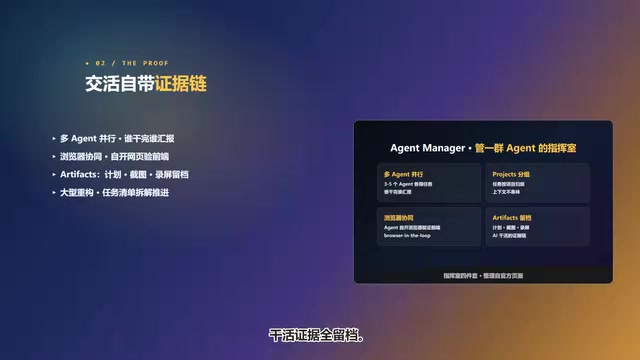
This design solves a long-standing trust problem in AI programming: how do you know that when an Agent says "fixed it," it's really fixed? Now acceptance is verifiable, with implementation plans and screen recordings serving as evidence of AI's work. For front-end developers, browser self-verification is especially convenient—verifying page changes no longer requires manual repeated clicking to confirm.

4. Pricing and Quotas: Free Is Enough, Heavy Parallelism Requires Payment
Developers can use it for free, with larger usage requiring a Google AI subscription, up to 5 to 20 times the base amount for the highest tier. Note that after the switch to a quota system in March this year, the free amount shrank considerably, and heavy parallel scenarios are still reserved for paid tiers. The intent of this pricing strategy is clear: use the free tier to attract individual developers to try it out, and use the quota system to filter out heavy users who genuinely need parallelism.

5. Two Pitfalls and Three Practical Tips
There are two pitfalls for existing users migrating. First, don't open too many Agents; three to five is the comfort zone, and exceeding that easily triggers 429 rate limiting. There are already hot threads discussing this on the official forum, and the community has even released tools for automatic account switching. Second, migrating command habits takes 15 minutes, but pipelines that depend on API keys are the hardest hit; it's recommended to verify first, then rebuild.
Based on official documentation and community testing, three tips are worth remembering: use Projects grouping to avoid context crossover; archive Artifacts for acceptance, with implementation plans and screen recordings serving as the evidence chain of AI's work; use the free tier sparingly, and schedule long tasks with timed messages to run at night.
6. Who It Suits: The Command Room Isn't for Everyone
Technical leads managing multiple projects are the best match—the command room was built for you. Front-end developers will benefit from the convenience of browser self-verification. But individual developers who just want to write code quietly may find this setup a bit heavy.
Other tools are an assistant; Anti-Gravity is a command room. You go from writing code to managing a code army—whether this role transition is worth it depends on how many projects you're pushing forward simultaneously.
Background Supplement
429 rate limiting refers to HTTP status code 429 (Too Many Requests), a response used by servers to indicate that the client has exceeded its quota for requests within a given time. In LLM applications, it's typically triggered by API rate limits, with limiting dimensions possibly including requests per minute (RPM), tokens per minute (TPM), or concurrent connections. For multi-agent parallel scenarios, each Agent opened generates independent model calls, consuming far more quota than a single-assistant mode, making 429 more likely. Different vendors have different quota windows and recovery strategies—some use sliding windows per minute, others reset daily—and when encountering 429, you usually need backoff retries or reduced concurrency.
The term Artifacts was first popularized in Anthropic's Claude product, referring to independently previewable and iterable outputs (such as code, web pages, charts) generated by the model during a conversation. Anti-Gravity adopts this term but extends its meaning: here it not only refers to the generated output itself but also emphasizes archiving process materials such as task lists, implementation plans, execution logs, and screenshots/screen recordings together, forming a traceable basis for acceptance. Compared with a simple code diff, Artifacts-style delivery packages "what was done, how it was done, and what the result was" together, facilitating manual review and team handover, and also making Agent behavior auditable when problems arise.
Multi-agent orchestration refers to a working mode where a scheduling layer splits tasks among multiple Agents with independent contexts, then aggregates their results. Its main differences from a single Agent are: context isolation (Agents don't contaminate each other), parallel execution (shortening end-to-end time), and division of responsibilities (e.g., separating planning, coding, and verification). The cost is increased scheduling complexity, multiplied quota consumption, and the need for additional result merging and conflict handling mechanisms. The "command room" mentioned in the article is essentially this orchestration layer, and "three to five Agents is the comfort zone" reflects the empirical balance point under orchestration overhead and rate-limiting constraints.
One-line Summary
Gemini CLI stops service and pivots to Anti-Gravity, as Google bets on a multi-agent collaborative development platform
Paragraph Summary
Google pivots its 107,000-star Gemini CLI project, stops service for free and professional accounts, and directs users to Anti-Gravity, sparking dissatisfaction in the developer community. The article outlines this development platform positioned as a "commander": it covers desktop, command line, and SDK forms, with the core being Agent Manager supporting multi-agent parallelism, project grouping, and scheduled task dispatch; browser collaboration and the Artifacts mechanism give Agent deliveries built-in evidence chains such as task lists, implementation plans, and screenshots/screen recordings, solving trust and acceptance issues in AI programming. On pricing, the free tier is usable but shrank after the quota system, and heavy parallelism requires a subscription. The article also offers two migration pitfalls and three practical tips, and notes that technical leads and front-end developers are the best match, while individual developers who just want to write code quietly may not need it.
Related articles

AI Abuse Alert: Reports of Child Sexual Abuse Material Surge 8,400% in Two Years
Hacker News reports show AI-related child sexual abuse material reports rose 8,400% in two years. This article analyzes how generative AI lowers the barrier to producing illegal content, the dilemma facing platform detection and legal regulation, and feasible directions for technical countermeasures.

Can Task-Specific 4B Models Replace Large Models?
A developer training Qwen3.5-4B-3D-Coder and LFM2.5-350M finds task-specific small models exceed expectations on 3D scene generation. Insights on epochs, SFT vs RL cost, and full fine-tuning on consumer hardware.
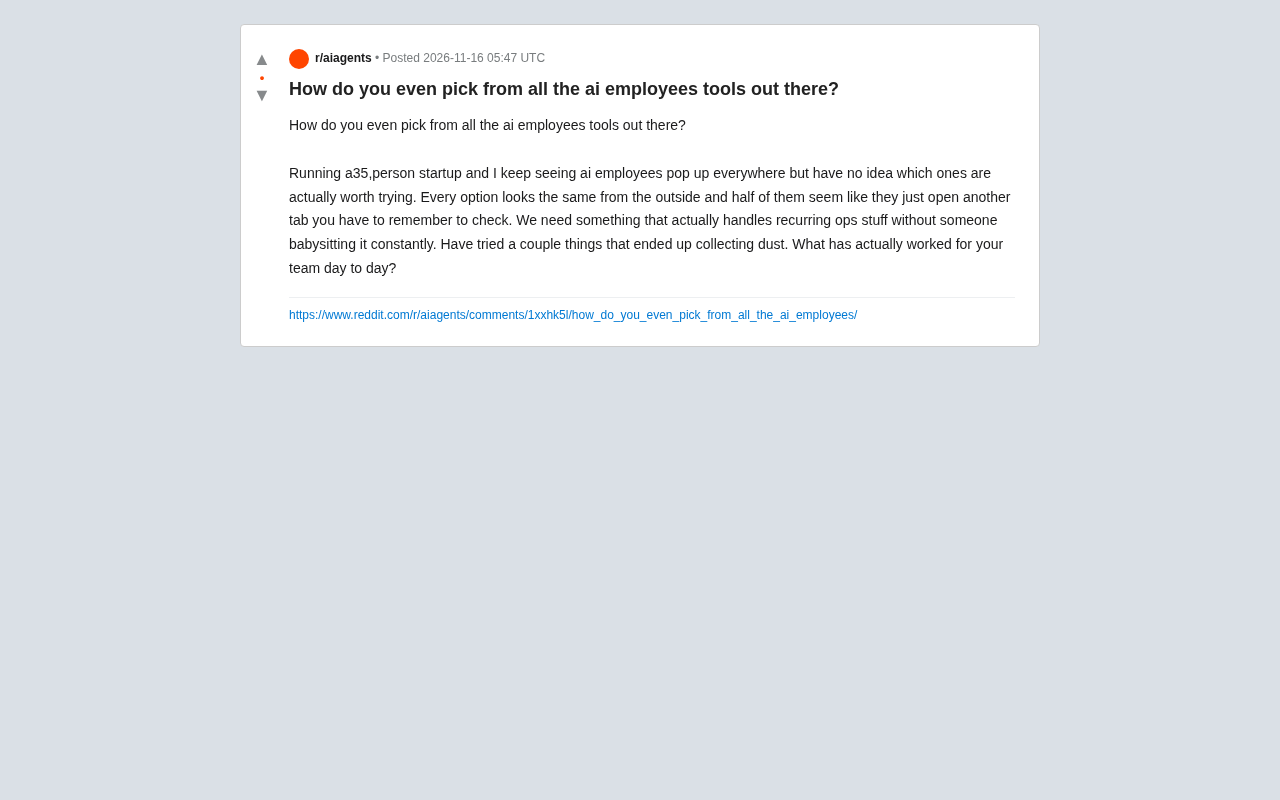
AI Employee Tools Are Everywhere — How Can a 35-Person Startup Pick the Ones That Actually Work?
A 35-person startup struggles with too many AI employee tools. Drawing on real community experience, this article distills three hard criteria—unattended operation, integration depth, and verifiability—to help you pick tools that actually work and avoid shelfware.