AnyS1: Accelerating Any Agent Workflow with a Single System-1 Model

AnyS1 defines decision points from skill text and trains a 4B pointer model for fast thinking, falling back to a large model when confidence is low—cutting costs sharply.
AnyS1 proposes a general dual-system agent approach to address the high cost and latency of autonomous LLM agents invoking large models at every step. It uses human-written procedural skills as a universal source of decision points, mining enumerable decisions from over 1,000 public skills to build the Any-DP dataset, then trains a calibrated 4B pointer-style System-1 model. At runtime, System-1 performs one forward pass for routine decisions and falls back to System-2 when confidence is below a calibrated threshold. Experiments on three unseen benchmarks and different System-2 model families show 75–91% lower per-turn cost and 63–92% less model invocation time while maintaining task reliability, with support for zero-shot threshold transfer.
Autonomous LLM agents invoke large models (System-2) at every step, even when merely choosing among a few known candidate actions—incurring high cost and latency. Dual-system agents attempt to offload such decisions to lightweight System-1 models, but rely on hooks written separately for each environment. AnyS1 proposes a different approach: treat human-written procedural skills as a universal source of decision points, train a single shared 4B pointer model, and at runtime use a confidence threshold to decide between fast thinking and slow thinking. According to its experiments, on three unseen benchmarks, this method reduces per-turn cost by 75–91% and model invocation time by 63–92%, while maintaining task reliability.
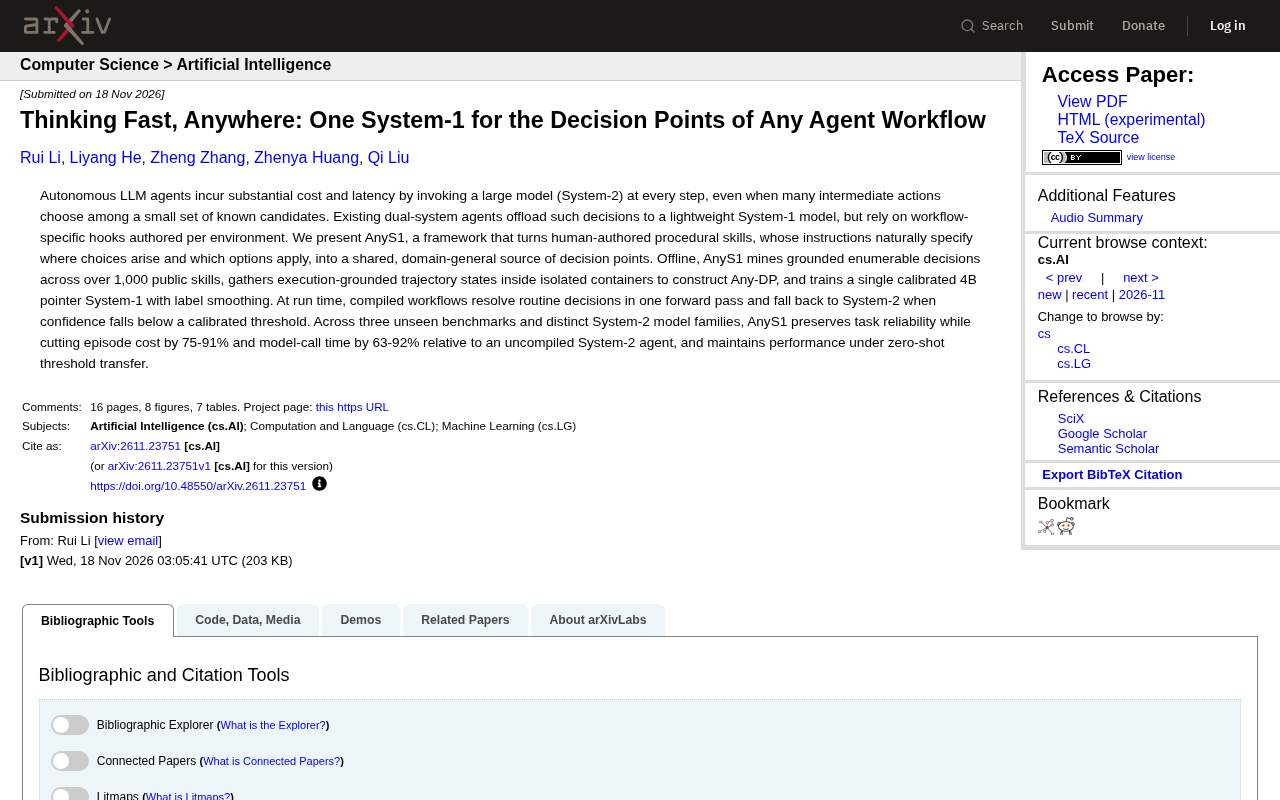
Core Problem: Calling a Large Model at Every Step Is Too Expensive
Agent workflows contain a large number of "routine decisions"—for example, choosing among a few known tools, parameters, or branches. Such choices have small candidate sets and repetitive patterns, yet still trigger full System-2 reasoning, causing substantial unnecessary overhead.
Existing dual-system approaches have recognized this, but their engineering is inelegant: developers must manually annotate "where choices can be made and what the options are" for each environment, forming workflow-specific hooks. When the environment changes, the hooks must be rewritten, making them hard to reuse. AnyS1 aims to solve this generality problem: decoupling the discovery and modeling of decision points from specific environments.
System-1 and System-2 are a pair of concepts from cognitive psychology, popularized by Daniel Kahneman in Thinking, Fast and Slow. System-1 refers to fast, automatic, intuitive thinking that consumes almost no attention; System-2 refers to slow, deliberate, effortful analytical thinking. In the context of LLM agents, System-2 usually refers to a full large-model reasoning call (e.g., a GPT-4-level model performing multi-step reasoning), while System-1 refers to fast decisions made by lightweight models or heuristic rules. The design goal of dual-system agents is to let System-1 handle most routine decisions and invoke System-2 only when necessary, thereby reducing computational cost and latency while maintaining reliability.
How AnyS1 Works: From Skill Text to Shared Decision Points
Offline Phase: Mining Enumerable Decisions
The key insight of AnyS1 is that human-written procedural skills themselves specify "where choices are made and what the possible options are." The research team mined context-bearing enumerable decisions from over 1,000 public skills and collected execution trajectory states in isolated containers to build the Any-DP dataset.
On this basis, they trained a calibrated 4B pointer-style System-1 model, using label smoothing to improve training stability. Covering multi-domain decision points with a single model, rather than training a separate small model for each task, is the main difference between AnyS1 and prior approaches.
Pointer models draw on the idea of Pointer Networks: such models do not directly generate output tokens but instead "point" to a candidate option from the input context. In the AnyS1 setting, the pointer model receives the current state and a set of candidate actions, and outputs a probability distribution over the candidate actions. This architecture is naturally suited to the decision type of "choosing from a small set of known candidates," because the output space is restricted to the candidate set, avoiding the problem that generative models may produce invalid actions. At the same time, the pointer mechanism enables the model to generalize to candidate combinations unseen during training, as long as the structure of the candidate set is similar.
Runtime: One Forward Pass, Fall Back When Unsure
At runtime, the compiled workflow first lets System-1 perform one forward pass to handle routine decisions; when the model's confidence is below a calibrated threshold, it falls back to System-2. This design bases the division of labor between "fast thinking" and "slow thinking" on confidence rather than hard-coded manual rules.
Worth noting is the threshold transfer capability: the paper claims that performance is maintained under zero-shot threshold transfer, meaning the calibrated threshold does not need to be retuned for each new benchmark—important for practical deployment.
Confidence calibration refers to the degree to which a model's predictive confidence matches its actual accuracy. A well-calibrated model, when it outputs a confidence of 0.9, should be correct about 90% of the time. AnyS1 uses a calibrated confidence threshold to decide whether to fall back to System-2: if System-1's confidence is below the threshold, the model is uncertain about the current decision, and it is handed back to the large model. Label smoothing here serves to prevent the model from being overconfident, thereby improving calibration quality. Zero-shot threshold transfer means that a threshold calibrated on one data distribution can be directly applied to new benchmarks without retuning, which relies on the model maintaining similar confidence distributions across domains.
Empirical Results: Cost and Latency Drop Sharply
The paper evaluates on three unseen benchmarks and across different System-2 model families. Relative to an uncompiled System-2 agent, AnyS1 reduces per-turn cost by 75–91% and model invocation time by 63–92%, while maintaining task reliability.
The significance of these numbers is that they cover "unseen" benchmarks and "different" System-2 families, indicating that the gains are not tied to a particular model or task. However, note that these are self-reported evaluation results from the paper; performance in real production environments still requires independent verification.
Points Worth Noting
Skills as a source of decision points. Treating human-written procedural documents as structured knowledge rather than merely prompt material is a perspective that can transfer to other agent infrastructure designs.
A single small model covers multiple domains. A 4B pointer model plus confidence calibration replaces the "one small model per environment" approach, reducing maintenance costs.
The fallback mechanism is the safety net. The confidence threshold lets the system hand back to the large model when uncertain, avoiding sacrificing reliability to save money.
Boundaries and limitations. The method relies on natural descriptions of decision points in skill text; for steps with unclear candidate sets or those requiring open-ended reasoning, System-1 cannot take over and will still fall back frequently. In addition, the engineering cost of collecting trajectories in isolated containers and the coverage of the Any-DP dataset itself both affect final results.
Procedural skills refer to structured text describing "how to complete a certain type of task," typically including steps, conditional branches, and optional operations, commonly found in operating manuals, tutorials, API documentation, or workflow instructions. Unlike ordinary prompt material, procedural skills naturally annotate decision points: for example, "if the user requests a refund, check the order status; if shipped, guide the return process." AnyS1 treats such text as a universal source of decision points, mining the conditional branches and candidate actions within to build a cross-environment reusable decision dataset. The key to this perspective is that the "if…then…" structures in skill text directly correspond to branch choices in agent workflows, thereby eliminating the engineering burden of manually annotating hooks for each environment.
Conclusion
AnyS1 turns the "fast thinking" of dual-system agents from hand-written hooks into a reusable general capability: define decision points with skill text, predict with a calibrated 4B pointer model, and control fallback with a confidence threshold. For teams building agent pipelines, this line of work suggests a cost-reduction approach—not making every step stronger, but identifying which steps do not need a large model at all.
One-line Summary
AnyS1 uses skill text to define decision points, trains a 4B pointer model for fast thinking, and falls back to a large model when confidence is low—cutting costs sharply.
Paragraph Summary
AnyS1 proposes a general dual-system agent approach aimed at solving the high cost and latency caused by autonomous LLM agents invoking large models at every step. Its core idea is to use human-written procedural skills as a universal source of decision points, mining enumerable decisions from over 1,000 public skills to build the Any-DP dataset, and then training a calibrated 4B pointer-style System-1 model. At runtime, System-1 first performs one forward pass to handle routine decisions, falling back to System-2 when confidence is below a calibrated threshold. Experiments on three unseen benchmarks and across different System-2 model families show that the method reduces per-turn cost by 75–91% and model invocation time by 63–92%, while maintaining task reliability and supporting zero-shot threshold transfer.
Related articles
Unlock All Claude Models for Free? Developer Mode + Gateway Configuration Tutorial
A YouTube tutorial claims that enabling Claude desktop developer mode and configuring a third-party gateway allows free use of all models, including Opus 5.5. This article breaks down the steps, analyzes the gateway technical principles, and reveals the triple risks of account bans, data privacy, and service stability, as well as the authenticity of model names.
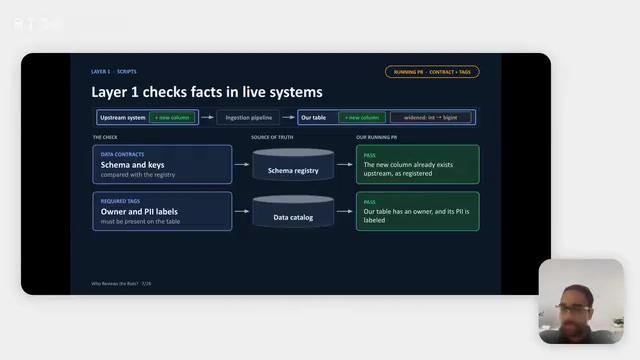
Robinhood's Hybrid AI Reviewer: 60% of Data PRs Auto-Merge
Robinhood's data platform team shares a hybrid AI PR reviewer: deterministic scripts verify facts, AI Agents judge contextual risk, and humans keep key decisions. About 60% of data pipeline PRs merge without human review, cutting review workload ~75%, saving ~132 engineering hours monthly, and reducing related incidents ~30%.

Making Marketing Videos with Claude Code Is More Efficient Than AI Video Generation
Generate marketing videos programmatically with Claude Code—more flexible and cheaper than AI video generators. Reference a style, generate a storyboard, output content as code, and make edits instantly.