AOP-Smart-Finder: How a Human-Machine Hybrid Framework Enables High-Throughput Mining of Adverse Outcome Pathways from Literature

AOP-Smart-Finder uses LLMs and RAG to enable high-throughput, traceable AOP construction and human-machine collaboration.
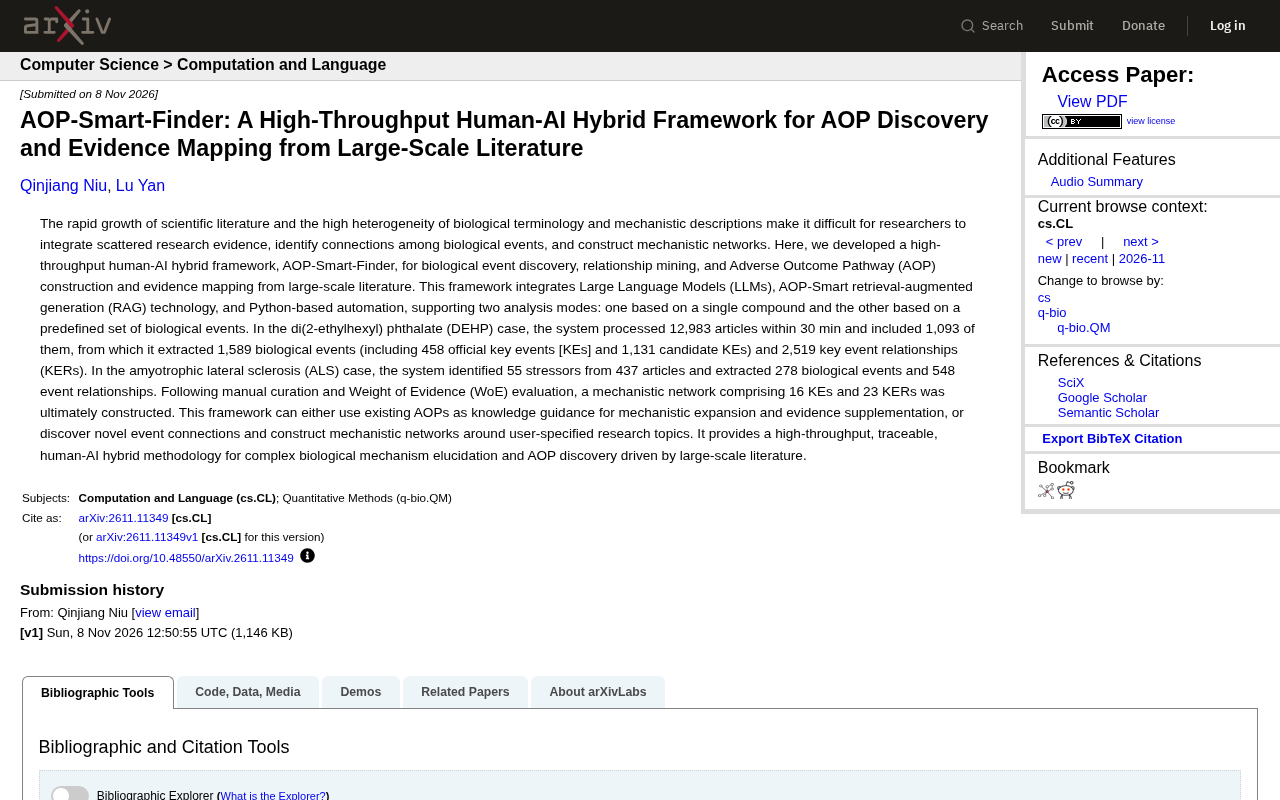
AOP-Smart-Finder is a high-throughput human-machine hybrid framework for biological event discovery and AOP construction, integrating large language models, AOP-Smart RAG, and Python automation. In the DEHP case, it processed 12,983 articles in 30 minutes and extracted 1,589 biological events and 2,519 key event relationships; in the ALS case, after manual curation and weight-of-evidence assessment, it constructed a mechanistic network with 16 KEs and 23 KERs. The paper emphasizes traceable evidence mapping and a division of labor where machines scale up and experts ensure quality.
Title
AOP-Smart-Finder: How a Human-Machine Hybrid Framework Enables High-Throughput Mining of Adverse Outcome Pathways from Literature
Meta Description
AOP-Smart-Finder is a human-machine hybrid framework integrating large language models, RAG, and Python automation to extract biological events and relationships from large-scale literature at high throughput, construct Adverse Outcome Pathways (AOPs), and complete evidence mapping. In the DEHP case, it processed nearly 13,000 articles in 30 minutes; in the ALS case, after manual curation, it constructed a mechanistic network containing 16 KEs and 23 KERs.
Article Content
The explosive growth of scientific literature and the high heterogeneity of biological terminology pose enormous challenges for researchers seeking to integrate scattered evidence, identify associations between biological events, and construct mechanistic networks. A new paper proposes the AOP-Smart-Finder framework, which attempts to use large language models (LLMs) and retrieval-augmented generation (RAG) technologies to push this process toward a high-throughput, traceable human-machine collaboration model.
Core Logic of the Framework Design
AOP-Smart-Finder positions itself as a "high-throughput human-machine hybrid framework" for biological event discovery, relationship mining, and construction and evidence mapping of Adverse Outcome Pathways (AOPs) from large-scale literature.
It integrates three key technologies: large language models handle semantic understanding and information extraction, AOP-Smart retrieval-augmented generation (RAG) provides domain knowledge anchors for the model, and Python automation handles process orchestration and batch processing. The framework supports two analysis modes—one centered on a single compound, and another for targeted mining based on a predefined set of biological events. This dual-mode design accommodates both the "substance-first" habit of toxicology research and the "event-first" need for mechanistic exploration.
Adverse Outcome Pathway (AOP) is a framework in toxicology for organizing mechanistic knowledge. It connects a molecular initiating event (MIE), a series of key events (KEs), and a final adverse outcome (AO) in a causal chain, and describes the evidence supporting adjacent events through key event relationships (KERs). The core value of an AOP lies in integrating scattered experimental observations into a reasoning-capable mechanistic chain, thereby supporting chemical risk assessment and cross-species extrapolation. AOPs are typically developed and curated under the coordination of organizations such as the Organisation for Economic Co-operation and Development (OECD), so the distinction between "official KEs" and "candidate KEs" reflects differences in the maturity of knowledge status—the former have received authoritative recognition, while the latter still require evidence accumulation.
Retrieval-Augmented Generation (RAG) is a technical paradigm that combines external knowledge retrieval with language model generation. Its basic workflow is: for a user query, first retrieve relevant snippets from a domain knowledge base or literature corpus, then provide these snippets as context to the LLM so that it generates an answer based on the retrieved evidence. The main advantage of RAG is that it provides verifiable knowledge anchors for model output, reducing hallucinations caused by incomplete or outdated parametric memory, while adapting to specialized domains without retraining the model. In biological scenarios with highly heterogeneous terminology, RAG can significantly improve the consistency between extraction results and the domain knowledge system.
Empirical Performance of Two Case Studies
The paper presents two specific cases to validate the framework's throughput capability.
In the di(2-ethylhexyl) phthalate (DEHP) case, the system processed 12,983 articles in 30 minutes, ultimately including 1,093, from which it extracted 1,589 biological events (including 458 official key events, KEs, and 1,131 candidate KEs) and 2,519 key event relationships (KERs). This scale demonstrates that in a single run, the framework can cover a volume of literature that previously required extensive manual screening.
In the amyotrophic lateral sclerosis (ALS) case, the system identified 55 stressors from 437 articles and extracted 278 biological events and 548 event relationships. After manual curation and Weight of Evidence (WoE) assessment, a mechanistic network containing 16 KEs and 23 KERs was ultimately constructed. The numerical contraction here is noteworthy: from automated extraction to manual refinement, the number of events and relationships dropped substantially, precisely reflecting the division of labor in the human-machine hybrid workflow—"machines scale up, humans ensure quality."
Weight of Evidence (WoE) is a systematic method used in toxicology and risk assessment to integrate multiple lines of evidence. It requires assessors to consider not only the quantity of evidence but also the quality, consistency, biological plausibility, and relevance to the target species of each piece of evidence. In AOP construction, WoE assessment is often used to determine whether a given KER has sufficient support, thereby deciding whether it can be included in the formal mechanistic network. This also explains the substantial contraction in the number of events and relationships in the ALS case from automated extraction to manual refinement: automated extraction provides a candidate pool, while WoE assessment is responsible for screening out mechanistically reliable connections with sufficient evidence.
The Real Value of Human-Machine Hybridization Lies in "Traceability"
Such frameworks are easily misunderstood as mere automated extraction tools, but the key term emphasized in the paper is "traceability." In toxicology and mechanistic research, whether a relationship holds depends on the evidence sources and experimental conditions behind it. AOP-Smart-Finder incorporates evidence mapping as part of the workflow, enabling every extracted biological event and event relationship to be traced back to the original text—this is more meaningful than extraction quantity alone.
At the same time, the framework can use existing AOPs as knowledge guidance for mechanistic expansion and evidence supplementation, and can also discover new event connections and construct mechanistic networks around user-specified research topics. The former is "building incrementally on existing knowledge," while the latter is exploratory in nature.
Implications for AI-Assisted Scientific Research
AOP-Smart-Finder demonstrates a pragmatic human-machine collaboration paradigm: LLMs do not replace expert judgment but free experts from the initial screening of massive literature, allowing them to focus on evidence weight assessment and mechanistic plausibility judgment. In fields where biological terminology and mechanistic descriptions are highly heterogeneous, the introduction of RAG also suggests a feasible path for reducing model hallucinations and improving domain adaptability.
The paper positions the framework as a high-throughput, traceable methodology for elucidating complex biological mechanisms and literature-driven AOP discovery at scale. Its value lies not only in the processing scale demonstrated in specific cases but also in providing a reusable workflow template for literature-intensive mechanistic research.
One-line Summary
AOP-Smart-Finder uses LLMs and RAG to enable high-throughput, traceable AOP construction and human-machine collaboration.
Paragraph Summary
AOP-Smart-Finder is a high-throughput human-machine hybrid framework for biological event discovery and Adverse Outcome Pathway (AOP) construction, integrating large language models, AOP-Smart retrieval-augmented generation (RAG), and Python automation workflows. The framework supports both single-compound analysis and predefined biological event set modes. In the DEHP case, the system processed 12,983 articles in 30 minutes and extracted 1,589 biological events and 2,519 key event relationships; in the ALS case, it identified 55 stressors and, after manual curation and weight-of-evidence assessment, constructed a mechanistic network containing 16 KEs and 23 KERs. The paper emphasizes the traceability of evidence mapping and advocates a division of labor in which machines scale up and experts ensure quality, providing a reusable workflow template for literature-intensive mechanistic research.
Related articles
GLM-5.4 Released: 50% More Quota but 9x Token Consumption
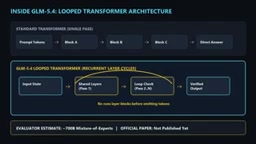
GLM-5.4 quietly launched: native vision, 50% more quota, but independent tests show reasoning token consumption is 9-14x that of Gemini 4 Neon due to its looped transformer architecture.

Z.AI's Looped Architecture Lets a 750B Model Rival 2T: A Deep Dive into GLM-5.4
Z.AI's GLM-5.4 uses a loop transformer to stretch 750B parameters across 106 effective layers, nearing 2T-class reasoning—but flagship benchmarks and openness are in question.
GLM-5.4 In-Depth Analysis: How a Looped Transformer Punches Above Its Weight
Z.AI releases GLM-5.4, using a looped Transformer to run its 28-layer network twice, pitting 75B parameters against trillion-scale models. This analysis covers the looped-reasoning原理, vision coding, speed and quota changes, and flags three issues: no public benchmarks, loop stalls, and a closed API.