API and MCP Are Not Rivals: Understanding Their Relationship in One Minute

MCP isn't a replacement for APIs—it's a standardized wrapper layer built on top of them.
The article clears up the popular misconception that MCP will replace APIs, noting that they operate at different levels of abstraction: APIs handle point-to-point data requests between programs, each with its own address, auth, and errors; MCP provides AI apps with a standardized tool discovery and invocation format across services. Crucially, MCP servers for services like GitHub still call their underlying APIs internally, just centralizing adapter code once at the server layer. MCP lowers multi-tool integration costs, but API knowledge remains essential—they coexist in layers, not as replacements.
Why Do People Always Pit API and MCP Against Each Other?
In the AI application development world, whenever MCP (Model Context Protocol) comes up, someone always treats it as a replacement for APIs. This misunderstanding isn't surprising—both involve "getting programs to talk to each other," so on the surface they do look like competitors in the same lane. But according to a plain-language explainer from the YouTube channel AIxplorewithmalli, the relationship between API and MCP is more like "bricks" versus "prefab panels": MCP doesn't replace APIs—it usually builds on top of them.
The key to understanding this is recognizing each one's scope of responsibility. APIs solve "how one program requests data from another," while MCP solves "how AI applications discover and use various tools in a unified way." Their design goals don't overlap.
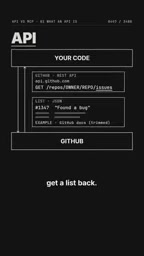
API: The Veteran Data Channel, But Each Has Its Own Style
APIs work in a very direct way. Take GitHub's API as an example. Your program sends it a request, and it returns a list of issues. The data channel is established, and the job is done.
The problem shows up at scale. Every API has its own address structure, authentication method, error code system, and calling conventions. Integration code written for GitHub will break if copied verbatim to Stripe—different parameter names, different auth flows, different response formats. Developers have to write a separate adapter for each service, and the duplicated effort piles up.
This isn't a flaw in APIs—it's their nature: APIs are designed for point-to-point communication and aren't responsible for unifying differences across multiple services.
MCP: A Unified Socket for AI Applications
MCP takes a completely different approach. It lets an AI application ask a tool server in a standardized way: "What can you do?" The server returns a list of tools with descriptions. The AI picks an operation based on the description—say, "list issues"—and executes it.
The key point is that a Stripe MCP server returns the same format as a GitHub MCP server. The AI application doesn't need to relearn a set of interaction rules for each service, and the same code flow can be reused across different tools. This dramatically lowers the barrier for AI applications to integrate multiple tools.
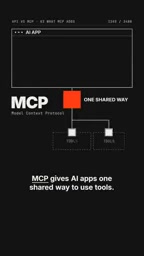
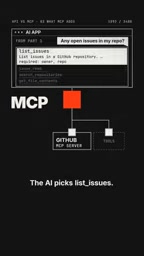
MCP was proposed and open-sourced by Anthropic in late 2024. Its full name is Model Context Protocol, and it's often compared to "the USB-C port of the AI world." It defines its communication format based on JSON-RPC 2.0, with core roles including the Host (the application running the AI model), the Client (the component inside the Host that communicates with servers), and the Server (the party exposing tools, resources, and prompt templates). A server can declare which tools (executable operations), resources (readable data), and prompts (preset instructions) it offers, and the client dynamically discovers and invokes them accordingly. Because it brings "tool descriptions" themselves into the protocol, an AI model can understand what a server can do without pre-hardcoding it—this is also the key difference from ordinary RPC frameworks.
The Key Truth: MCP Servers Still Call APIs Internally
The most noteworthy line in the video is this: GitHub's MCP server is, at its core, still calling GitHub's API. MCP doesn't bypass the API—it simply moves the API call code that used to be scattered across AI applications into the server, written only once.
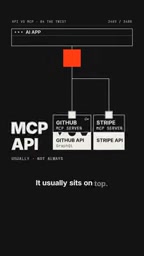
The significance of this architectural shift is separation of responsibilities. In the past, every AI application had to implement GitHub API call logic itself; now, that logic is handled uniformly by the MCP server, and the AI application side only faces a standardized interface. As the video puts it, "your code goes through the same steps every time, calling the API"—except that step now happens at the server layer rather than the application layer.
This pattern also explains why many tool-oriented AI applications choose to layer MCP on top of APIs: it's not about abandoning the existing API ecosystem, but about using a standardized wrapper to lower integration costs.
There's a conceptual distinction here that's easy to confuse: an "API call" refers to a program requesting data from a remote service via HTTP or similar protocols, whereas MCP defines the protocol layer between AI applications and tool servers. The two are not at the same level of abstraction—APIs are the data entrance and exit, while MCP is the protocol for describing and orchestrating tool capabilities. In other words, an MCP server is itself usually just an ordinary backend service: it receives standardized requests from AI applications, translates them into concrete API calls, and returns the results in a standard format. So to judge whether an MCP server "bypasses" the API, you only need to check whether it ultimately makes network requests to external services—and the answer is almost always yes.
Practical Takeaways for Developers
If your AI application needs to integrate multiple external services, the standardized tool discovery mechanism MCP provides can save you a lot of adapter code. But that doesn't mean API knowledge becomes irrelevant—quite the opposite. The implementation quality inside an MCP server depends directly on how deeply you understand the underlying API. Whoever writes an MCP server still needs to master the corresponding API.
Another point worth noting: MCP's standardization benefits depend on service providers being willing to offer MCP servers. For APIs that don't yet have an MCP wrapper, developers still have to handle raw calls themselves. For the foreseeable future, APIs and MCP coexist in layers rather than replacing each other.
Treating the two as competitors leads people to misjudge the direction of technology choices; treating them as infrastructure at different layers is the only way to see the real changes happening in AI tool integration.
One-line Summary
MCP is not a replacement for APIs, but a standardized wrapper layer built on top of them.
Paragraph Summary
The article clears up the popular misconception that "MCP will replace APIs," pointing out that the two sit at different levels of abstraction: APIs handle point-to-point data requests between programs, with each service having its own address, authentication, and error system; MCP provides AI applications with a standardized format for tool discovery and invocation, letting MCP servers for different services return capability lists in a consistent way. The key point is that MCP servers for services like GitHub still call their underlying APIs internally—they simply centralize the adapter code that used to be scattered across AI applications into the server layer, written only once. So for developers, MCP can significantly cut the cost of multi-tool integration, but understanding the underlying API remains the foundation for writing high-quality MCP servers. The two coexist in layers rather than replacing each other.
Related articles

Getting Started with Gemini 4 Argonne: A Hands-On Guide from Building Sites to Agents
Complete Gemini 4 Argonne tutorial: build a calorie tracker app with one prompt in Google AI Studio, review 10-page technical documents with long context, develop a browser game as a coding Agent in Anti-Gravity, plus API Key setup, pricing, and subscription requirements.

Cursor vs. Claude Code vs. Copilot: A Scenario-Based Selection Guide
Cursor, Claude Code, or GitHub Copilot? A scenario-based guide covering daily coding, large refactors and long tasks, and teams locked into existing IDEs—plus common pitfalls and combined-use advice.

DB Chat: Conversing with PostgreSQL in Natural Language, with AI Auto-Generating SQL
dbchat lets users converse with a PostgreSQL database in natural language, with an AI agent auto-generating SQL and returning live results. This article analyzes its MCP Server + Next.js + AWS full-stack architecture and anti-hallucination guardrail design.