API vs. Local LLM Deployment: Cost Analysis and Selection Guide

APIs win on getting started, local deployment wins in the long run—choose based on usage and privacy needs.
The article breaks down "cloud API vs. local model" into a cost calculation, concluding that APIs win on getting started and local deployment wins in the long run. The API route requires zero hardware, is compatible with the OpenAI format, integrates in a few lines of code, and often includes free registration credits—but has credit caps, rate limits, and per-Token overage charges; light users consuming tens of millions of Tokens monthly with a cheap model pay only 2-30 RMB, making APIs clearly more cost-effective. The real cost of local deployment is hardware: the 7B quantized version runs on 4-6GB VRAM, a used 3090 costs two to three thousand RMB, and 70B requires 48GB+ VRAM at over ten thousand RMB; a one-time investment pays for itself after a few months of heavy use, then becomes nearly free with data staying on-device. The article categorizes users into light/prototype development, heavy users, and privacy-sensitive users, offering selection advice for each, and recommends Ollama as the easiest local deployment path.
Why This Calculation Is Worth Getting Right
When it comes to large language models, many people's first reaction is a dilemma: should I use a cloud API or buy a GPU and run a local model myself? A video on Bilibili broke this question down into a concrete cost calculation—no mysticism, just costs and scenarios. The video's core conclusion is clear: APIs win on getting started, local deployment wins in the long run. But behind this conclusion are several key variables—usage frequency, hardware investment, and privacy requirements—that deserve closer analysis.
The API Route: Low Barrier to Entry, but with Hidden Constraints
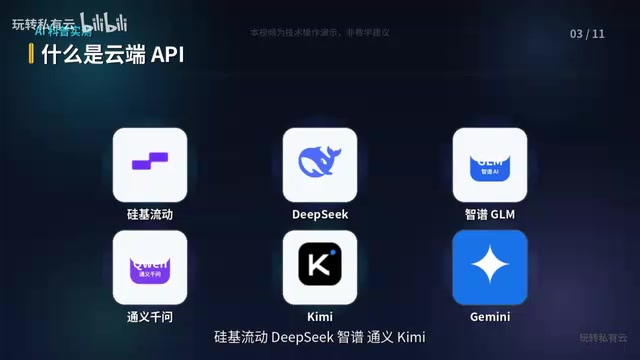
The essence of an API is calling interfaces opened up by major providers. Platforms like DeepSeekAd, Zhipu, Kimi, and Google Gemini mostly offer free credits upon registration—no hardware purchase needed, and easy to get started: most are compatible with the OpenAI format, so you just install an SDK, fill in a key, and a few lines of code get the model running.
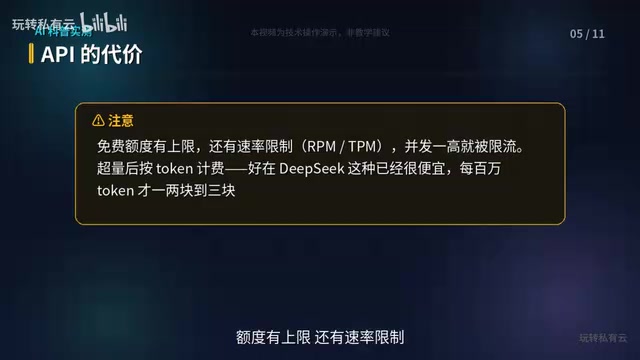
But free doesn't come without a cost. There are credit limits and rate limits—high concurrency gets throttled; beyond the quota, you pay per Token. Fortunately, DeepSeek's pricing is already very low. The video mentions that light users consuming tens of millions of Tokens per month with a cheap model pay only 2-30 RMB—at that scale, APIs completely beat local deployment.
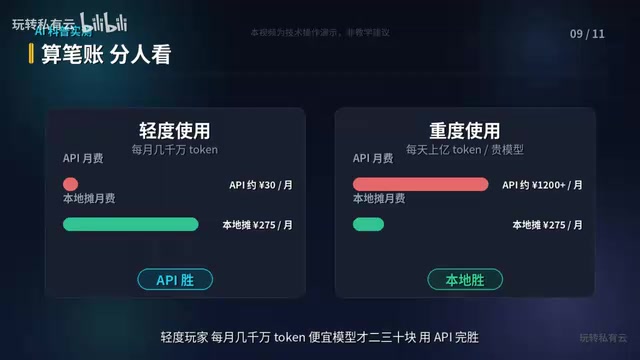
What's worth noting is that the API cost structure is linear: you pay for what you use, and heavy long-term use accumulates continuously. The video's reference point: using over a hundred million Tokens per day or relying on scaled services like GPT Cloud, monthly fees easily reach thousands.
Tokens and rate limits are two foundational concepts for understanding API cost structure. A Token is the smallest unit of text a model processes, roughly understood as a "word/character fragment": an English word often corresponds to about 1 Token, while a Chinese character typically takes about 1-2 Tokens. API billing is priced separately for "input Tokens + output Tokens," so long-context, long-conversation costs are significantly higher than short Q&A. Rate limits are the platform's quota constraints on requests or Tokens per unit time, commonly including requests per minute (RPM) and Tokens per minute (TPM); once concurrency exceeds the threshold, requests are queued or return throttling errors. This is why free credits suit validation and light use but not high-concurrency production scenarios—the retries and latency caused by throttling often affect experience more than the fees themselves.
Local Deployment: One-Time Investment, Amortized Over Time
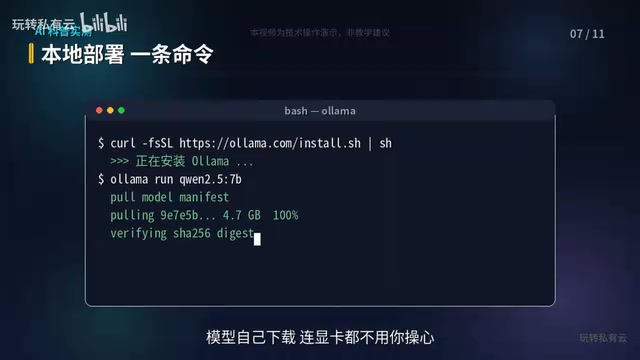
Local deployment means downloading the model to run on your own machine. The easiest path recommended in the video is Ollama: one line to install, one line to start, the model downloads itself, and you don't even need to worry about the GPU—it's called automatically and just works.
The real cost is hardware. According to the data in the video: the 7B quantized version runs on 4-6GB of VRAM, 8GB is more comfortable; a used 3090 costs two to three thousand RMB; running 70B requires 48GB+ of VRAM, and multi-GPU or professional cards instantly push costs past ten thousand.
The amortization logic is straightforward: a one-time cost of two to three thousand RMB, recouped after a few months of heavy use, and essentially free thereafter—plus data never leaves your machine. For users with long-term high load who care about privacy, this is value APIs cannot offer.
Quantization is the key to running local deployment on consumer-grade GPUs. It compresses model weights from 16-bit floating point to 8-bit, 4-bit, or even lower precision, trading a small amount of accuracy for significantly improved VRAM usage and inference speed—which is why "the 7B quantized version runs on 4-6GB of VRAM" holds true. The 7B and 70B in model names refer to parameter count (in billions); larger parameter counts generally mean stronger capabilities but also roughly linear increases in VRAM requirements, which is why 70B needs 48GB+ of VRAM. Additionally, tools like Ollama wrap model downloading, quantization format selection, and GPU invocation, saving you from manually configuring inference frameworks—but when VRAM is insufficient, they still fall back to CPU inference, which is noticeably slower. This is one point to confirm in advance when evaluating local solutions.
Calculating by User Type: Selection Advice for Three Scenarios
The video divides users into two categories; in practice, the decision can be refined into three:
Light users / prototype development: With tens of millions of Tokens per month, a cheap model costs only 2-30 RMB—the money for a GPU could pay for API usage for a long time. If you want to avoid hassle and quickly validate ideas, APIs are the most worry-free choice.
Heavy users: Over a hundred million Tokens per day or reliance on scaled services means monthly fees easily reach thousands, while a one-time local investment of two to three thousand RMB pays for itself in a few months. In the long run, local is more cost-effective.
Privacy-sensitive users: If data cannot leave the local machine, the API route is immediately ruled out—local deployment is the only option.
Conclusion and Next Steps
APIs win on getting started: zero hardware investment, integration in a few lines of code, pay-as-you-go. Local wins in the long run: one-time costs amortized to near zero, with controllable data. The key to the decision is not which technology is better, but where your usage frequency and privacy requirements fall. The video ends with a preview of the next episode—building your own knowledge base with Ollama, which is exactly a typical real-world scenario for local deployment.
FAQ
Q: Are free API credits enough? A: It depends on usage. Credits have limits and rate limits apply—high concurrency gets throttled, and overages are billed per Token. Free credits suffice for light use; heavy use requires evaluating paid costs.
Q: Do I need a high-end GPU to run local models? A: Not necessarily. The 7B quantized version runs on 4-6GB of VRAM, 8GB is more comfortable. Only running large models like 70B requires 48GB+ of VRAM, with significantly higher costs.
Q: Is Ollama suitable for beginners? A: The video's assessment is that it's the easiest local deployment method: one line to install, one line to start, models download automatically, and no manual GPU invocation management is needed.
Related articles

64 Releases in 40 Days: How Strata Uses Release Velocity to Define Its AI Local Inference Roadmap
Strata shipped 64 releases in 40 days with 460k+ characters of notes. From 0.1.0 to 0.2.10, a three-step path: make it run, make it fast, make it trustworthy.
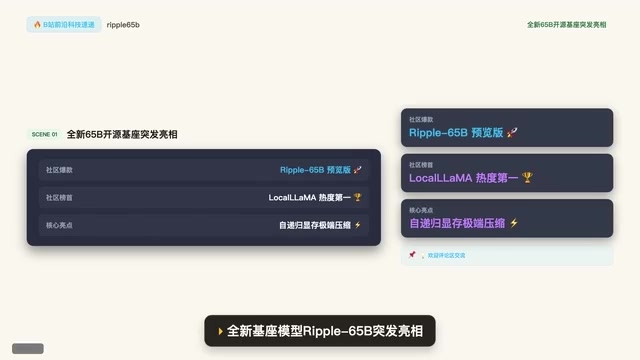
Ripple-65B Open-Source Model Tops Community Charts
Ripple-65B open-source LLM debuts atop community charts, using a self-recursive architecture to slash long-context KV cache for low-latency hundred-billion-scale inference on ordinary GPUs, with preview weights, quantized files, and one-click Olema & VLM deployment.

Deploy Open-Source Video Model MiniMax H3 Locally in 5 Minutes and Skip Cloud Generation Fees
Bilibili creator tests local deployment of open-source video model MiniMax H3: three-step ComfyUI install, 5-minute setup, no coding. Same prompt generates in 2 minutes locally vs 4 minutes online with queuing, saving about 30 RMB per 15-second 720P video. Includes VRAM requirements and RTX 5080 test results.