Apple Acquires Huxe Team and Technology: Early Signs of an AI Podcast Push

Apple acquihires AI personalized podcast startup Huxe, hinting at a push into intelligent audio content.
Apple has disclosed a deal to hire the team behind personalized podcast startup Huxe and license its technology — an acquihire rather than a full acquisition. Huxe specializes in using AI to automatically generate or customize audio content based on user interests, aligning closely with the current AI audio generation trend. For Apple, the move could strengthen Apple Podcasts' personalized recommendation and AI audio capabilities, complementing its existing investments in on-device AI and voice synthesis. Apple has not disclosed specific product plans, so the direction of any AI podcast features remains speculative — but the deal signals that personalized audio is a strategic area Apple is watching closely.
Apple's Latest Move: Acquiring Personalized Podcast Startup Huxe
Apple has recently disclosed a deal involving the hiring of the team behind personalized podcast startup Huxe and licensing its technology. The news has sparked widespread speculation about Apple's next strategic direction — is the company positioning itself to enter the AI-generated podcast space?
This kind of "acquihire" model — recruiting a core team and licensing key technology rather than completing a full acquisition — is nothing new among tech giants. Compared to a straightforward buyout, Apple's approach allows it to quickly absorb innovative capabilities while avoiding some regulatory scrutiny and integration costs. Historically, Apple has used similar moves multiple times to bring in small startup teams and bolster its R&D in specific areas.
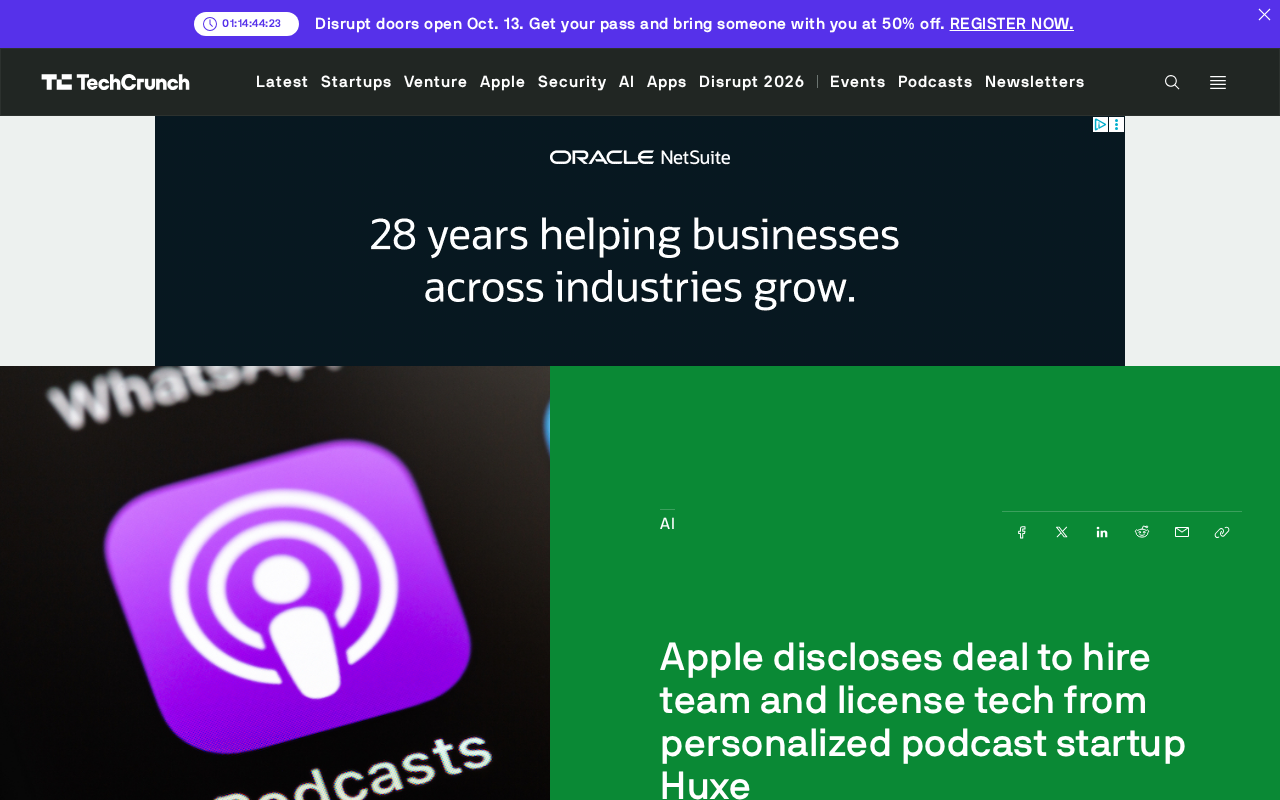
Huxe's Focus and Apple's Potential Intent
Huxe is a startup focused on "personalized podcasts" — audio content that uses AI to automatically generate or curate material tailored to a user's interests, listening habits, and even real-time information. This aligns closely with the broader AI audio generation wave in recent years, spanning text-to-speech, synthetic podcasts, and LLM-powered content orchestration. Personalized audio is fast becoming a new frontier in content consumption.
For Apple, the strategic value of this deal is worth examining. Apple operates Apple Podcasts, one of the largest podcast distribution platforms in the world, while continuously investing in on-device AI and voice synthesis (through Siri and on-device speech capabilities). Bringing in Huxe's personalization technology could strengthen Apple's position in audio content generation and recommendation, delivering listening experiences that more closely match individual user preferences.
The personalized podcast space has already attracted a number of startups in recent years. Notable examples include Google's NotebookLM, which launched an "Audio Overview" feature that automatically converts documents into two-person conversational podcasts; Spotify has accumulated voice synthesis capabilities through acquisitions like Sonantic and launched its AI DJ feature, which generates personalized real-time commentary based on user taste. These efforts demonstrate that the core technology stack for personalized audio typically consists of three layers: content understanding and summarization (powered by large language models), natural-sounding speech synthesis (TTS, such as OpenAI's TTS or ElevenLabs solutions), and user preference modeling and recommendation. Huxe's specific strengths within this stack have not been fully disclosed publicly, but Apple's recruitment of its team most likely aims to reinforce the "user-data-driven content orchestration" layer — precisely the area where Apple holds a natural advantage thanks to iPhone on-device data.
Will AI Podcasts Become the Next Battleground?
The central question raised by the original report is whether Apple wants to enter the AI-generated podcast space. Apple has not made any official statements about specific product plans; available information remains limited to the deal disclosure itself. As a result, how Apple intends to deploy Huxe's technology is largely informed speculation rather than established fact.
That said, judging by industry trends, AI-generated and personalized audio is clearly a direction that major tech companies are actively exploring. Whether through automatic summarization, multilingual synthesis, or user-data-driven content customization, AI is reshaping how audio content is produced and distributed. Apple's move to shore up relevant talent and technology through this deal at least signals that it is paying close attention to the space.
Implications for the Industry
This deal reinforces the widespread strategy among large tech companies of rapidly absorbing AI talent through acquihires. For startups, having their team and technology "absorbed" by a giant has also become a common exit path.
For users and developers, it's worth watching how Apple moves next on personalized audio. If Apple truly integrates AI-generated podcast capabilities into its ecosystem, it could have significant implications for existing podcast creators and the broader platform landscape. For now, all of this awaits validation through Apple's future product releases.
Note: This article is based on publicly available reports. Content regarding Apple's specific product plans represents industry speculation; Apple's official communications should be treated as the authoritative source.
Against a backdrop of tightening regulation, acquihires have become a well-worn path for large tech companies to sidestep antitrust scrutiny. Traditional full acquisitions require lengthy regulatory approval processes, while the structural arrangement of "hiring a team plus licensing technology" often falls below the merger filing thresholds in most jurisdictions. Recent notable examples include Microsoft's recruitment of the Inflection AI founding team and Amazon's hiring of core Adept employees — both following the same model. For the acquired startups, this exit path may come at the cost of brand continuity, but it allows teams to continue pursuing their technical vision with far greater resources, making it a pragmatic choice. Notably, regulators such as the U.S. FTC have begun scrutinizing whether such transactions substantively constitute "covert acquisitions," and related rules may tighten further in the future.
Related articles

Frontend to AI Agent Development: A Frontline Architect Explains Career Paths and Opportunities
A frontline AI architect explains the industry changes and practical paths for frontend developers transitioning to AI Agent development: why pure frontend jobs are disappearing, why Agent + full-stack has become mainstream in hiring, and three transformation routes—Agent development engineer, FDE, and remote contracting—along with corresponding learning strategies.

How to Choose an AI Agent Development Course: Five Pitfall-Avoidance Guidelines
A mechanical-engineering career changer's two-year pitfall-tested checklist for screening AI Agent development courses: complete delivery pipeline, resume-worthy projects, real development perspective, update frequency, and coaching feedback—with concrete judgment methods and pitfall-avoidance tips.

Coze AI Agent Building for Beginners: A Zero-Code AI Agent Development Guide
Coze, ByteDance's one-stop AI application development platform, supports zero-code drag-and-drop AI agent building. This article outlines Coze's core concepts, three advantages, differences between the domestic and international versions, and the distinction between agents and apps, helping beginners quickly get started with AI Agent development.