Apple App Store Tax and Pricing Updates: Four Key Changes Developers Need to Know
Apple adjusts App Store taxes and pricing: new taxes in four African countries, SaaS attribute launch, California sales tax in 2027, and auto price updates in five countries in December.
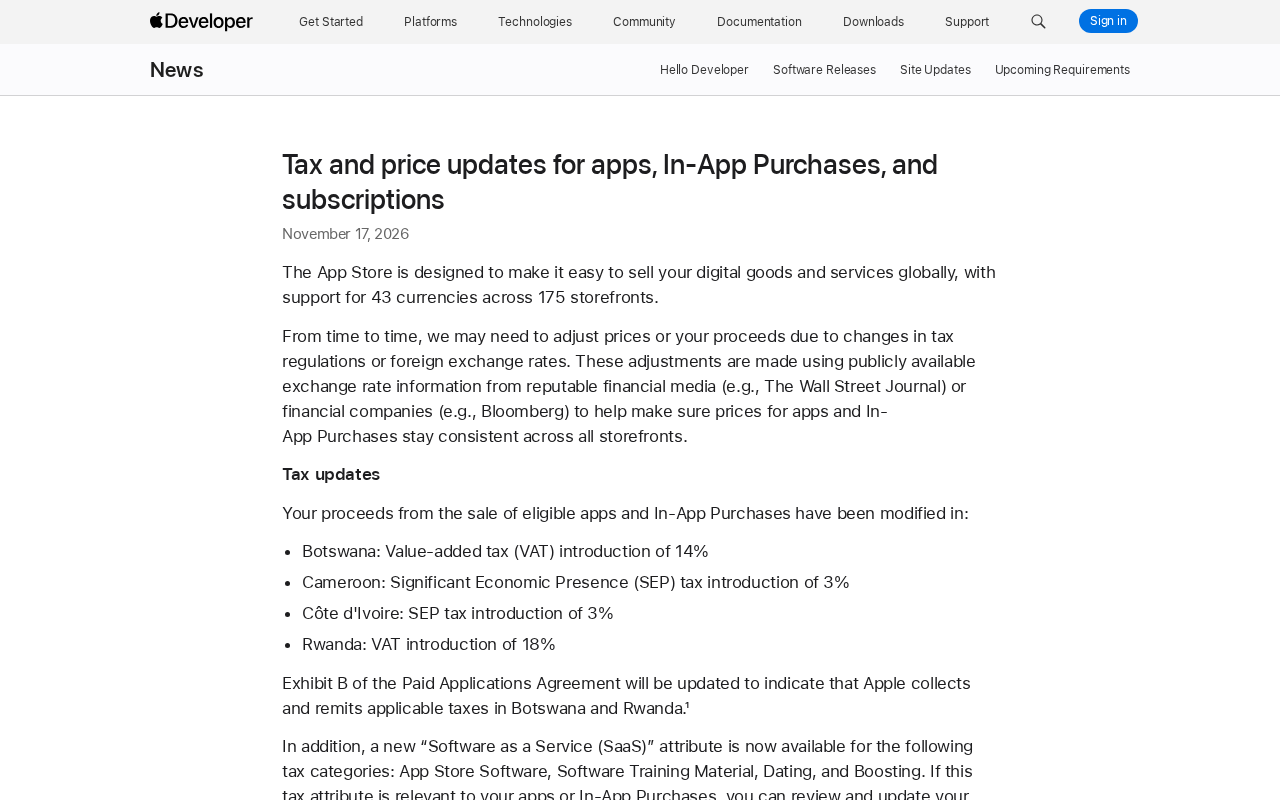
Apple notified developers of multiple changes to App Store and In-App Purchase tax rules and pricing. Botswana and Rwanda introduce 14% and 18% VAT collected by Apple; Cameroon and Côte d'Ivoire introduce 3% SEP taxes that may require developer compliance. Apple adds a SaaS tax attribute covering four categories including App Store Software, which developers can update in App Store Connect. From January 1, 2027, California will impose sales and use tax on these categories—developer proceeds stay the same but tax-inclusive customer prices may rise. On pricing, five storefronts—Botswana, Colombia, Egypt, Rwanda, and Turkey—will auto-update prices on December 3, 2026, excluding auto-renewable subscriptions and manually priced storefronts. Developers should verify tax classifications, assess revenue impact, and review pricing settings.
Apple recently notified developers of adjustments to tax rules and pricing strategies for the App Store and In-App Purchases. This update involves the introduction of Value Added Tax (VAT) and Significant Economic Presence (SEP) taxes in several African countries, a new SaaS tax attribute, upcoming sales tax changes in California, and automatic price updates in five countries. For developers selling digital goods on the App Store—which spans 175 storefronts and supports 43 currencies—these changes directly affect net revenue and pricing strategy, and require careful review.
New Taxes in Four African Countries Affect Developer Proceeds
Apple stated in its notice that proceeds from qualifying apps and In-App Purchases in certain countries have been adjusted due to changes in tax regulations. Specifically: Botswana introduces a 14% Value Added Tax (VAT), Cameroon introduces a 3% Significant Economic Presence (SEP) tax, Côte d'Ivoire introduces a 3% SEP tax, and Rwanda introduces an 18% VAT.
For Botswana and Rwanda, Apple collects and remits the taxes on behalf of developers, and Exhibit B of the Paid Applications Agreement will be updated accordingly. This means developers do not need to handle tax filings themselves in these two markets, but proceeds will be reduced by the new tax rates. The SEP taxes in Cameroon and Côte d'Ivoire, however, may involve developers' own tax compliance obligations and require further confirmation against local regulations.
For developers targeting African markets or with a user base in the region, this round of tax introductions will directly reduce net income per transaction. It is recommended to review sales data for the relevant regions in App Store Connect and assess the impact of tax rate changes on overall revenue.
Value Added Tax (VAT) is a consumption tax levied at each stage of a goods or services transaction, ultimately borne by the consumer but collected and remitted by the seller. In the global digital services sector, VAT rules for cross-border digital goods vary widely: some countries require foreign suppliers to register for a tax ID and self-report (such as the EU's OSS mechanism), while others designate platforms (such as Apple) as the "deemed supplier" to collect and remit. Botswana and Rwanda fall into the latter category—Apple deducts the tax directly from developer proceeds and remits it on their behalf, so developers do not need to register separately. The SEP taxes in Cameroon and Côte d'Ivoire rely more on developers to determine their own compliance obligations; in practice, this may depend on local tax law, bilateral tax treaties, and whether the developer constitutes an "economic presence" locally. It is advisable to consult a local tax advisor before deciding whether to file.
SaaS Tax Attribute Launched, California Sales Tax Starting 2027
In addition to country-level tax rate adjustments, Apple has added a "Software as a Service (SaaS)" attribute to its tax categories, applicable to four existing categories: App Store Software, Software Training Material, Dating, and Boosting. If a developer's app or in-app purchase falls under the SaaS model, they can review and update their tax classification selection in the "Pricing and Availability" section of App Store Connect.
More noteworthy is the change in California. The notice states that effective January 1, 2027, the above categories (SaaS, App Store Software, Software Training Material, Dating, Boosting) will be subject to sales and use tax in California. Because U.S. storefront prices are displayed to customers exclusive of tax, developer proceeds will not change, but the total amount customers actually pay (tax-inclusive) may increase.
This change presents a hidden challenge for developers targeting California users: tax-inclusive price increases may affect conversion rates, especially among price-sensitive user segments. Although developer proceeds remain unchanged, demand-side fluctuations are worth anticipating.
Significant Economic Presence (SEP) is a digital tax concept introduced by several developing countries in recent years to tax foreign enterprises that have no physical entity in the country but continuously earn revenue through digital channels. Its core logic: the traditional "permanent establishment" test relies on office space or employees, but in the digital economy companies can serve users remotely without physical presence, so indicators such as user count, revenue scale, or transaction volume are used as the basis for determining "economic presence." The SEP tax rate in Cameroon and Côte d'Ivoire is 3%, typically levied on digital services revenue. Unlike VAT, SEP taxes are often not withheld and remitted by platforms, and developers must assess on their own whether a tax obligation is triggered; non-compliance may result in late fees or penalties.
Pricing in Five Countries Auto-Updates in December, Excluding Subscriptions and Manual Pricing
On the pricing front, Apple announced that effective December 3, 2026, prices for apps and In-App Purchases in five storefronts—Botswana, Colombia, Egypt, Rwanda, and Turkey—will be updated, provided developers have not set these storefronts as their base storefront.
If a developer has set any of the above countries as their base storefront, that storefront's price remains unchanged, and prices in other storefronts will be adjusted to maintain parity with the base price. This mechanism is Apple's standard practice for maintaining price consistency across global storefronts, based on public exchange rate information (such as from The Wall Street Journal, Bloomberg, and other sources) and the aforementioned VAT introductions.
Two cases are unaffected: first, in-app purchase prices for auto-renewable subscriptions remain unchanged; second, storefronts where developers manually manage prices will not be covered by automatic parity adjustments. This provides some stability for developers relying on subscription revenue, but also reminds those with manual pricing to monitor exchange rate fluctuations themselves.
Developers can now view upcoming price changes in the "Pricing and Availability" section of App Store Connect and adjust prices for apps, in-app purchases, and auto-renewable subscriptions at any time.
Developer Action Checklist: Review Tax Classification and Pricing Strategy
Overall, this update requires developers to take action on several fronts. On taxes: confirm changes to proceeds in collect-and-remit markets such as Botswana and Rwanda, and check whether SEP taxes in Cameroon and Côte d'Ivoire bring additional compliance requirements; also assess whether the SaaS attribute applies to your product and update your tax classification promptly. On pricing: review the price adjustments taking effect December 3 in the five countries and determine whether to adjust your base storefront or manual pricing strategy.
For developers targeting global markets, the App Store's tax and pricing system is increasingly complex, and regularly reviewing the relevant settings in App Store Connect has become an indispensable part of operations. Apple's notice also provides links for viewing price changes, editing base countries or regions, setting in-app purchase prices, and setting tax classifications. Developers are advised to follow these step by step and confirm each item.
Related articles

Pure-Code Video Generation Tested: Which AI Model Actually Follows Instructions?
A Bilibili creator tested three AI models' pure-code video generation with unified prompts and three revisions each: Xiaonaomao has a high ceiling but lacks stability, GPT 6.2 Extra models well but only follows half the instructions, and OPAS 5.5 remains the benchmark.

GPT-6 Six-Tier Hands-On Test: Astra Ultra Dominates but Bills Double
GPT-6 six-tier test: Astra Ultra sweeps 3:0 in 3D tasks thanks to sub-agents and runs 14% faster, but hidden backend bills make its real cost 2.6x single-threaded.

GPT-6.2 Astra vs Fable 5.2: Huge Cost-Efficiency Gap Across 12 Real-World Tests
Bilibili creator tests GPT-6.2 Astra vs Fable 5.2 across 12 real tasks: Fable wins 7-5 but costs 7.2x more and takes nearly 5x longer. Token efficiency emerges as the key selection metric.