Apple CEO Admits iPhone Duo Supply Is Unpredictable — What's Behind the Production Bottleneck?

Apple CEO says he cannot predict when iPhone Duo supply and demand will balance, and the production bottleneck may persist.
In an interview with Reuters, Apple CEO John Ternus said the company currently "cannot predict" when iPhone Duo supply and demand will return to balance. This unusually vague statement suggests the production ramp-up is more complex than expected. The article analyzes that the shortage may stem from manufacturing difficulties caused by innovative design, global supply chain volatility, and Apple's strict quality control standards. Stockouts have led to scalper markups and channel premiums, affecting the consumer experience, but strong demand also confirms the product's appeal. The industry expects the supply-demand conflict to ease within the next several quarters, but uncertainty remains, and Apple needs to accelerate capacity expansion and manage market expectations.
The supply-demand imbalance for Apple's new-generation iPhone Duo is becoming a focal point of market attention. In an interview with Reuters, Apple CEO John Ternus stated plainly that the company currently "cannot predict" when supply and demand will return to balance. This statement reveals the severe challenges Apple faces in supply chain management and has sparked in-depth industry discussion about the iPhone Duo's production bottleneck.
Official Confirmation of the Supply Shortage
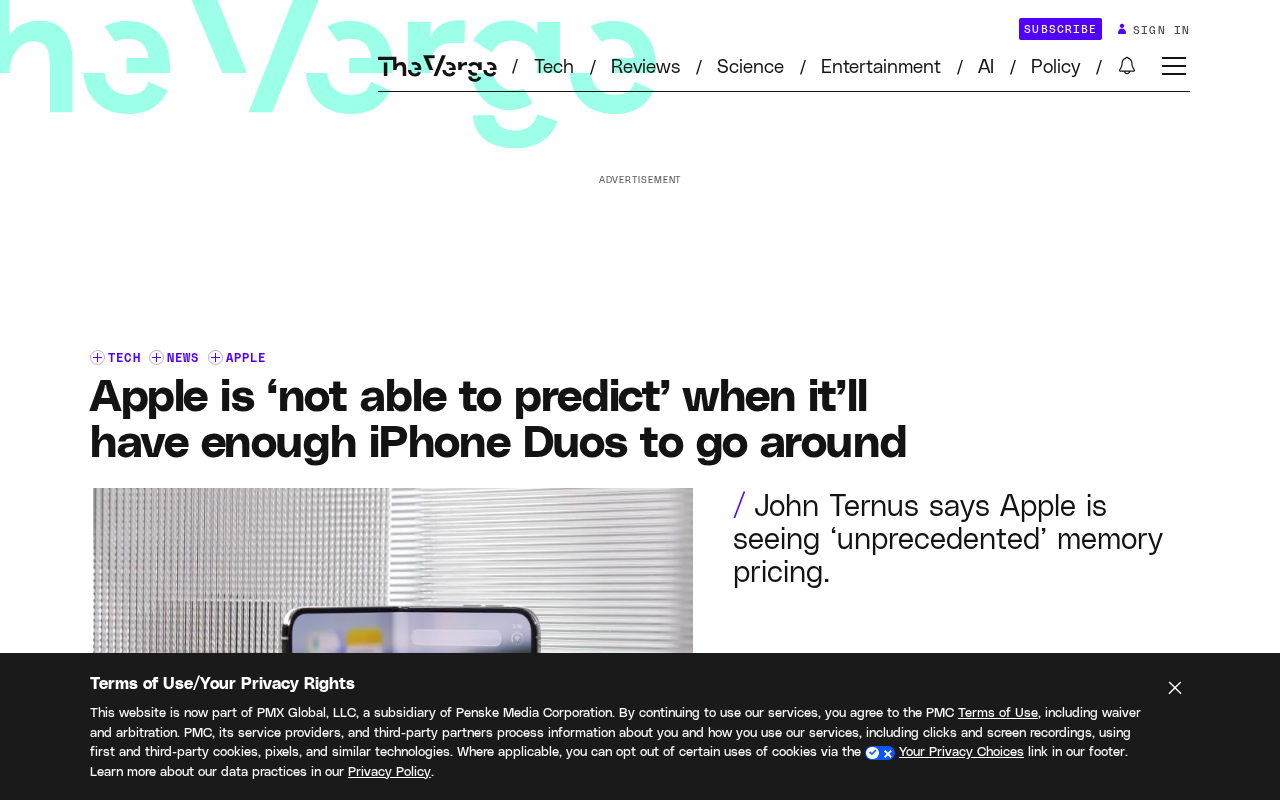
In the interview, Ternus acknowledged that Apple is "working to get products to as many customers as possible as quickly as we can," but "at this point, we can't predict when supply and demand will match." This wording is consistent with Apple's historically cautious stance on new product supply issues, yet the phrase "cannot predict" is still unusual. Typically, Apple provides a rough time window for supply chain recovery, and this vague response suggests that the iPhone Duo's production ramp-up may be more complex than expected.
Judging from market reaction, demand for the iPhone Duo has remained strong since its launch, with shortages appearing in many regions. Ternus's statement effectively confirms that the supply-side problem cannot be solved in the short term. For consumers eager to get the new device as soon as possible, this means a potentially longer wait.
Potential Causes of the Production Bottleneck
Although Apple has not disclosed specific details, industry context suggests that the iPhone Duo's supply constraints may stem from multiple factors. First, innovative designs for new products often require more complex manufacturing processes and stricter quality control standards, and initial yield rates take time to climb. Second, volatility in the global supply chain persists, and the supply stability of key components directly affects overall output. In addition, Apple's consistently high quality requirements may also slow the pace of capacity release.
Ternus emphasized that the company is "working hard," indicating that Apple is aware of the seriousness of the problem and is actively coordinating supply chain resources. However, the "cannot predict" wording suggests that achieving supply-demand balance in a short period will be difficult.
Production Ramp-Up and Yield Rates
In consumer electronics manufacturing, "production ramp-up" refers to the stage in which output gradually increases as a new product moves from trial production to mass production. The core challenge at this stage is "yield" — the proportion of qualified products in total output. Innovative designs for new products often introduce new processes and materials, and initial yields are usually low, requiring engineering teams to repeatedly adjust equipment parameters and optimize workflows. Every percentage point increase in yield means a large number of deliverable products. Apple's strict quality control requirements further lengthen the yield ramp-up cycle, because any minor defect may lead to scrapping or rework of the entire device. Therefore, even if the production line is already running, actual output may be far below theoretical capacity — this is the important technical background behind the supply-demand imbalance.
Knock-On Effects for Consumers and the Market
The direct consequence of the supply shortage is a decline in the consumer purchasing experience. Stockouts can lead to scalper markups and channel premiums, affecting brand reputation. For Apple, although short-term revenue may be suppressed by limited supply, strong demand also confirms the product's market appeal.
From a broader perspective, the iPhone Duo's supply problem also reflects the common challenge facing the consumer electronics industry in seeking a balance between innovation and mass production. As an industry benchmark, Apple's supply chain management capability has long been regarded as one of its core competencies, and this supply bottleneck is undoubtedly a test of its operational efficiency.
The Economic Logic of Scalpers and Channel Premiums
When official channels are out of stock, prices in the secondary market are often determined by the supply-demand gap. Scalpers obtain inventory through rush buying and stockpiling, then resell at prices above the official list price, with profit margins positively correlated with the degree of shortage. Channel premiums refer to the phenomenon in which authorized dealers or third-party retailers raise prices when supply falls short of demand. Although this dual-price system can meet some urgent demand in the short term, it undermines the uniformity of the pricing system, causes consumer dissatisfaction, and even breeds counterfeit goods and fraud risks. For brands, scalping is an intuitive signal of supply-demand imbalance; if it persists, it may weaken trust in official channels, so Apple typically compresses arbitrage space by increasing direct supply after production capacity improves.
Future Outlook: When Will It Be Available?
Ternus did not provide a clear timetable, but the industry generally believes that as production capacity gradually ramps up and supply chain coordination deepens, the supply-demand conflict is expected to ease within the next several quarters. However, this process is uncertain and depends on component supply, manufacturing yield, and changes in market demand.
For Apple, the immediate priority is to accelerate capacity expansion while managing market expectations. Ternus's candid statement may trigger short-term concerns, but it also shows that the company is facing the problem squarely. Consumers may need to be more patient, while Apple needs to prove through action its ability to resolve supply issues.
Key Points:
- Apple CEO Ternus says he cannot predict when iPhone Duo supply and demand will balance, and supply constraints may persist.
- The supply bottleneck may stem from complex design, supply chain volatility, and quality control requirements; production ramp-up takes time.
- Stockouts affect the consumer experience, but strong demand confirms the product's appeal, and Apple is working to coordinate its supply chain.
- The industry expects the supply-demand conflict to ease within the next several quarters, but uncertainty remains.
One-line Summary
Apple CEO says he cannot predict when iPhone Duo supply and demand will balance, and the production bottleneck may persist.
Paragraph Summary
In an interview with Reuters, Apple CEO John Ternus said the company currently "cannot predict" when iPhone Duo supply and demand will return to balance. This unusually vague statement suggests the production ramp-up is more complex than expected. The article analyzes that the supply shortage may stem from manufacturing difficulties caused by innovative design, global supply chain volatility, and Apple's strict quality control standards. Stockouts have already led to scalper markups and channel premiums, affecting the consumer experience, but strong demand also confirms the product's appeal. The industry expects the supply-demand conflict to ease within the next several quarters, but uncertainty remains, and Apple needs to accelerate capacity expansion and manage market expectations.
Related articles

9 AI Subscription Plans Compared: The Real Cost Per 100M Tokens Revealed
Bilibili creator tests 9 AI subscription plans from Volcano, Alibaba, Tencent, Baidu, Zhipu, Xiaomi, MiniMax and more, converting them all to real cost per 100M tokens, breaking down fixed-quota vs. three-tier coefficient billing and how caching, time-of-day discounts, and window limits affect actual quota.

Vibe Coding for Beginners: Expressing Intent Instead of Handwriting Code
What is Vibe Coding? A 137-episode Bilibili course defines it: the core is expressing intent, not writing code. This article analyzes Vibe Coding's productivity logic, target audience, and entry expectations to help beginners decide if it's worth learning.

LangChain Beginner's Guide: An Agent Development Roadmap from LangGraph to Deep Agents
Clarify the encapsulation relationship among LangChain, LangGraph, and Deep Agents, and master the learning path and selection logic for agent development frameworks—suitable for beginners in large model development.