Apple HomeView Smart Display First Review: Is $299 Worth It?
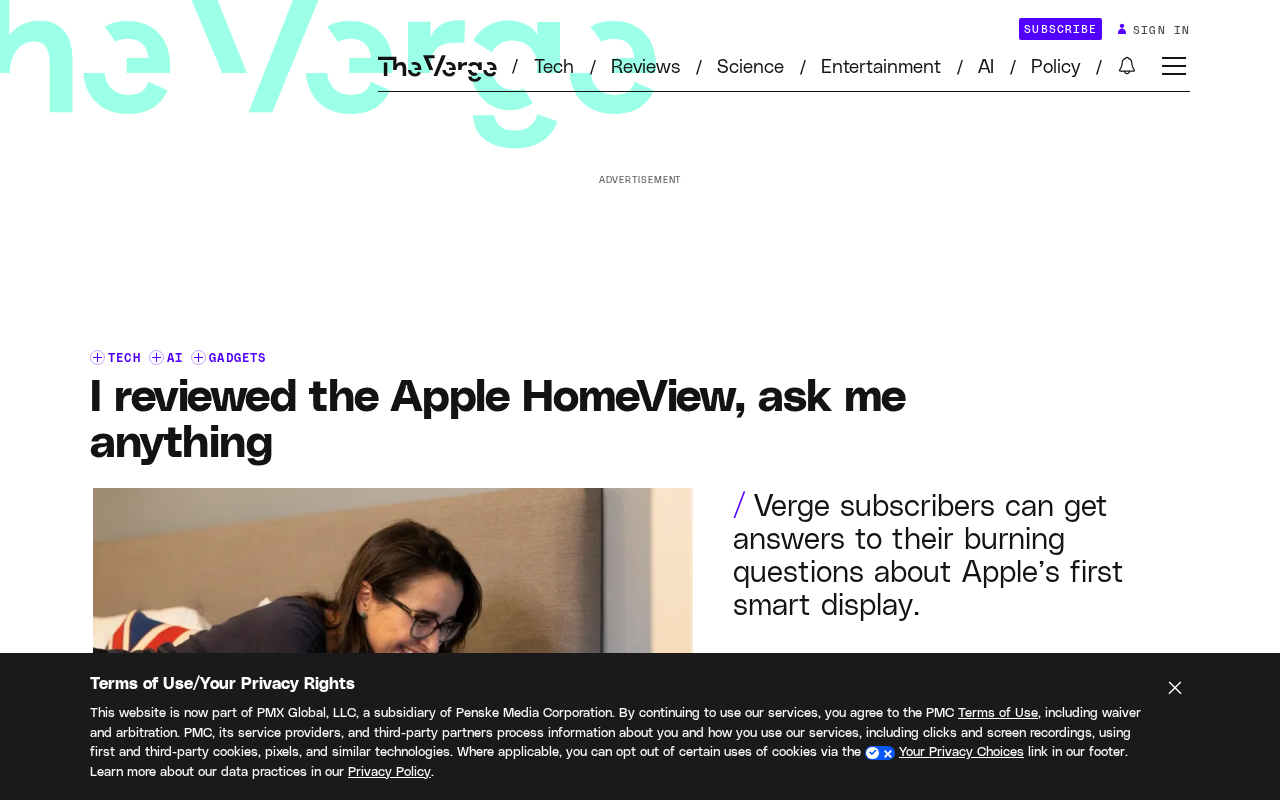
Apple's first smart display HomeView at $299, tested over a week across multiple scenarios
Apple launches its first smart display HomeView at $299, available in desktop and wall-mounted forms. The Verge senior smart home reviewer Jen Tuohy spent a week testing it across kitchen countertops, nightstands, and offices. Having tested every Amazon and Google smart display, she brings rich cross-comparison experience. The article analyzes HomeView's differentiated positioning: the $299 price reflects deep Apple ecosystem integration, more appealing to heavy HomeKit users. The biggest question is whether Apple can drive the smart display category toward becoming a home automation hub.
Apple has finally launched its first smart display—the HomeView, priced at $299. The Verge senior smart home reviewer Jen Tuohy spent a week deeply testing both the desktop and wall-mounted versions across multiple settings including kitchen countertops, nightstands, and offices. As an expert who has long tracked Amazon and Google smart displays, her perspective may help you decide: is Apple's entry redefining the category, or simply adding one more option?
Apple's Smart Display: Differentiation from a Latecomer
The smart display market is nothing new. Amazon Echo Show and Google Nest Hub series have gone through multiple generations, covering a complete product line from entry-level to high-end. Apple's launch of HomeView at this point is clearly not simple bandwagon-jumping.
According to Jen Tuohy's review, HomeView offers both desktop and wall-mounted forms, indicating Apple has given more careful thought to scenario adaptation. The $299 price point sits in the mid-to-high range, forming direct competition with mainstream market products.
One notable detail: Jen mentioned in her review that she has tested "every single" smart display Amazon and Google have ever made, so her assessment of HomeView is built on rich cross-comparison. This experiential backing makes her conclusions more valuable as reference—though unfortunately, the original material does not elaborate on specific feature comparison details.
Smart Display is a smart speaker with a touchscreen, typically centered on voice assistant interaction while supporting video playback, recipe viewing, video calls, and smart home control. Amazon Echo Show pioneered this category in 2017, with Google following with its Nest Hub series. Both have iterated through multiple generations covering 7-inch to 15-inch screens and a full product line from entry-level to high-end. The core value of these devices lies in visualizing the "invisible" interaction of voice assistants and serving as a control panel for the home IoT. Apple enters at this point facing a market that has been educated to maturity but with slowing growth, and its differentiation space comes primarily from ecosystem integration rather than category innovation.
One-Week Test: How Does It Perform Across Scenarios?
Jen placed HomeView in multiple locations including kitchen countertops, nightstands, and offices, covering the most typical use scenarios for smart displays. The kitchen scenario corresponds to recipe viewing, timers, and video playback needs; the nightstand involves alarms, sleep monitoring, and voice assistant interaction; the office may test calendar management and video call capabilities.
The existence of the wall-mounted version is particularly noteworthy. It suggests Apple wants HomeView to be more than "a screen on a table"—it should integrate into walls and become a home control hub. This aligns with Apple's long-term smart home ecosystem strategy.
However, the original material only provides a review framework without disclosing specific performance, interaction experience details, or pros and cons analysis. For readers wanting to understand the actual user experience of HomeView, the firsthand details in the full review are key.
HomeKit is Apple's smart home framework launched in 2014, allowing users to uniformly control compatible lights, locks, thermostats, and other accessories through iPhone, iPad, HomePod, and other devices, with support for scene automation and end-to-end encryption. Compared to Amazon Alexa and Google Assistant ecosystems, HomeKit's advantage lies in privacy protection and seamless coordination between Apple devices, but its disadvantage is fewer compatible accessories and higher certification thresholds. A HomeKit hub device with a screen means users can directly view camera feeds and adjust accessory status on the wall without picking up their phone. This is also the key context for understanding HomeView's product logic—its value largely depends on the density of HomeKit devices in the user's home.
The $299 Pricing Logic and Market Positioning
$299 is not cheap in the smart display category. Both Amazon and Google offer lower-priced products, but Apple has never competed on low prices. HomeView's pricing more likely corresponds to: better screen quality, deeper Apple ecosystem integration (HomeKit, Siri, Apple TV, etc.), and potentially more refined design and build quality.
For users already deeply invested in the Apple ecosystem, HomeView's appeal lies in seamless integration—if you have HomePod, Apple TV, and numerous HomeKit devices at home, a screen hub that can coordinate all of them is worth more than $299 itself. But for cross-platform users, whether this price is reasonable requires more detailed review data to support.
Matter is a smart home interoperability standard jointly promoted by Apple, Google, Amazon, and others, officially released in 2022, aimed at breaking down platform ecosystem barriers so devices from different brands can work together across platforms. Apple is one of Matter's primary initiators, meaning HomeView could theoretically control third-party devices not certified by HomeKit through the Matter protocol, rather than being limited to the Apple ecosystem. However, Matter's adoption and actual compatibility still vary widely, and specific support levels should be based on product specifications. For users evaluating whether the $299 price is reasonable, the presence and depth of Matter support directly determines whether this device is an "Apple ecosystem exclusive accessory" or a "universal home hub."
Will the Smart Display Market Landscape Change?
The biggest question about Apple's entry into smart displays isn't about the product itself, but whether it can drive category evolution. Amazon and Google have accumulated years of advantages in voice assistants and content ecosystems, while Apple's strengths lie in privacy protection, device coordination, and consistency of user experience.
Jen Tuohy tested both desktop and wall-mounted forms in her review, which itself indicates Apple is trying to cover more use scenarios. If HomeView can achieve true differentiation in home automation control, it could evolve from "just another smart screen" to "the true entry point for smart homes."
But all of this depends on the product being stable and smart enough in actual use. The original material does not provide clear conclusions on this front, and interested users are advised to follow The Verge's full review.
Frequently Asked Questions
What smart home protocols does HomeView support? Judging from Apple's ecosystem strategy, HomeView likely deeply integrates HomeKit, but the original material does not explicitly mention support for other protocols.
What's the difference between the desktop and wall-mounted versions? Jen Tuohy tested both forms, but the original material does not disclose specific differences. Consult the full review for details.
Is $299 worth buying? It depends on how deeply you use the Apple ecosystem. For heavy HomeKit users, the value of device coordination may exceed the price itself; for cross-platform users, it's advisable to wait for more detailed comparative reviews.
Related articles
Benchmarking WorkBuddy's Five-Platform Strategy: How Agent Development Can Win Through Differentiated Competition
Starting from benchmarking WorkBuddy, this article analyzes differentiated competition strategies for general-purpose agent development: how five-platform full-stack capabilities (desktop/iOS/Android/H5/web) build job-hunting advantages, and how to leverage big tech products to understand underlying implementations.
Claude Gets Creative: 24 AI Projects Anyone Can Replicate
24 real Claude use cases: from Bluetooth phone finder and 8x faster Wi-Fi to 3D-printed bridges, cancer tools, and food allergy drug design—most free to replicate.
Fleetlayer: A Framework for Scheduling…
Fleetlayer: A Framework for Scheduling Multiple AI Agents Across Machines
Fleetlayer is a framework posted on Hacker News for running large numbers of AI Agents across multiple machines. This article analyzes its positioning, the core challenges of multi-machine multi-Agent scheduling, and the current competitive landscape and project maturity in the multi-Agent infrastructure space.