Benchmarking WorkBuddy's Five-Platform Strategy: How Agent Development Can Win Through Differentiated Competition
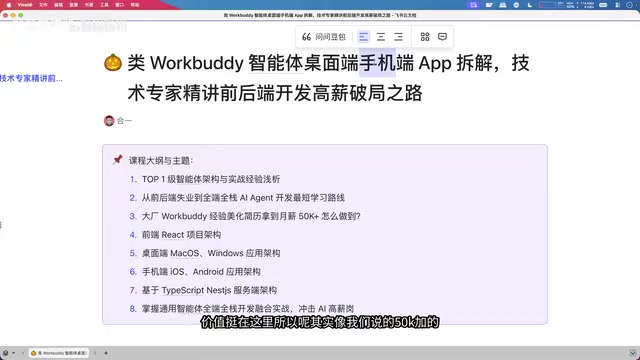
General-purpose agents are becoming a battleground for big tech; developers should compete through differentiation with five-platform full-stack skills and benchmarking big tech.
The article points out that general-purpose agents are becoming a core direction for big tech competition. Doubao's personal agent has entered public beta, and its token consumption ranks among the top domestic phenomenon-level products, reflecting real user demand and commercial value. For developers, learning the underlying implementation of general-purpose agents has more long-term value than staying at the application layer with AI knowledge bases and AI customer service. The author suggests taking a differentiated competition route: master the ability to integrate across desktop, iOS/Android, H5, and web platforms, combine it with server-side experience to form a distinctive label, and use standardized AI Coding practices to reuse one architecture across multiple platforms. It also emphasizes that "leveraging big tech" means benchmarking their underlying implementations rather than learning how to use them, with references such as WorkBuddy, Open Code, Py Agent, and GraphRAG. Business is extending toward Personal Agents, and AI transformation across enterprise departments requires versatile talents—the 50K+ salary reflects a talent gap where demand exceeds supply.
Why General-Purpose Agents Are Becoming the New Focus of AI Development
General-purpose agents are becoming a core direction that major tech companies are competing for. According to observations from a Bilibili creator in a video, Doubao's personal agent has already been released for public beta, and he predicted well before the Lunar New Year that this would be a fiercely contested area for all the major companies. The reason this type of product deserves developers' attention is that its token consumption ranks among the top domestic phenomenon-level products, reflecting genuine user demand and commercial value.
For developers, learning the underlying implementation of general-purpose agents has more long-term value than staying at the application layer with AI knowledge bases, AI customer service, and the like. The creator puts it bluntly: the latter has become "much harder"—both the technical barrier and the competitiveness are declining.
General-Purpose Agent refers to an AI system that is not limited to a single task and can autonomously plan and invoke multiple tools to complete cross-domain complex tasks. Unlike traditional task-oriented bots (such as customer service Q&A or document retrieval), general-purpose agents typically have memory, planning, tool-calling, and multi-round reflection capabilities, and can continuously execute tasks in open environments. Their technical foundation generally includes a large language model as the reasoning core, tool-calling protocols (such as Function Calling, MCP), and task decomposition and state management mechanisms. The high token consumption is precisely because these agents require multi-round reasoning, repeated tool calls, and context maintenance—a single task often consumes tens of thousands or even hundreds of thousands of tokens. That's why token consumption is often used as a metric for measuring the real depth of a product's usage.
Differentiated Competition: Full-Stack Five-Platform Capability Is the Key to Breaking Through
Multi-Platform Integration Creates a Differentiated Advantage
There are plenty of job postings in the recruitment market requiring "server-side development + Agent development experience," but competing head-on with backend engineers offers no obvious advantage. The creator suggests taking a differentiated competition route: master the ability to integrate across desktop, mobile (iOS/Android), H5, and web platforms, then add mini-program development experience. This five-platform full-coverage architecture, combined with server-side development experience, can give developers a distinctive differentiated label in job hunting.
The key is that you don't need to hand-write every platform from scratch; instead, master a standard, well-structured AI Coding approach and reuse one architecture across multiple platforms. In the video, the creator demonstrated a complete implementation based on Codex, covering macOS, Windows, Web, H5, iOS, and Android—one layer more than WorkBuddy with the mid-range application, totaling a standard five-platform product form.
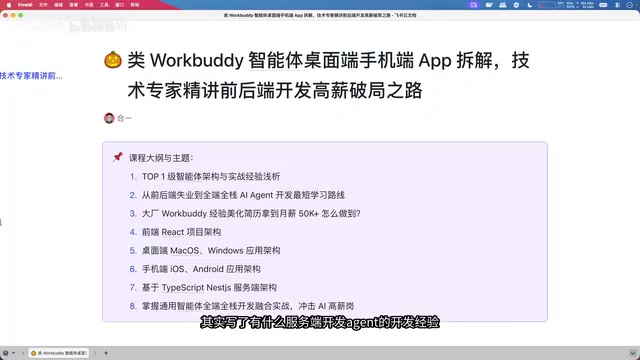
AI Coding in this context refers to a development approach that uses AI programming assistants (such as Codex, Cursor, Copilot, etc.) to complete code generation, refactoring, and cross-platform adaptation. Its core value lies in: developers describe requirements in natural language, and AI generates code that conforms to the target platform's specifications, greatly reducing the repetitive work of multi-platform development. A standardized AI Coding approach means developers can establish reusable prompt templates, architectural conventions, and component abstractions, allowing the same business logic to quickly adapt to different runtime environments such as macOS, Windows, Web, H5, iOS, and Android. This is precisely the technical prerequisite that makes "one architecture reused across multiple platforms" possible—AI handles the boilerplate code for platform-specific API differences and UI adaptation, while developers focus on architecture design and core logic.
Leveraging Big Tech: Benchmark Against, Don't Just Use
"Leveraging" is the second strategy the creator repeatedly emphasizes—see what big tech is doing and directly benchmark against their product implementations. For general-purpose agents, benchmark WorkBuddy; for coding agents, benchmark the open-source project Open Code; for the underlying execution engine, study Py Agent; for the knowledge base direction, refer to solutions like AmWiki, Ontology, and GraphRAG. In the AIGC space, you can look at Jimeng's short-drama canvas feature.

It's important to be clear: benchmarking is not the same as learning how to use it. An ordinary user learning to use WorkBuddy doesn't help with job hunting; what developers need to understand is its underlying implementation logic, how it adapts to all platforms, and how the architecture is designed. The creator stresses: "Even if you can't build it, you must look at and think about how WorkBuddy was made."
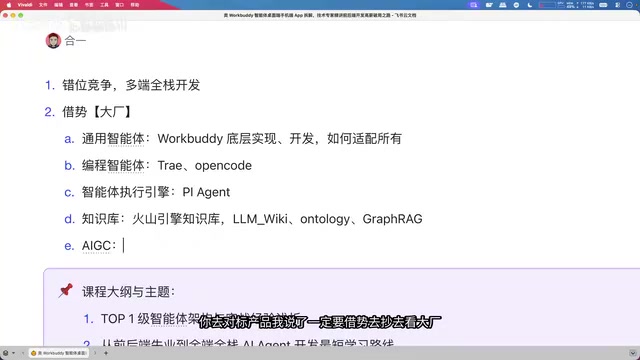
GraphRAG (Graph Retrieval-Augmented Generation) is a knowledge base solution proposed by Microsoft. It extracts documents into a knowledge graph of entities and relationships, then combines graph community summaries for retrieval. Compared with traditional vector RAG, it can better answer cross-document, global questions. Ontology is a formal description of concepts and their relationships in a certain domain, providing a unified semantic skeleton for the knowledge base so that data from different sources can be aligned and reasoned over. AmWiki is a lightweight open-source Wiki documentation system, often used as the front-end carrier for knowledge bases. These three correspond to the three layers of knowledge base retrieval augmentation, semantic modeling, and content management, respectively. Understanding their positioning helps developers judge the technology selection approach of big tech knowledge base products.
Personal Agent Trends and Talent Demand
The creator judges that business is extending toward Personal Agents and suggests developers plan ahead for next year's recruitment demand. AI transformation within enterprises is not limited to technical departments—employees in sales, operations, finance, and other roles all need to participate in AI-driven efficiency improvement, and versatile talents who can drive this process become highly valuable.
This is also why a 50K+ salary is "no exaggeration"—versatile talents are in high demand but short supply. On the surface, the recruitment market seems oversupplied and jobs hard to find, but the talent gap in high-value directions like general-purpose agents still exists. For developers, rather than engaging in involution in crowded tracks, it's better to use multi-platform full-stack capabilities and big-tech benchmarking experience to build their own competitive moat.
Related articles
Claude Gets Creative: 24 AI Projects Anyone Can Replicate
24 real Claude use cases: from Bluetooth phone finder and 8x faster Wi-Fi to 3D-printed bridges, cancer tools, and food allergy drug design—most free to replicate.
Fleetlayer: A Framework for Scheduling…
Fleetlayer: A Framework for Scheduling Multiple AI Agents Across Machines
Fleetlayer is a framework posted on Hacker News for running large numbers of AI Agents across multiple machines. This article analyzes its positioning, the core challenges of multi-machine multi-Agent scheduling, and the current competitive landscape and project maturity in the multi-Agent infrastructure space.
Fear of AI Is Spreading: A Technologist's Confession
A Hacker News post 'I'm Scared of AI' sparks debate with 212 points and 247 comments, showing AI anxiety spreading from the public into the tech community itself.