Claude Gets Creative: 24 AI Projects Anyone Can Replicate
A creator highlights 24 real Claude use cases spanning everyday pain points, hardware, healthcare, and research.
The article reviews 24 real Claude use cases from a creator's video, covering Bluetooth item finding, router tuning, family data audits, cancer report assistants, Lego manuals, CNC furniture, 3D-printed bridges, lab equipment control, tennis analytics, and food allergy design. Most include free tutorials, with users treating Claude as a collaborator rather than writing code from scratch. Three patterns emerge: shorter perceive-decide-execute loops, value in thinking through steps, and clear refusals with alternative paths.
A creator highlighted 24 real-world use cases of Claude in a video, ranging from finding a lost phone to designing a 3D-printed bridge that can bear weight, with almost every case including a link to a replicable project. What these cases share is that users don't need to write code from scratch—they treat Claude as a collaborator that can understand the physical world, operate tools, and generate executable plans.
From Everyday Pain Points to Hardware Modifications
Ranked 25th is a highly relatable case: someone whose company had disabled "Find My Device" simply had Claude design a Bluetooth signal tracker. The app displays signal strength in real time—as you walk around, the numbers climb—and ultimately helped the owner find their phone in the office. Similarly, the 21st user handed router photos to Claude, which logged into the admin panel, completed a backup, identified six settings dragging down network speed, and provided before-and-after comparisons for each one. After the changes, network speed improved roughly eightfold. The 20th user discovered their ISP was monitoring every website they visited in plaintext, so they had Claude build a free app that monitors the network while staying private—Mac and Windows only—running directly on an existing Claude subscription to save on API costs.
The hardware cases better demonstrate Claude's "cross-modal" capabilities. Someone built a lock-picking robot with a 3D printer, with two micro-sensors detecting resistance in each lock cylinder; Claude reads the data over Wi-Fi and decides the next action in real time—the maker invested over 200 hours in this machine. In another project, five AI models were asked to design a bridge with a two-foot span. After printing and load testing, Claude's version held about 130 pounds, while GPT's version managed only 17.5 pounds.
When AI Starts Handling Family Data and Health Issues
The 22nd case carries an obvious warning: someone connected their mother's iPhone backup to Claude Code for analysis and discovered that an iPad she'd given away two years ago had never been logged out—a stranger's device was continuously receiving photos and messages from family chats. It also uncovered an app reporting location every 15 minutes. This kind of "digital checkup" is especially valuable for helping parents inspect their devices.
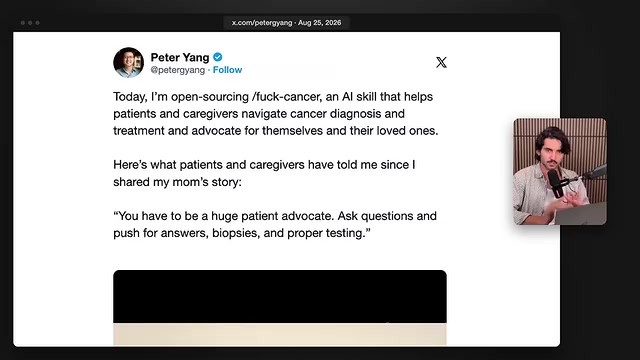
The 14th case is more somber. After creator Peter Yang's mother was diagnosed with cancer, he kept hearing the same advice: you must proactively ask questions and request more biopsies and tests. But reports, insurance, scans, and documents quickly become overwhelming. So he built a free tool where users submit existing reports and it generates action steps and summaries in plain language, pulling from trusted databases rather than random sources when verification is needed, with results synced to a Google Doc for the whole family to view. Its purpose isn't to replace doctors but to ensure you ask the right questions.
Design, Manufacturing, and Spatial Imagination
Claude also shines in design and manufacturing. One user had Claude design a Lego robot set, verifying the connections of 1,100 bricks one by one, generating step-by-step building instructions, and pricing each part for easy ordering. Another user converted a favorite table design into CNC cutting files, had it processed at a local woodworking shop and delivered—essentially using AI to draw and a factory to do "IKEA." Another project had Claude design an object, print it, then drive a robotic arm to remove the finished product from the printer—the maker said the hardest part turned out to be getting the arm to open the printer lid.
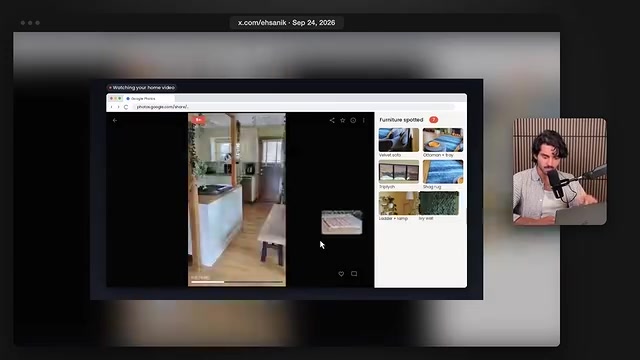
Spatial applications are also practical. Someone filmed a video of their existing furniture and, along with a Zillow listing link, gave it to Claude, which identified every piece of furniture, reconstructed the new house in 3D, and completed the layout—letting them preview moving in with their existing furniture ahead of time.
Penetration into Research, Education, and Professional Scenarios
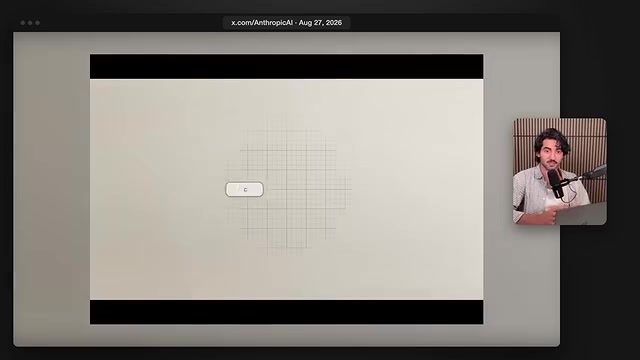
According to the video, a capability pushed by Anthropic itself has broken down software barriers between lab equipment: Claude can now drive microscopes, robotic arms, and lasers. Quantum computing company Q-era uses it to track lasers and correct drift, achieving 99% success rates without human intervention.
For learners, there's "anatomy here": describe a machine in one sentence and Claude generates a rotatable, disassemblable 3D model—jet engines, pressure cookers, gearboxes can all be taken apart, and it can even explain abstract concepts like "how websites remember things." Sports has also seen attempts: a tennis player filmed himself with a phone and tallied stats for every shot, then submitted them alongside equivalent data from professional players to Claude, which identified his weaker side without prompting and refuted the player's original suspicion about his forehand.
In medical and biological fields, the most striking is the food allergy project. About 200 million people worldwide are affected by food allergies, and existing drugs can only clear free-floating alarm tags in the blood—tags already attached to cells remain for weeks or even years. The lab Divergence wanted to create a "tiny hand" to remove the tags, and Claude generated about 35,000 design proposals for screening, with the final physical version validated against roughly 20 types of tags.
Common Threads Behind These Cases
Looking at these 24 projects together, several patterns emerge. First, the "perceive—decide—execute" loop is getting shorter: Bluetooth tracking, vehicle data dashboards, and router tuning that once required dedicated teams can now be built by one person plus Claude in a very short time. In the 10th case, a user plugged a cheap reader into their father's car, and with a single prompt Claude figured out how to communicate with the vehicle on its own, building a real-time dashboard in about five minutes.
Second, Claude's value often isn't in "writing the code for you" but in "thinking through the steps for you." Lock-picking robots, Lego manuals, and CNC cutting files are essentially translating vague requirements into executable engineering paths. Third, failures and boundaries are equally worth recording: someone wanted to recover deleted photos from an old iPhone, and Claude clearly stated it couldn't do that—but instead suggested checking other sync sources, ultimately recovering over 2,000 photos from a 2019 backup on their mother's laptop, including a video of their grandfather laughing in the garden.
Most of these projects come with free tutorials, and the barrier to replication is lower than you'd think. What's truly scarce isn't the tool but the awareness to transform a specific frustration into a problem AI can handle.
One-line Summary
A creator highlights 24 real Claude use cases, showcasing cross-domain capabilities from everyday pain points to hardware, healthcare, and research.
Paragraph Summary
The article reviews 24 real-world Claude use cases from a creator's video, covering Bluetooth item finding, router tuning, family data audits, cancer report assistants, Lego building manuals, CNC furniture manufacturing, 3D-printed bridges, lab equipment control, tennis data analysis, and food allergy design. Most projects include free tutorials, and users don't need to write code from scratch—they treat Claude as a collaborator that understands the physical world, operates tools, and generates executable plans. The author distills three common threads: the perceive-decide-execute loop is shortening; Claude's value lies more in "thinking through the steps" than simply writing code; and it will clearly refuse impossible tasks while offering alternative paths.
Related articles
Benchmarking WorkBuddy's Five-Platform Strategy: How Agent Development Can Win Through Differentiated Competition
Starting from benchmarking WorkBuddy, this article analyzes differentiated competition strategies for general-purpose agent development: how five-platform full-stack capabilities (desktop/iOS/Android/H5/web) build job-hunting advantages, and how to leverage big tech products to understand underlying implementations.
Fleetlayer: A Framework for Scheduling…
Fleetlayer: A Framework for Scheduling Multiple AI Agents Across Machines
Fleetlayer is a framework posted on Hacker News for running large numbers of AI Agents across multiple machines. This article analyzes its positioning, the core challenges of multi-machine multi-Agent scheduling, and the current competitive landscape and project maturity in the multi-Agent infrastructure space.
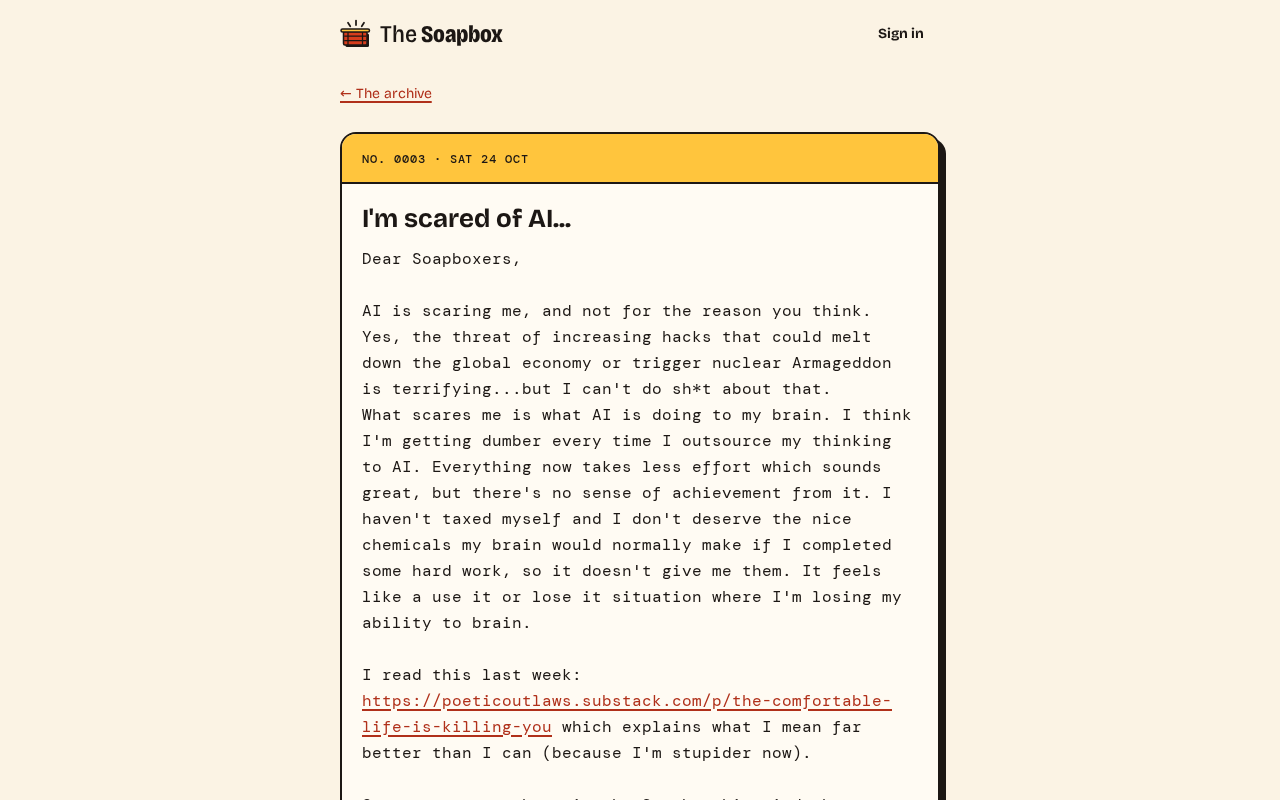
Fear of AI Is Spreading: A Technologist's Confession
A Hacker News post 'I'm Scared of AI' sparks debate with 212 points and 247 comments, showing AI anxiety spreading from the public into the tech community itself.