Fleetlayer: A Framework for Scheduling Multiple AI Agents Across Machines
Fleetlayer: A Framework for Scheduling…
Fleetlayer is a framework posted on Show HN for running many AI Agents across multiple machines, but details remain sparse.
The article introduces Fleetlayer, a new project in Hacker News' Show HN section positioned as a framework for running large numbers of AI Agents across multiple machines. The author notes that as Agents move from demos to scale, single machines hit compute bottlenecks and single points of failure, necessitating infrastructure capabilities like task distribution, state and context management, and deployment scaling. Fleetlayer belongs to the runtime and scheduling layer of the multi-Agent ecosystem rather than the collaboration orchestration layer—a layering valuable for scaling upper-layer applications. However, the post has very low engagement (7 points, 2 comments), technical details are not yet public, and the project is at a concept-first stage. The article suggests supplementing architecture explanations, getting-started guides, and deployment cases, and advises developers to stay attentive and evaluate cautiously.
In the Show HN section of Hacker News, a new project called Fleetlayer was submitted, positioned as "a framework for running large numbers of AI Agents across multiple machines." Although the post didn't gain much traction (7 points, 2 comments), it touches on a real pain point in today's AI engineering landscape: when Agents move from demos to scale, running on a single machine is no longer enough.
Why We Need a "Multi-Machine Multi-Agent" Framework
Deploying a single AI Agent is relatively simple, but once the numbers go up, problems emerge. Each Agent needs inference resources, tool-calling capabilities, and state management, and must also coordinate with other Agents. Piling all of this onto one machine leads to compute bottlenecks and single points of failure. Fleetlayer's approach is to distribute Agent workloads across multiple machines, forming a scheduling layer—the word "Fleet" in the project name hints at this design orientation.
From an industry trend perspective, discussions around multi-Agent systems are shifting from "can it run" to "how to run it reliably." Fleetlayer's timing aligns precisely with this shift in focus.
AI Agent typically refers to a software entity driven by a large language model that can autonomously plan steps, call external tools, and loop until a goal is achieved. Unlike single-turn Q&A, an Agent maintains a growing context during execution (conversation history, tool return results, intermediate reasoning) and may issue multiple concurrent model requests. This loop of "model calls + tool calls + state accumulation" makes the resource overhead of a single Agent far higher than ordinary API requests, which also explains why a single machine struggles to handle them as numbers grow.
Single point of failure refers to a situation where the failure of one component in the system renders the whole unavailable. When Agents are deployed on a single machine, if that machine goes down or the inference service is overloaded, all Agents on it are interrupted simultaneously; distributed deployment can reduce overall availability risk by spreading Agents across multiple nodes and rescheduling them when a node fails.
Potential Design Directions for the Framework
The original material says little about Fleetlayer's specific implementation, but the description "running large numbers of Agents across multiple machines" itself points to several key design questions:
- Task distribution: How to route Agent startup and execution requests to different machines while avoiding overloading certain nodes;
- State and context management: How intermediate state and tool call results generated during Agent execution are passed between nodes or persisted;
- Deployment and scaling: Whether the framework provides a unified deployment method and whether it can increase or decrease the number of Agents on machines based on load.
These are core issues that any multi-machine Agent framework must address. Whether Fleetlayer can provide satisfactory answers will require more technical details to be made public before we can judge.
State persistence is especially critical in multi-machine Agent scenarios: an Agent's context window is limited, and long tasks require writing history and intermediate results to external storage (such as databases or object storage) so that execution can be resumed after switching machines, restarting, or scaling. Common practices include assigning a unique identifier to each Agent and saving its state snapshots and checkpoints in shared storage, based on which the scheduler decides on which node to resume execution.
Scaling in this context refers to dynamically increasing or decreasing the number of running nodes based on the number of pending Agents or queue depth. Unlike stateless web services, Agent instances are stateful; when scaling up, one must decide where new instances load context from, and when scaling down, one must safely migrate or persist running tasks—this is also one of the main difficulties in multi-machine framework design.
The Competitive Landscape of Multi-Agent Infrastructure
Fleetlayer does not appear in isolation. Around multi-Agent orchestration and infrastructure, multiple directions are already advancing in parallel: one category focuses on collaboration orchestration between Agents, another focuses on the runtime and deployment layer. Fleetlayer clearly belongs to the latter—it doesn't solve "how Agents think" but rather "where Agents run and how they are scheduled."
This layering is valuable for the entire ecosystem. When the runtime layer is mature enough, upper-layer Agent applications can more easily scale. However, projects in this space generally face the same problem: concepts come first, implementation details lag behind. Fleetlayer is currently at this stage as well.
Observations on Community Feedback
The Show HN post has limited engagement (2 comments), indicating the project has not yet sparked broad discussion. For infrastructure projects, this is not unusual—they are less intuitive than application-layer products and require technical documentation and examples to build trust. If Fleetlayer can supplement architecture explanations, quick-start guides, and reproducible deployment cases, it will be better positioned to attract early users and contributors.
Signals Worth Watching
For developers focused on AI Agent infrastructure, Fleetlayer offers a direction to observe: Agent execution is evolving from "a single process" to "a distributed fleet." This direction itself is reasonable, but the project's maturity remains to be verified. Whether it's worth investing in depends on whether it can present sufficiently clear designs for scheduling, state management, and deployment experience.
Until more technical materials are made public, staying attentive and evaluating cautiously is a prudent attitude toward such early-stage frameworks.
One-line Summary
Fleetlayer is a framework posted on Show HN for running large numbers of AI Agents across multiple machines, but details remain sparse.
Related articles

Benchmarking WorkBuddy's Five-Platform Strategy: How Agent Development Can Win Through Differentiated Competition
Starting from benchmarking WorkBuddy, this article analyzes differentiated competition strategies for general-purpose agent development: how five-platform full-stack capabilities (desktop/iOS/Android/H5/web) build job-hunting advantages, and how to leverage big tech products to understand underlying implementations.
Claude Gets Creative: 24 AI Projects Anyone Can Replicate
24 real Claude use cases: from Bluetooth phone finder and 8x faster Wi-Fi to 3D-printed bridges, cancer tools, and food allergy drug design—most free to replicate.
Fear of AI Is Spreading: A Technologist's Confession
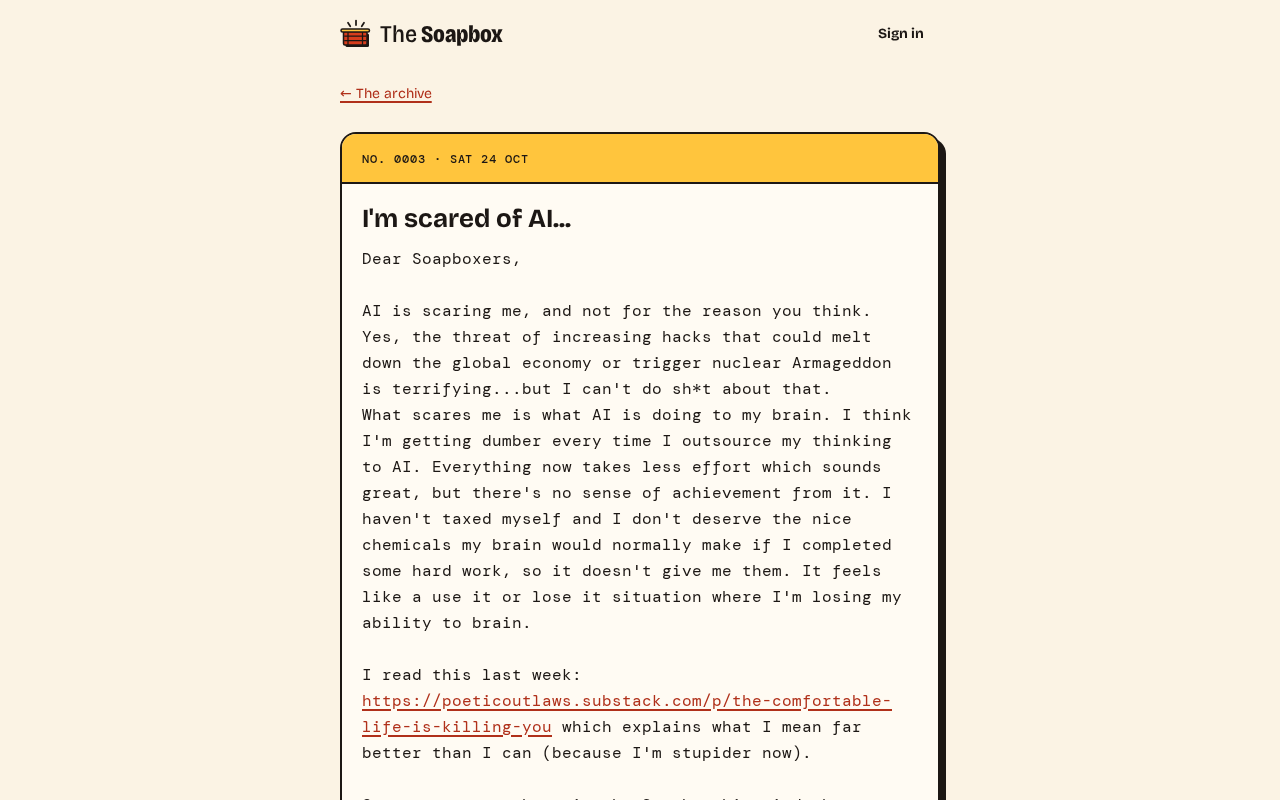
A Hacker News post 'I'm Scared of AI' sparks debate with 212 points and 247 comments, showing AI anxiety spreading from the public into the tech community itself.