Apple Launches New Apple TV 4K: Siri AI-Powered, No Remote Required
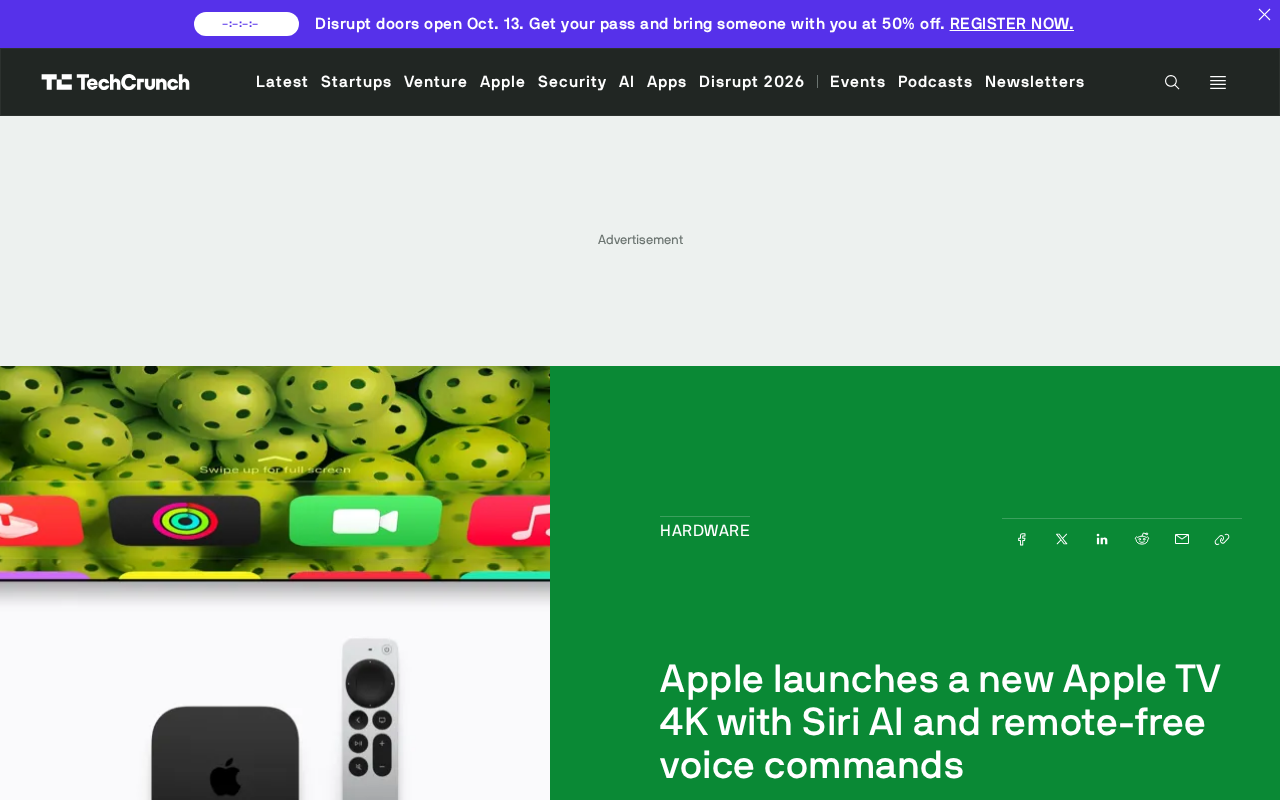
Apple launches the $299 new Apple TV 4K, with Siri AI and remote-free voice interaction as its core selling points.
Apple has introduced the new Apple TV 4K, priced at $299 and going on sale November 13. The focus of this upgrade is not hardware specs, but pushing Siri AI to the center of interaction: users can use voice to directly handle content search, playback control, and even cross-app operations, moving away from the habit of holding a remote. Apple hopes voice will become the lowest-friction entry point in living room scenarios, provided Siri can understand at a natural-conversation level. Pricing continues the premium route, targeting experience-sensitive users deeply embedded in the Apple ecosystem rather than trading low prices for volume. The launch timing also positions it for the year-end shopping season, as Apple aims to reignite market attention with an AI narrative.
Apple has made another move in the home entertainment hardware space. The new Apple TV 4K has officially arrived, priced at $299 and set to go on sale on November 13. The most striking change is that Siri AI has been pushed to the center of the interaction model—users no longer need to constantly hold a remote, as voice can directly handle content search, playback control, and even cross-app operations.
From Remote to Voice: A Shift in Interaction Logic
Previous generations of Apple TV upgrades mostly focused on picture quality and chip performance. Although the remote went through touchpad improvements, it was still fundamentally built around the idea of a "handheld device." The new "remote-free voice commands" mean Apple is attempting to elevate voice from an auxiliary feature to the primary interface.
The premise of this shift is that Siri AI's comprehension is now strong enough to support natural conversation, rather than the word-by-word matching of command-style interactions in the past. In the living room scenario, users often have their hands occupied—grabbing snacks, holding children, doing chores—making voice the lowest-friction way to operate. Apple's decision to strengthen voice at this particular moment reflects a reassessment of the pain points in home scenarios.
Siri is Apple's voice assistant, launched in 2011 alongside the iPhone 4S, and it relies on multiple layers of technology including speech recognition, natural language understanding, and dialogue management. Early Siri was primarily based on fixed-phrase matching, with low tolerance for variations in word order and expression—if a user's wording deviated from preset templates, it would easily fail. With advances in large models and on-device inference, the new generation of Siri has shifted to a semantics-first architecture, capable of handling more colloquial requests, context-dependent references, and even multi-turn follow-up questions. This is the technical prerequisite that gives Apple the confidence to upgrade voice from an auxiliary feature to the primary interface on a TV box.
tvOS is the TV operating system Apple developed for the Apple TV series, known for its app store ecosystem and deep integration with iPhone, iPad, and AirPods (such as AirPlay screen mirroring, Continuity, and serving as a HomeKit smart home hub). It is precisely this system ecosystem that constitutes Apple TV's differentiated moat among similar streaming boxes, and it is also the core basis for maintaining its high pricing.
The $299 Pricing Strategy
A $299 price tag is not cheap in the streaming box category. Apple TV has always taken a premium route, relying on the tvOS ecosystem, integration with iPhone, and picture quality to justify its premium. This price range means Apple has no intention of trading low prices for sales volume, but rather continues to target users who are experience-sensitive and already deeply invested in the Apple ecosystem.
The mainstream price band for streaming boxes is concentrated in the $30 to $100 range, with representative products including Roku, Amazon Fire TV Stick, and Google TV, which generally use low-cost hardware to secure entry points for content and services. Apple TV's pricing has long been significantly higher than this range, with its premium stemming from the tvOS ecosystem, an ad-free system experience, powerful chip performance, and seamless integration with other Apple devices. Therefore, the $299 price point essentially continues the existing premium positioning rather than participating in price competition.
Beyond Hardware
Judging from the launch information alone, the core selling point this time is the integration of software and AI capabilities, rather than simply stacking hardware specs. How well Siri AI performs on Apple TV will directly affect users' acceptance of the "remote-free" experience. If voice responses are fast enough and recognition accurate enough, it could change people's expectations for how a TV box should be operated; if the experience is unstable, it will instead amplify users' dependence on the remote.
The November 13 launch date also puts this product directly into the competitive window of the year-end shopping season. Apple clearly hopes to use the Siri AI narrative to reignite attention in the streaming hardware market.
Related articles

Cursor AI Programming in Practice: Build a Student Management System from Scratch in 30 Minutes
A Bilibili creator demonstrates Cursor AI programming: generating a student management system in 30 minutes with natural language. Details on Agent mode, Claude selection, prompt techniques, and thresholds.

Top 20 AI Coding Tools Ranking: From Rock-Solid to Lackluster, a Scored Matrix
Bilibili creator releases top 20 AI coding tools ranking, tiered T0–T4 from rock-solid to lackluster, with Claude Code and Codex tied at T0. This article details the scoring dimensions (capability, reliability, robustness, durability, cost, domestic availability) and tool performances to help developers choose the right AI coding assistant.

Vibe Coding Systematic Tutorial: Master AI-Assisted Programming from Zero
A three-month Vibe Coding tutorial from a Bilibili creator covering Codex, ClaudeCode, and Cursor, from core logic to commercial project practice for beginners.