Apple Releases Accessory Dimensional Drawings: The Invisible Foundation of Its Hardware Ecosystem
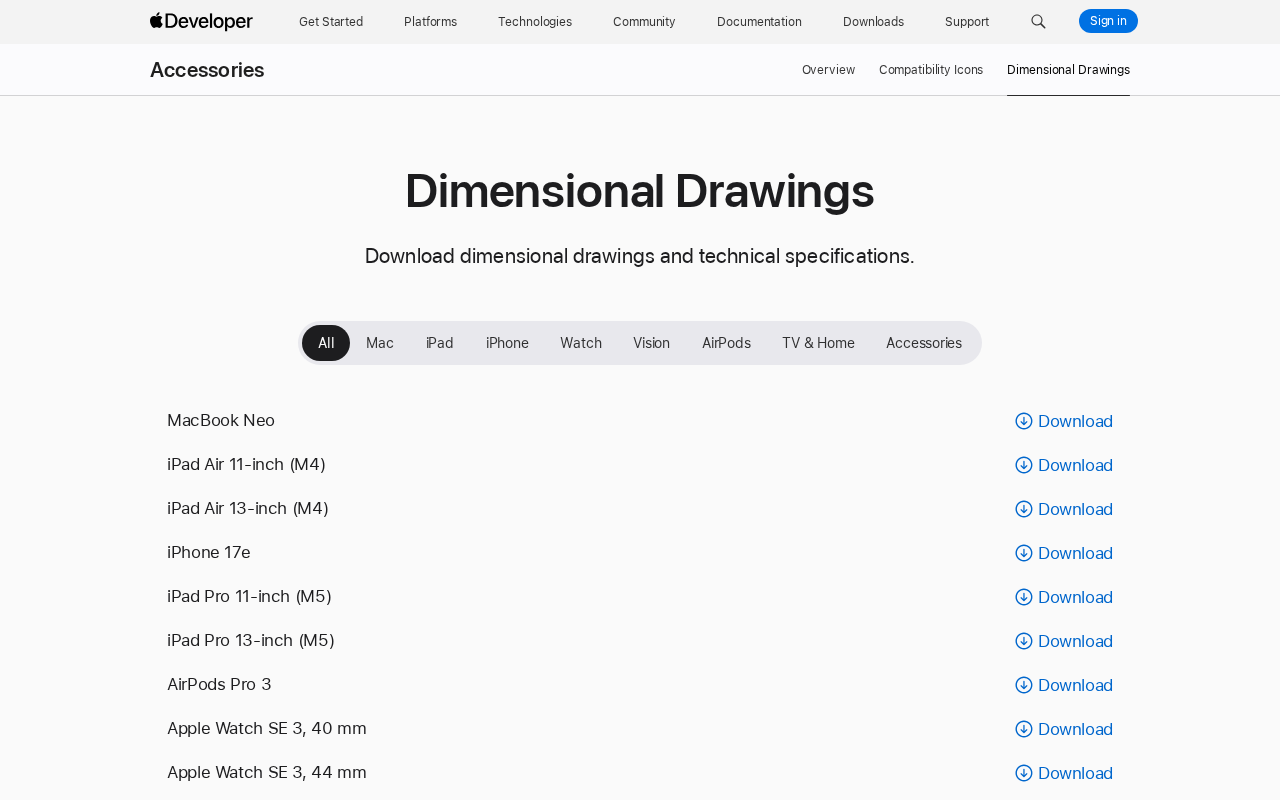
Apple publishes official device dimensional drawings on its developer portal, lowering the bar for third-party accessory development.
Apple has released Dimensional Drawings through its developer portal, providing third-party manufacturers with precise physical specifications for devices like the iPhone, iPad, and Mac. Previously, accessory makers relied on manual measurement or even 3D scanning — methods that were costly, slow, and error-prone. Official CAD-grade drawings eliminate that uncertainty, letting manufacturers model directly from authoritative data and accelerate the path from design to production. The move complements Apple's MFi certification framework and reflects its signature "limited openness" strategy: maintaining control over its brand and certification ecosystem while supplying the technical infrastructure that legitimate third-party creators need. The resource sparked active discussion on Hacker News, underscoring how closely the developer and hardware community follows the details of Apple's ecosystem.
Why Apple Is Publishing Accessory Dimensional Drawings
Apple has published a Dimensional Drawings resource through its developer portal, providing third-party accessory manufacturers with precise physical specifications for a range of Apple devices. The resource garnered 191 points and 73 comments on Hacker News, reflecting the ongoing interest among developers and hardware makers in the finer details of Apple's hardware ecosystem.
Dimensional drawings may seem like dry technical documentation, but they are the invisible foundation on which the entire accessory ecosystem runs. Any manufacturer looking to design a case, stand, or dock for an iPhone, iPad, Mac, or other Apple device needs accurate, millimeter-level data on the device's physical form. By publishing these drawings officially, Apple means third parties no longer need to reverse-engineer dimensions through manual measurement or teardowns.
What Dimensional Drawings Mean for the Hardware Ecosystem
Lowering the Barrier to Entry for Third-Party Accessories
Without official data, accessory manufacturers have typically had to purchase physical units, take repeated caliper measurements, and sometimes even use 3D scanning to reconstruct a device's shape. This approach is costly, time-consuming, and prone to human error — ill-fitting cases, misaligned cutouts, and unstable stands are all common consequences of dimensional inaccuracies.
The value of Apple's official drawings lies in removing that uncertainty from the process. Manufacturers can model directly from authoritative, CAD-grade data, shortening the time from design to mass production while improving fitment accuracy. This is especially critical for smaller accessory studios that typically lack the resources to measure every new device generation themselves.
Precision and Trust
Official publication also adds a layer of credibility. Accessory makers who cite Apple's own dimensional data can make stronger claims in their marketing and compatibility statements. For an ecosystem that relies on the MFi (Made for iPhone/iPad) certification framework, dimensional drawings are part of this standardized collaboration, helping Apple maintain a quality baseline across its vast accessory market.
What the Community Is Talking About
The high engagement on Hacker News signals that this resource addresses real pain points for developers and hardware enthusiasts alike. Discussions in the comments typically center on a few themes: whether the drawings cover all current and legacy models, whether the data formats are easy to import into mainstream CAD tools, and how Apple's openness around hardware information compares to other manufacturers.
Notably, Apple has historically maintained tight control over hardware details, so proactively publishing dimensional drawings reflects a careful balance in its accessory ecosystem strategy: preserving the exclusivity of its brand and certification system while providing the technical support necessary for legitimate third-party creation. This kind of "limited openness" is a hallmark of Apple's broader ecosystem approach.
Practical Value for Developers
For teams actively developing hardware accessories for Apple devices, this resource should be the first stop in the design process. Compared to self-measured data, official figures offer clear advantages in both precision and traceability. Designers can use the drawings as a modeling baseline and layer in their own tolerances on top, ensuring a proper fit without risking an assembly that's too tight.
For a broader audience, this serves as a reminder that a thriving hardware ecosystem depends not only on flagship products, but also on this kind of invisible infrastructure. Dimensional drawings, certification frameworks, and interface specifications together form the underlying protocol that allows tens of thousands of third-party products to exist.
Takeaway
Apple's release of accessory dimensional drawings is a quiet but practical move. It lowers the barrier to developing third-party accessories, improves fitment accuracy, and offers a glimpse into Apple's stance on hardware ecosystem openness. It may not be headline-grabbing product news, but it has a tangible impact on the day-to-day operations of the entire accessory supply chain — which explains why it sparked such lively discussion in the tech community.
Related articles

Hacker News Monthly 'What Are You Working On?' Thread: A Window Into the Developer Community
Hacker News's monthly 'What are you working on?' thread drew 180 upvotes and 558 comments. We explore why this community ritual persists and what it reveals about developer trends.

After Towns Cancel Flock Contracts: The Lingering Fallout of AI License Plate Recognition Cameras
Towns across the US are canceling Flock AI license plate camera contracts amid public backlash, but terminating contracts doesn't erase collected data. A look at the data retention risks that persist.

OpenArch: An Open-Source Project Reimplementing Modern LLM Architectures in PyTorch
OpenArch is an open-source PyTorch project reimplementing modern LLM architectures with a focus on clean, readable code. Learn about its value for learners and researchers.