Apple's $50 AI Usage Pack: The Emergence of Paid Intelligence

Apple launched a $49.99 AI usage pack in Logic Pro, as Apple Intelligence begins testing tiered paid usage.
Apple added a "Buy More Usage" option in a Logic Pro update, allowing a one-time payment of $49.99 for additional Apple Intelligence usage credits—the first explicit pricing of the AI feature usage limits described in its September support document. The article argues that choosing professional audio creation, a high-frequency, high-value scenario, for the trial is low-risk and allows observation of real willingness to pay, avoiding premature impact on ordinary iPhone users. For musicians and producers, the additional cost of AI features needs to be budgeted; in the longer term, if the "base allowance + paid expansion" model is replicated in other Apple applications or system-level features, it will reshape users' expectations of Apple Intelligence's free boundary. The editorial view notes that this marks Apple Intelligence's first step from an all-free selling point to a tiered paid service, and what needs attention next is how the quota is calculated, whether a subscription-based alternative emerges, and whether it will trickle down to mass-market product lines.
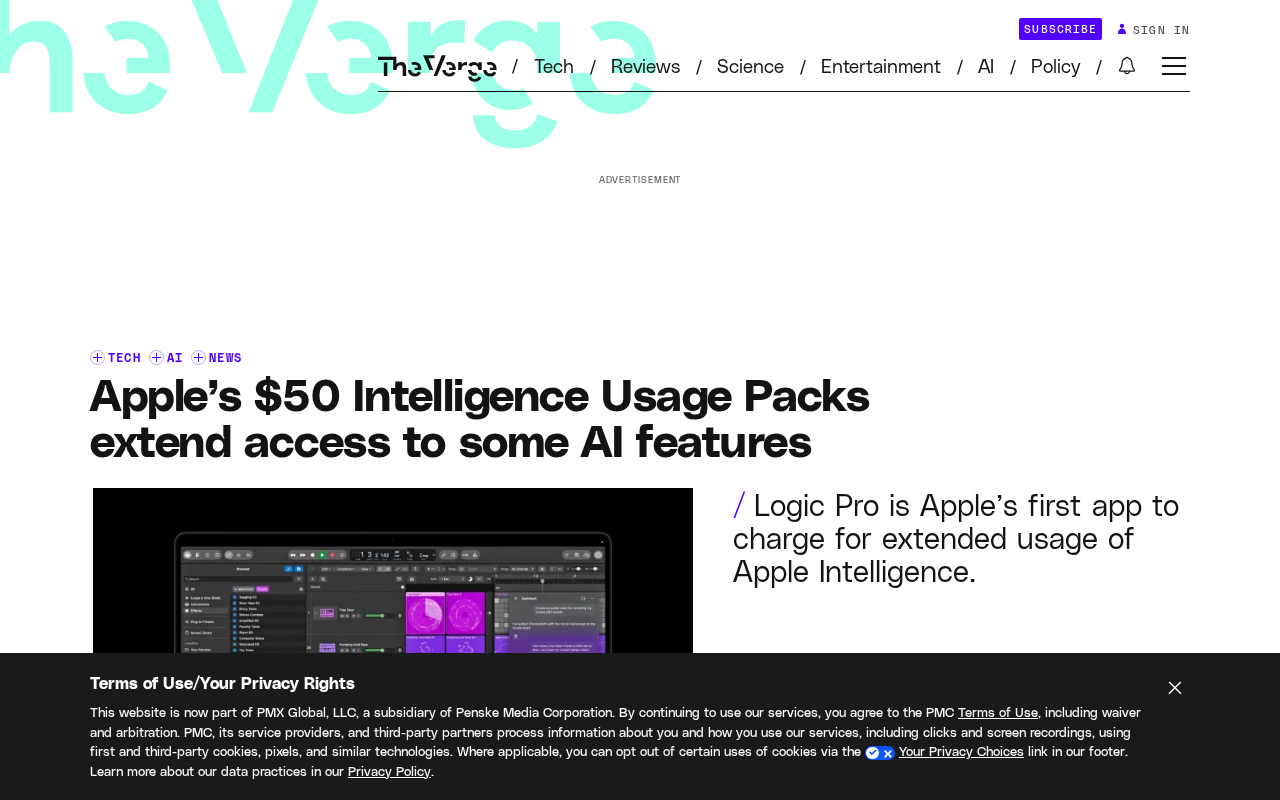
Apple is quietly testing the paid boundaries of Apple Intelligence. According to 9to5Mac, Apple added a "Buy More Usage" option in a Logic Pro update, allowing users to pay a one-time fee of $49.99 for additional AI feature usage credits.
From Free to Paid: Apple Intelligence's Usage Limits Surface
This change is not an isolated event. In early September, Apple published a support article specifically explaining that some Apple Intelligence features have usage limits. Logic Pro's "Buy More Usage" option is the first time this restriction strategy has appeared to users in the form of explicit pricing.
Logic Pro's built-in AI assistant can help users "start a new song, set up..." and other operations, and the additional usage pack means heavy users will need to pay for AI calls beyond the base allowance. The one-time pricing of $49.99 reveals Apple's judgment on the value of AI in professional creative scenarios—it does not intend to make high-intensity usage completely free.
Apple Intelligence is a set of system-level AI features announced by Apple at WWDC 2024, covering writing assistance, notification summaries, image generation (Image Playground), Genmoji, and an upgraded Siri, initially rolled out with iOS 18, iPadOS 18, and macOS Sequoia. Its architecture is characterized by the collaboration between on-device models and Private Cloud Compute: simple tasks are completed locally on the device, while complex requests are uploaded to Apple's self-built cloud servers, which promise not to retain data. For this reason, "usage" is not a purely abstract concept—every cloud inference incurs real computing costs. Apple initially offered Apple Intelligence for free as a device selling point, but as the features penetrate professional scenarios, setting quotas for high-frequency calls and monetizing them through usage packs is consistent with the tiered subscription logic of its cloud services (iCloud+, Apple One).
Why Logic Pro Is the First to Test the Waters
Choosing Logic Pro as the first product to implement paid usage is not hard to understand logically. Professional audio creation is a typical high-frequency, high-value scenario. Once features such as AI-assisted arrangement and material generation are integrated into workflows, users' depth of usage will far exceed that of ordinary consumer scenarios.
For Apple, testing a payment mechanism in a professional application allows it to observe real willingness to pay without prematurely angering ordinary iPhone users. This is a low-risk way to explore commercialization.
Logic Pro is Apple's professional digital audio workstation (DAW), with a large user base in music production, film and television scoring, and podcast post-production. In 2023, it also launched an iPad version and switched to a subscription model (about $4.99 per month). It has long been regarded as a representative of Apple's professional application matrix (Final Cut Pro, Motion, Compressor, etc.), with users who are accustomed to paying and sensitive to the marginal value of tool efficiency. Compared with mass-market services such as iCloud storage, professional creative software has a higher payment threshold, and users are more willing to pay for features that directly improve output efficiency. Therefore, testing AI usage packs in Logic Pro is equivalent to conducting a real pricing experiment among the group with the strongest willingness to pay and the highest tolerance for prices, and its data reference value is far higher than testing in free consumer applications.
Practical Impact on Users and Developers
Ordinary users are unlikely to feel the change directly in the short term, but the signal is clear: Apple Intelligence is not an unlimited free supply. For musicians and producers who rely on Logic Pro's AI features for their daily work, the additional cost needs to be factored into their budgets.
In the longer term, if this "base allowance + paid expansion" model is replicated in other Apple applications or system-level AI features, it will reshape users' expectations of Apple Intelligence. Apple's advance explanation of the limits in its support document and its provision of a purchase entry point in the application indicate that this mechanism has been designed internally rather than being an impromptu move.
"Base allowance + paid expansion" is currently the most mainstream commercialization paradigm for generative AI products: ChatGPT Plus, Claude Pro, GitHub Copilot, and others all adopt a structure of monthly subscription plus usage caps, with degradation or token-based billing after exceeding the limit. Apple currently chooses "one-time buyout of additional usage" rather than a subscription, and this design difference is worth noting—it is closer to the consumer mindset of "material packs" and "plug-in packs" in professional software, reducing users' decision pressure and unsubscribe friction. If it later shifts to a subscription model, it may be bundled with Apple One to form stable recurring revenue for system-level AI services. For third-party developers, if Apple in the future opens system AI capabilities to applications through frameworks such as App Intents, how the quota rules stack with developers' own subscriptions will directly affect their cost structure and pricing strategy.
Editorial View
Apple has always been good at turning free features into ecosystem stickiness and then converting high-value capabilities into revenue. The $50 usage pack currently appears only in Logic Pro, a single professional application, so its scale is limited, but it marks Apple Intelligence's first step from an "all-free selling point" to a "tiered paid service." What is worth watching next is how the quota is calculated, whether there will be a subscription-based alternative, and whether this model will trickle down to more mass-market product lines.
Sources: 9to5Mac's report on Apple's Logic Pro update, and Apple's support article published in September.
One-line Summary
Apple launched a $49.99 AI usage pack in Logic Pro, as Apple Intelligence begins testing tiered paid usage.
Paragraph Summary
Apple added a "Buy More Usage" option in a Logic Pro update, allowing a one-time payment of $49.99 for additional Apple Intelligence usage credits. This is the first explicit pricing of the AI feature usage limits described in its September support document. The article argues that choosing professional audio creation—a high-frequency, high-value scenario—for the trial is low-risk and allows observation of real willingness to pay, avoiding premature impact on ordinary iPhone users. For musicians and producers, the additional cost of AI features needs to be budgeted; in the longer term, if the "base allowance + paid expansion" model is replicated in other Apple applications or system-level features, it will reshape users' expectations of Apple Intelligence's free boundary. The editorial view notes that this marks Apple Intelligence's first step from an all-free selling point to a tiered paid service, and what needs attention next is how the quota is calculated, whether a subscription-based alternative emerges, and whether it will trickle down to mass-market product lines.
Related articles

AI and Mathematicians Collaborate to Prove the Riemann Hypothesis? The Controversy Behind 1.7 Billion Lines of Lean Code
AI and mathematician Levent Alpoge used 17 million lines of Lean code to prove the Riemann Hypothesis? An AnyGeometry definition sparked controversy, yet an independent audit says the logic holds. This article explains the Riemann Hypothesis, the Yes machine controversy, and the real impact on RSA encryption.

PeppermintOS Launches Void Edition: A Lightweight Experience Without SystemD or XLibre
PeppermintOS launches PepVoid based on Void Linux, featuring XFCE and XLibre with a non-SystemD architecture. This article covers installation, software center experience, preinstalled software, and technical verification for users interested in a lightweight non-SystemD distribution.

Clojure Native Apps: Letting AI Reshape Software at Runtime
Explore how Clojure enables native apps to be reprogrammed at runtime by developers or AI, drawing on Emacs' extensibility, and analyzing REPL-driven development, AI collaboration, and challenges.