Apple's Four New Macs Decoded: From Desktop Agents to Local LLM Workstations
Apple's four new Macs form a complete local AI ladder from desktop agents to 512GB LLM workstations.
Apple released four new Macs — from the $899 Mac mini M6 to the $5,499 Mac Studio M5 Ultra with 512GB unified memory and 1.2TB/s bandwidth. This article analyzes Apple's three-layer local AI strategy (always-on agents, local large models, multi-machine clusters), breaks down the memory budget for models from 70B to 671B parameters, and highlights the hidden costs in framework compatibility, training overhead, and operations that define the real gap between Mac workstations and AI servers.
On August 25, 2026, Apple launched four new Macs in one go. On the surface, this looks like a routine product refresh. But dig into the pricing and specs, and you'll find that what Apple actually delivered isn't a single "AI Mac" — it's a complete price ladder ranging from an $899 desktop agent to a $5,499+ local large model workstation.
What is this ladder designed to address? And what specific tasks does each tier unlock? This article breaks down Apple's vision for local AI across three dimensions: product segmentation, memory budgeting, and performance bottlenecks.
Four New Macs: An Upward-Climbing Price Ladder
This product lineup can be clearly divided into two categories across four tiers.
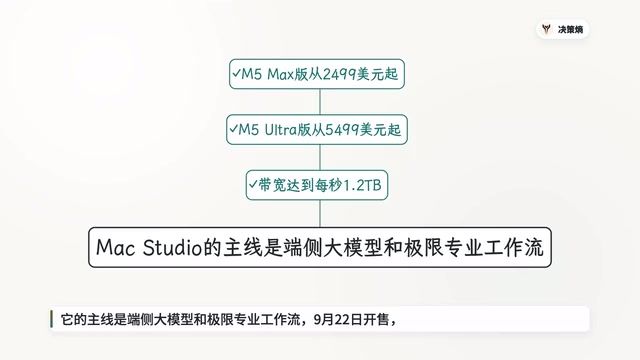
Mac mini is split into two tiers: the M6 version starts at $899 with up to 32GB of unified memory, positioned as an "always-on desktop agent"; the M5 Pro version starts at $1,995 with up to 64GB and adds Thunderbolt 5 ports, targeting larger local models and professional workflows. Both go on sale September 22, 2026.
Mac Studio pushes further up: the M5 Max version starts at $2,499 with up to 128GB; the M5 Ultra version starts at $5,499 with up to 512GB and memory bandwidth reaching 1.2TB per second. Its focus is on-device large models and extreme professional workflows, with the 512GB version expected to ship in late October.
You may not have noticed the overall price increase. Compared to the previous generation's U.S. launch prices, the entry-level model went from $599 to $899, and the Mac Studio Ultra went from $3,999 to $5,499 — increases of roughly 21% to 50% across all four tiers. With all four starting prices rising together, the AI price center for desktop Macs is clearly shifting upward.
Unified Memory: The Architectural Foundation of the Entire Product Line
Before unpacking the segmentation logic, it's essential to understand the hardware foundation of Apple's product line — Unified Memory Architecture (UMA). Since the M1 chip, Apple has used this design where CPU, GPU, and Neural Engine share the same physical memory pool. Any compute unit can directly access the entire memory space without copying data back and forth between CPU memory and GPU VRAM, as traditional PCs must do. In conventional architectures, data transfers between the two go through the PCIe bus, adding latency and wasting bandwidth. With UMA, model weights only need to be loaded once, and the GPU and Neural Engine can read them directly — dramatically reducing the traditional "not enough VRAM" bottleneck. This is why a 512GB Mac Studio can compete with multi-GPU servers equipped with hundreds of gigabytes of VRAM in data centers on the same class of inference tasks — it's not "borrowing" system memory; all compute units natively share the same memory pool.
Apple's Three-Layer Vision for Local AI
Behind the pricing lies Apple's layered logic for local AI capabilities.
From Always-On Agents to Multi-Machine Clusters
The first layer is always-on agents, prioritizing low power consumption and continuous operation — this is the "desktop" position occupied by the Mac mini M6. The second layer is local large models, where the core requirement shifts to memory capacity and bandwidth for enterprise-grade throughput, corresponding to the high-memory Mac Studio workstations. The third layer is multi-machine scaling, using Thunderbolt 5 to link multiple devices into inference clusters.
The hardware upgrades serve this logic entirely. The new chips place neural accelerators directly inside the GPU — meaning Apple has likely integrated dedicated neural compute units into the GPU's streaming processor array in a manner similar to NVIDIA's Tensor Cores. Apple's Neural Engine has existed as an independent unit since the A11 Bionic chip, specifically accelerating deep learning operators like matrix multiplication and convolution. In the traditional design, the Neural Engine was physically isolated from the GPU, each with its own scheduler. The new fused architecture reduces the overhead of moving data between different compute units, allowing the GPU to interleave neural network inference while executing general-purpose computation, significantly improving die area efficiency and real-world throughput. This is one of the architectural foundations behind Apple's claim that the M5 Ultra's peak AI compute is 4.3 times that of the M3 Ultra.
The M5 Ultra's memory bandwidth is 50% higher than the M3 Ultra's; Mac Studio can also use Thunderbolt 5 for direct data transfer to form clusters, with Apple claiming four-machine distributed inference can achieve up to three times the performance of a single machine.
Thunderbolt 5 is based on the USB4 V2 specification, with a single-port bidirectional bandwidth of 80Gbps, and up to 120Gbps upstream in asymmetric mode — more than double Thunderbolt 4's 40Gbps. The core challenge of multi-machine inference is inter-node data synchronization: tensor parallelism in large models requires exchanging intermediate activation values after each layer's computation, making it extremely sensitive to latency and bandwidth. Traditional data centers solve this with InfiniBand or high-speed Ethernet (100/400GbE). While Thunderbolt 5's absolute bandwidth still falls short of InfiniBand's 400Gbps, it dramatically lowers the barrier for networking desktop devices — no switches, no dedicated NICs, just direct connections to form a small inference cluster. Apple's claim of "up to three times single-machine performance with four-machine distributed inference" implies roughly 75% parallel efficiency, which is a remarkable figure for desktop-level interconnects.
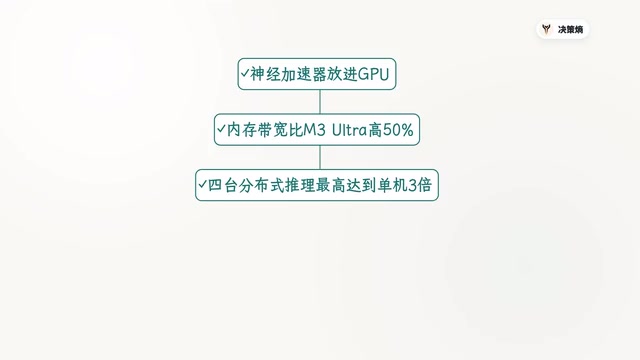
In one sentence, the three upgrade pillars of this generation of Macs are: compute, bandwidth, and scaling.
The Memory Ledger: Capacity Determines How Large a Model You Can Run
This segmentation is first and foremost defined by a model's "memory budget."
Weight Quantization and Capacity Thresholds
Weight quantization is the technique of compressing model parameters from high-precision floating-point numbers (such as FP16 at 16 bits, with each parameter occupying 2 bytes) down to lower bit widths (such as INT4 at 4 bits, with each parameter occupying roughly 0.5 bytes). Popular quantization methods include formats like GPTQ, AWQ, and GGUF, which use different mathematical strategies to balance precision loss against compression ratio. Quantized models perform comparably to original models on most conversational and reasoning tasks, but may exhibit perceptible quality degradation in scenarios requiring high-precision numerical reasoning. Common 4-bit quantization compresses each parameter to roughly half a byte. By this calculation:
- 70-billion parameter model: Theoretical weight size of ~35GB. Official low-bit versions like GPT-OSS can run within 80GB, so 64GB to 128GB covers two tiers of commonly used low-bit models.
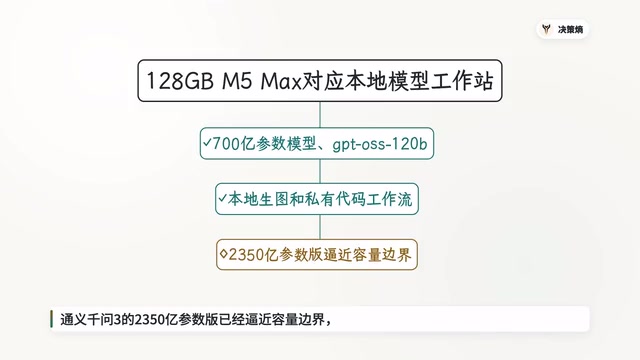
- Qwen 3's 250-billion parameter version: The 4-bit weight floor is ~118GB; after accounting for OS overhead and KV cache, 128GB is already quite tight.
- Full DeepSeekAd R1 (671 billion parameters): The 4-bit weight floor is ~336GB; the previous-generation M3 Ultra's tested peak was ~392GB. At this scale, 512GB becomes the decisive resource.
But capacity is only the first hurdle. The operating system, runtime, and KV Cache all consume unified memory. KV Cache (Key-Value Cache) is the core optimization mechanism of the Transformer architecture during autoregressive generation: each time the model generates a new token, it needs to perform attention computation over all previous tokens; if recalculated from scratch each time, the time complexity grows quadratically with sequence length. KV Cache works by caching the already-computed Key and Value vectors from each attention layer, so subsequent generation only needs to compute attention for the new token. The trade-off is that memory usage scales proportionally with "number of layers × number of attention heads × context length × precision." For a 70-billion parameter model with 80 layers and 64 attention heads, the KV Cache for a 16K context could consume tens of additional gigabytes. The longer the context and the higher the concurrency, the greater the consumption. Being able to load the weights only means you can start the model; the remaining headroom determines your context length and concurrency capacity.
Speed Is What Really Separates the Tiers
If capacity determines "can it run," then speed determines "does it run well."
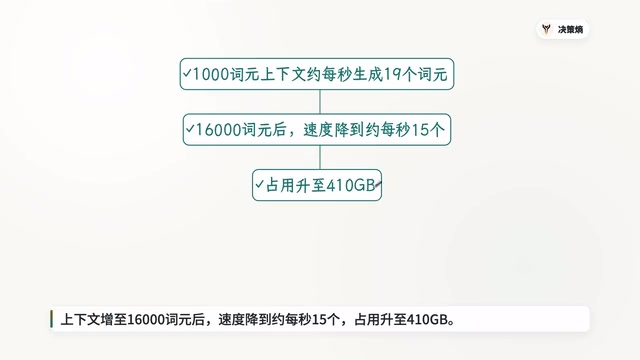
According to real-world benchmarks, the M3 Ultra running 4-bit DeepSeek R1 at a 1,000-token context generates approximately 19 tokens per second, using 392GB; when the context extends to 16,000 tokens, speed drops to approximately 15 tokens per second, with usage rising to 410GB.
This speed is sufficient for single-user interaction, but service-oriented workloads care more about aggregate concurrent throughput. The M5 Ultra targets precisely these speed bottlenecks: Apple's internal tests show its peak AI compute is up to 4.3 times that of the M3 Ultra. However, independent testing with the same model, quantization, and context will have to wait until the first units ship. What truly distinguishes a workstation from a server is metrics like time-to-first-token, multi-user aggregate throughput, failure recovery, and cost per request.
Product Tiers Mapped to Specific Tasks
Place these metrics back into real-world tasks, and the product segmentation becomes crystal clear.
- M6 Mac mini: Day-to-day automation, small models, and a gateway to cloud-based agents. When the core model lives in the cloud, even older Macs can serve as an agent endpoint.
- 64GB M5 Pro: Larger local models, always-on operation, and high-speed networking.
- 128GB M5 Max: 70-billion parameter models, local image generation, and private code workflows fall within this capability tier. Running Qwen 3's 25-billion version on 128GB is a "tight fit, not a comfortable one."
- M5 Ultra (512GB): Running hundreds-of-billions-parameter models locally, keeping data on-device, and sustained high-frequency machine utilization. Only under these conditions can you amortize the $5,499+ fixed cost.
For users who already own an M3 Ultra, the capacity remains the same; the upgrade value centers primarily on the actual speed gains once units ship.
Hidden Costs Beyond the Spec Sheet
It's worth noting three categories of costs that are easily overlooked beyond the spec sheet:
- Framework compatibility: New models may need to wait for framework adaptation before they can run efficiently. Apple's ecosystem primarily relies on Core ML and MLX frameworks, while open-source models are typically optimized for CUDA first. Porting a newly released model from PyTorch/CUDA to MLX or Core ML can take days to weeks, during which users can only use unoptimized generic inference paths with potentially significant performance penalties.
- Training overhead: Full training of hundred-billion-parameter models requires storing gradients, optimizer states, and intermediate activations, with memory demands far exceeding inference. Using mixed-precision training with the Adam optimizer as an example, each parameter requires an FP16 weight copy (2 bytes), an FP32 master weight copy (4 bytes), FP32 first-moment estimates (4 bytes), and FP32 second-moment estimates (4 bytes) — totaling approximately 14 bytes per parameter, which is 28 times the 0.5 bytes used during 4-bit quantized inference. Add in the intermediate activations that must be retained during backpropagation (proportional to batch size and sequence length), and full-parameter training of a 70-billion parameter model could require over 1TB of memory. Even though the 512GB Mac Studio Ultra excels at inference, full model training remains the domain of data center-grade GPU clusters.
- Operations overhead: Serving multiple users requires monitoring and failover. Once a Mac workstation takes on a server-like role, you need to consider load balancing, health checks, automatic restarts, log aggregation, and other operational infrastructure. Mature toolchains exist for this in traditional server ecosystems (such as Kubernetes and Prometheus), but solutions on macOS remain incomplete.
Software, training, and operations costs represent the true distance between a Mac workstation and a general-purpose AI server.
Conclusion: What's Really Been Upgraded Is Task Reach
With this release, Apple has built a task ladder for local AI: Mac mini turns always-on agents into a desktop capability, Mac Studio pushes single-machine model scale into the hundreds of billions of parameters, and Thunderbolt 5 extends compute to multi-machine inference.
What this generation of Macs truly upgrades is the task reach of local AI. And the boundary separating it from general-purpose AI servers is shifting from raw memory capacity toward concurrent throughput, software ecosystem, and operations infrastructure. If you ask how far Apple's new Macs are from being AI servers, the answer may not lie on the hardware spec sheet — but in the moat of software and operations that still needs to be built.
Related articles

Bilibili's Hit Dify Tutorial: A Practical Guide to Building 20+ AI Apps from Scratch
A distilled guide to Bilibili's top-rated Dify tutorial: Windows + Docker deployment, MySQL connection, five app types, model integration strategy, and publishing.

Agent Skills Beginner's Guide: From Concepts to Multi-Agent Collaboration in Practice
A comprehensive guide to Agent Skills: core concepts, components, the importance of Description, standardization, beginner learning paths, and multi-agent collaboration.

One Neuron Detects Both Cats and Cars? We Reproduced It and Found a New Explanation
The cat-car neuron reinterpreted: researcher Cammarata argues it distinguishes pointy from round, not cats from cars. We reproduced the experiment and found the new explanation holds on most inputs—but cars are the exception. The interpretability debate continues on language models.