Apple Synthesizes Robot Training Data, NVIDIA RTX 5090 Sets New Planning Speed Record

Robots move from demo to reliable tasks: virtual data, millisecond planning, and real-robot success rates define the capability frontier.
This issue's 14 news items show robotics moving from "can demo" to "can reliably complete tasks." Apple synthesized 300 hours of training data across 1,000 virtual homes, with Yushu G1 hitting 91% in 360 real-robot trials; NVIDIA's new motion planner cut computation to 4.43 ms and pick-and-place cycles by 34.6%. Manipulation agents near usability but still trail humans on hard tasks (60% vs. 90%), and long-horizon memory remains weak (20.4%). Three threads emerge: industrialized data production, compute sinking to control, and evaluation via repeated real-robot experiments.
Apple has synthesized large-scale training data for humanoid robots in virtual environments, while NVIDIA's new motion planning tool has pushed robotic arm computation down to the millisecond level. Meanwhile, Google and OpenAI have each made strides with new models, and robots capable of taking photos and brewing tea appeared at the China International Import Expo. The common thread across this wave of progress: robots are moving from "can demo" to "can reliably complete tasks."
Apple: 300 Hours of Training Data Synthesized Across 1,000 Virtual Homes
According to a roundup by Bilibili creator "Meteorite Briefing," Apple synthesized 300 hours of training data for humanoid robots across 1,000 virtual residential scenarios. Using this data, Yushu G1 learned movements such as turning sideways through doorways, ducking under tables, pushing boxes, and sitting down. In 360 real-world experiments spanning 6 physical environments and 6 individual task types (10 trials each), the average success rate reached 91%.
The significance of these results lies not in how flashy any single action is, but in the fact that the "virtual synthesis + real-robot validation" loop has been proven out. Using virtual homes to cover the diversity of real homes, then running real-robot re-tests against a unified task list, amounts to providing embodied intelligence with a scalable data production pipeline. The 91% success rate shows this data has transfer capability in real environments, but the 6 task categories remain fairly basic — performance on complex, long-horizon tasks is still to be seen.
Sim-to-Real transfer in embodied intelligence refers to the technical approach of generating training data in physics simulation environments and then transferring it to real robots for task execution. The core challenge is bridging the "reality gap" between simulation and the real world — differences in lighting, friction, sensor noise, and other factors can all cause policies to fail on real hardware. Common countermeasures include domain randomization (randomizing textures, mass, lighting, and other parameters) and system identification (calibrating simulation physics parameters to match the real system). Apple's synthesis of data across 1,000 virtual homes is precisely an effort to cover the distribution of real homes through scene diversity, thereby improving policy generalization. The 91% real-robot success rate indicates this loop has been preliminarily proven on basic tasks, but task complexity remains a key variable for transfer effectiveness.
NVIDIA: Average Planning Time of 4.43 ms on RTX 5090
NVIDIA released a new version of its robotic arm motion planning tool. In planning tests with a 3 kg payload, the RTX 5090 achieved an average computation time of 4.43 milliseconds; on real hardware equipped with an RTX 6000 Ada, the team recorded 53 complete pick-and-place cycles averaging 5.93 seconds each — a 34.6% reduction compared to the previous version.
Motion planning has long been one of the bottlenecks for robotic arm deployment: slow computation means cycle times can't go up; coarse computation means trajectories aren't safe. Millisecond-level planning time means higher layers can replan more frequently, enabling timely obstacle avoidance and course correction in dynamic environments. A pick-and-place cycle reduction of over 30% is a direct gain for production line takt time. The highlight here is that general-purpose GPU compute is being applied more deeply to low-level robot control, not just on the training side.
Motion planning is a classic problem in robotics: given a start pose and a goal pose, compute an executable trajectory while satisfying joint limits, obstacle avoidance, and dynamic constraints. Traditional algorithms such as RRT* and PRM often require tens to hundreds of milliseconds in complex scenes, making high-frequency replanning difficult. NVIDIA's key to pushing planning computation to the millisecond level lies in using GPU parallelism for sampling and collision detection — problems naturally suited to massively parallel processing. Millisecond-level planning allows robots to replan at higher frequency during execution, enabling timely responses to obstacle changes in dynamic environments. This directly relates to the "34.6% reduction in pick-and-place cycle time": faster planning means less waiting and higher throughput.
Manipulation Agents: From "Can Write" to "Can Run"
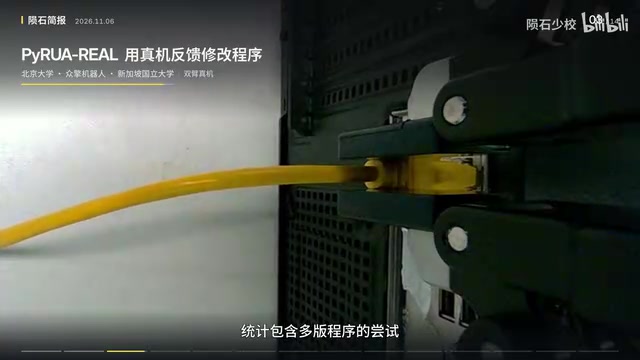
Peking University, Chongqing Robot Core, and the National University of Singapore collaborated to have coding agents write and modify robotic arm manipulation programs. Of 8 dual-arm real-robot tasks, 7 ultimately ran the programs the agents wrote; tasks like plugging in network cables still required assistance from an online agent. The average success rate during the development phase was 91.1%, including attempts across multiple versions of programs.
Berkeley, NVIDIA, and Siemens tested manipulation agents across 6 types of simulated workstations. Taking gear meshing as an example, with 30 instances each at two difficulty levels: at the harder level, the manual process achieved a 90% success rate while the automatically generated process achieved 60%. The team plans to open-source the code by November 9.
Looking at both efforts together, the conclusion is fairly clear: agents are approaching usability for "generating runnable programs," but on high-difficulty, tightly constrained fine manipulation, there remains a significant gap with human engineers. The 60% vs. 90% gap precisely marks the current boundary of automation capability.
Memory and Policy: Hierarchical Methods Still Have Notable Weaknesses
The Beijing Institute for General Artificial Intelligence, the University of Science and Technology of China, and other teams trained soccer policies that let Yushu G1 switch from trapping the ball to dribbling or shooting. Real-robot tests used off-field optical equipment to track the robot and ball; each of the four skills was tested 20 times, with an average trap time of 1.84 seconds and the ball traveling an additional 1.07 meters after contact.
Five universities including USTC and Tongji University tested robot memory across 9 simulated kitchen tasks: the robot had to put a cup back where it was before wiping the table, and remember how many drawers it had opened while searching for items. Training used 1,800 successful demonstrations; the hierarchical policy achieved an average success rate of 20.4% across the 9 tasks, while the π0.5 model achieved 16.2%.
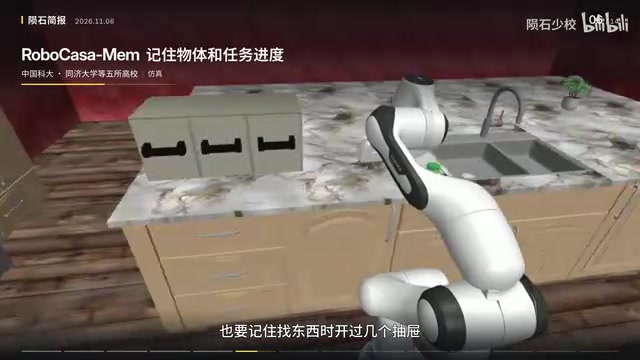
Success rates around 20% indicate that long-horizon memory and task state tracking remain hard problems for embodied intelligence. A robot being able to complete individual actions does not mean it can remember process information like "which drawers have I already opened." Hierarchical policies slightly outperform end-to-end models, but both are far from deployable.
Hierarchical policy decomposes complex tasks into two levels: high-level task planning and low-level action execution. The high level decides "what to do next" (e.g., open the drawer first, then find the cup), while the low level handles "how to do it" (e.g., how the arm moves to the drawer handle). This structure is theoretically better suited to long-horizon tasks because the high level can perform state tracking and subtask switching in an abstract space. However, hierarchical policy performance is highly dependent on the accuracy of high-level decisions — once a subtask is chosen incorrectly, no amount of low-level precision can recover. The 20.4% average success rate across 9 kitchen tasks shows that current hierarchical methods still have clear bottlenecks in long-horizon memory and state tracking, and the gap with end-to-end models (16.2%) indicates that neither approach is close to mature.
Simulation and Data: Cosmos and Haptic Gloves Fill Two Gaps
NVIDIA's new Cosmos model can predict the next segment of video based on robotic arm actions, and another model converts simulated depth and contours into color video. Replaying dual-arm actions on a single GB300, generating 640×352 frames through four denoising steps, the median latency per eight frames using the Tate Super decoder was 166 milliseconds. Weights and inference code for all three models are available for download on Hugging Face.
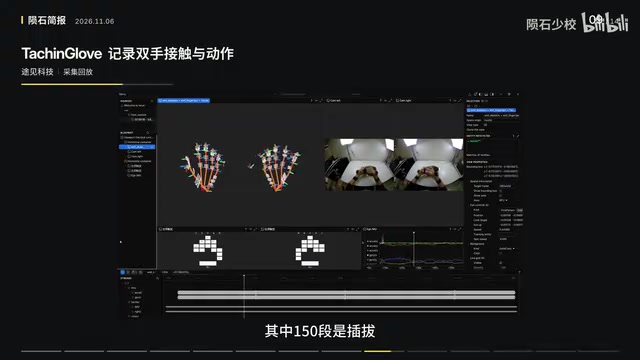
On the data collection side, Tujian Technology's haptic glove can synchronously record palm contact, fingertip poses, and first-person video. The team released 369 segments of human hand manipulation records across five task categories, of which 150 are insertion/extraction tasks; raw signals and corresponding dark video data are available for download for non-commercial use.
Additionally, Hugging Face released LeRobot 0.7: the robot runtime can switch subtasks, maintain connections, and carry over in-memory state; the new version also supports streaming demonstration data from the cloud, eliminating the need to download full datasets before training. Lowering simulation costs, adding a haptic dimension on the collection side, and simplifying data flow on the runtime side — all three point toward the same goal: making data acquisition no longer the most expensive link.
World models are generative models capable of predicting future observations based on current state and actions. NVIDIA's Cosmos predicts the next segment of video from robotic arm actions, essentially learning the dynamic evolution rules of the environment. The value of such models lies in two aspects: on one hand, they can serve as simulator substitutes to generate training data at low cost; on the other hand, they can be used for policy evaluation — predicting action consequences before real execution. Converting simulated depth and contours into color video reduces the visual gap between simulated data and real video, aiding policy transfer. The median generation latency of 166 milliseconds on a single GB300 indicates that world model inference is approaching usability, though there is still a gap to real-time closed-loop control.
Deployment in the Field: Import Expo and Warehousing
At the opening of the Shanghai China International Import Expo, a robot in the news center picked up a Polaroid, pressed the shutter, and handed the thin photo paper to a reporter. According to on-site reporting by Xinmin Evening News, the process from raising the camera to handing over the photo took about 40 seconds. In the rest area, volunteer robots also brewed Kung Fu tea for guests on the spot.
Cainiao announced in Hong Kong that it is opening its warehouse network to Jusheng Intelligent partners, conducting R&D, real-robot training, and business validation at actual workstations. Cainiao said previous pilots have involved package labeling, small-item sorting, and depalletizing; multiple companies have signed cooperation agreements with the first batch of enterprises. The value of robots entering warehouses lies not in demonstrations but in continuous operational data from real workstations — precisely the part that simulation cannot fully replace.
American humanoid robot company Agility Robotics has listed common stock and warrants on Nasdaq, with trading beginning November 5 under the ticker AGLT for common stock. The company said the merger and related financing raised approximately $465 million in total, before deducting transaction fees.

Google and OpenAI: Two Tracks — Video and Cybersecurity
Google DeepMind launched Gemini Omni 1.2 Flash, which can continuously modify the same video clip, natively generates up to 15 seconds, and produces 720p video at $0.07 per second — 30% cheaper than the previous version. Continuously modifying the same video clip means video generation is starting to move toward "editable workflows" rather than one-shot gacha-style generation.
OpenAI launched GPT-6 Cyber for cybersecurity research, initially available to select vetted Daybreak Red customers. In tests requiring exploitation of specified remote vulnerabilities, the model scored 48.5%, up from 32.1% for the previous generation. That's a substantial improvement, but still far from reliable — a success rate near 50% means the other half fails in security scenarios, and such models are better suited in the short term to assisting research than to automated attacks.
Common Threads in This Wave of Progress
Looking at 14 news items together, three main threads emerge: first, data production is being industrialized, with virtual synthesis, haptic collection, and streaming loading each solving a piece; second, low-level compute continues to sink into the control layer, with planning, rendering, and simulation all being GPU-accelerated; third, evaluation increasingly relies on repeated real-robot experiments — numbers like 91%, 60%, and 20.4% say more about capability boundaries than any demo video. The excitement in the robotics industry lies in demonstrations; real progress hides in success rates.
One-line Summary
Robots move from demo to reliable tasks: virtual data, millisecond planning, and real-robot success rates define the capability frontier.
Paragraph Summary
This issue's 14 news items show the robotics industry moving from "can demo" toward "can reliably complete tasks." Apple synthesized 300 hours of training data across 1,000 virtual homes, with Yushu G1 achieving a 91% average success rate in 360 real-robot experiments; NVIDIA's new motion planning tool pushed computation to 4.43 milliseconds and cut real-robot pick-and-place cycles by 34.6%. Manipulation agents generating programs are approaching usability, but the 60% success rate on hard gear-meshing tasks still trails the human 90%. Long-horizon memory remains a weakness, with hierarchical policies averaging only 20.4% across 9 kitchen tasks. On simulation and data, the Cosmos world model and haptic gloves fill in prediction and perception dimensions respectively. On deployment, Import Expo robots took photos and brewed tea, while Cainiao opened its warehouse network for real-robot training. Google and OpenAI iterated on video editing and cybersecurity models respectively. Overall, three threads emerge: industrialized data production, compute sinking to the control layer, and evaluation relying on repeated real-robot experiments.
Related articles

Gemini 4 Neon Review: Benchmark Scores Rival Carbon, API Pricing and Quota Breakdown
Google Gemini 4 Neon is now live, benchmark scores closely tracking Carbon, API pricing 3/15 at twice Hydrogen's rate. This article compiles Bilibili creator testing: Neon can replace 90% of Carbon scenarios, AntiGravity quota consumption is only one-third of Carbon, plus subscription channel restrictions and 2API ban risks.

Gemini 4 Helium Coming Soon? Signals of Google Loosening Subscription Restrictions
Google team member hints releases will continue; community speculates Gemini 4 Helium (Flash Lite) may be next. Subscription ban controversy gets a response as product lead says "Soon," suggesting restrictions may be lifted. This article covers Gemini developments, OpenAI Coding Agent and risk management, Doubao real-time audio-video API, and compute business dynamics.

AI-Assisted React Development in Practice: Optimizing a Video App and Handling Errors
A 14-year veteran developer demonstrates AI-assisted React video app optimization: compressing video from 80MB to 5MB (~94%) via ImageKit, plus reliable error handling and retry mechanisms. Includes planning, code understanding, and verification methods for working with AI.