Apple Teams Up with OpenEvidence to Study the Practicality of AI Health Tools
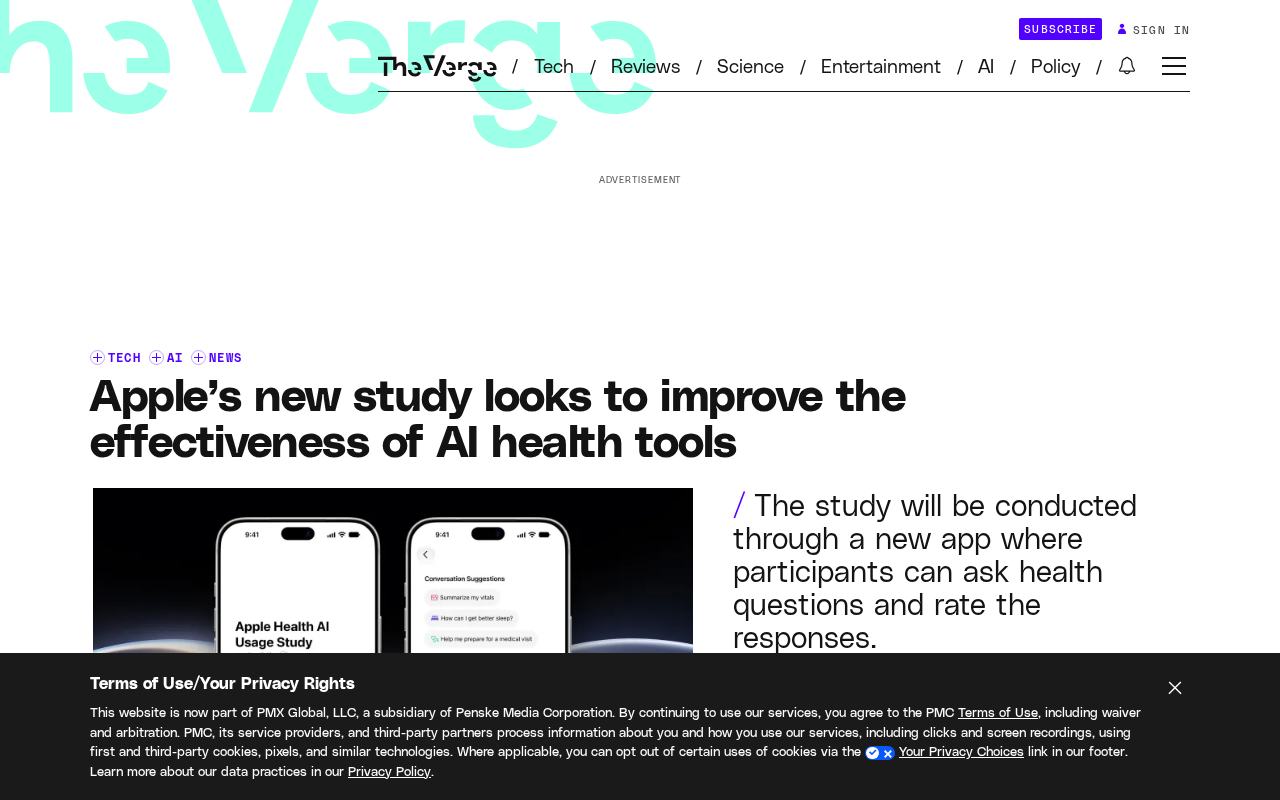
Apple and OpenEvidence launch a study to evaluate real-world usage and answer effectiveness of conversational AI health tools.
Apple announced the Apple Health AI Usage Study with clinical AI platform OpenEvidence to investigate how people interact with conversational AI health tools and whether their answers are truly useful. OpenEvidence serves medical professionals with citable, literature-based answers, so the study may cover both professional and consumer perspectives. The article notes that conversational AI is entering health faster than systematic evaluation, with users lacking clear understanding of accuracy, error scenarios, and comprehension. The study focuses on usage behavior and answer usefulness, potentially setting benchmarks for AI health tools and influencing product design and industry standards. Health data privacy handling will also affect public trust.
Apple is turning its attention to the real-world utility of AI health tools—not just feature stacking.
A Study Focused on the "Real World"
According to RSS sources, Apple has announced a new study called the "Apple Health AI Usage Study," aimed at gaining a deeper understanding of how people interact with conversational AI health tools and how useful the answers these tools provide actually are. This study is not an Apple solo effort—it is being conducted in collaboration with the clinical AI platform OpenEvidence.
OpenEvidence's positioning is noteworthy: it is a clinical AI platform for medical professionals that generates answers based on medical literature. This means Apple's chosen partner is not a generic chatbot vendor, but a player with practical experience in professional medical scenarios.
Clinical AI platforms typically refer to AI systems designed for medical professionals that are grounded in evidence-based medicine and emphasize traceability and verifiability of answers. Their typical capabilities include retrieving medical literature, clinical trial data, and treatment guidelines, and generating answers with citations. Compared with general-purpose chatbots, these platforms are designed with greater emphasis on reducing hallucination risk, clarifying evidence levels, and complying with medical information regulations. OpenEvidence belongs to this category: it primarily serves professional users such as physicians, and its answers must be verifiable. Understanding this context helps grasp the logic behind Apple's choice of partner—the study is not about building general conversational capabilities from scratch, but rather leveraging an existing clinical-grade Q&A system to observe real-world usage behavior and outcomes. This also means the study must balance answer rigor with user readability.
Why This Study Is Worth Attention
Conversational AI is entering the health domain far faster than its effectiveness is being systematically evaluated. Users ask AI about symptoms, look up medications, and interpret medical test reports, but few can clearly say: How accurate are these answers? In what scenarios are errors more likely? Can ordinary users correctly understand AI's wording and limitations?
Apple's study targets exactly these gaps. It focuses on two dimensions—"usage behavior" and "answer usefulness"—rather than purely technical metrics. This research approach aligns with Apple's long-standing emphasis on user experience and health data privacy.
From an industry perspective, this is also a signal: mainstream tech companies are beginning to establish evaluation benchmarks for AI health tools. If the study produces a reusable methodology, it could influence future product design and industry standards.
AI hallucination refers to a model generating content that appears plausible but is factually incorrect or unsupported. The risk is especially high in health scenarios—for example, fabricating drug dosages, confusing symptoms with the corresponding diseases, or giving advice unsuitable for specific populations. Once conversational AI enters the health domain, evaluation challenges go beyond simply whether answers are right or wrong; they also include whether users can recognize uncertainty and whether they mistake vague statements for definitive conclusions. Systematic evaluation typically requires a combination of manual annotation, clinical expert review, and real-world usage logs to observe under what types of questions and health topics errors are more likely to occur. This is precisely the difference between "real-world research" and mere benchmark testing: the latter mostly measures accuracy on standardized questions, while the former focuses more on how ordinary users understand, trust, and act on AI answers in natural interactions.
The Role of Partner OpenEvidence
OpenEvidence's core capability lies in transforming medical knowledge into citable AI answers, and its audience is medical professionals. This differs from consumer-facing health consultation scenarios—professional users demand greater rigor in answers, while ordinary users may care more about readability and actionable advice.
Apple's choice of such a partner suggests the study may cover both professional and consumer perspectives, or explore how to transfer clinical-grade answer quality to mass-market products. Currently, public information is limited; the specific study design, sample size, and duration have not been disclosed.
Potential Impact on AI Health Tools
If the study can reveal typical pitfalls in user interactions with AI health tools—such as over-trust, misreading advice, or relying on AI in emergencies—product teams can make targeted improvements to interaction design and risk warnings.
Another point of interest is data privacy. Health data is sensitive information, and how Apple handles user data during the study will directly affect public trust in such tools. Apple's existing reputation for privacy may be one of its advantages in advancing this type of research.
The study is still in its early stages, and concrete results remain to be seen. But the direction itself is commendable: for AI health tools to be truly usable, model capability alone is not enough—continuous observation and validation of real-world usage scenarios are also needed.
Health data privacy and compliance are unavoidable prerequisites for such research. Health information is classified as sensitive personal data in many jurisdictions. When research involves users' conversations with AI and usage behavior logs, it typically must follow principles such as informed consent, data minimization, de-identification, and access control, and must clearly define the boundaries of data use and retention periods. For platforms, it is also necessary to clarify whether data will be used for model training, whether it will be shared with third parties, and whether users can withdraw authorization. These arrangements affect not only whether the research can pass ethical review but also whether users are willing to use the tools honestly and provide feedback. Apple has long used on-device processing and privacy protection as product selling points, so its data handling approach in this study is exemplary and may serve as a reference for industry discussions on the trust foundation of AI health tools.
One-line Summary
Apple and OpenEvidence have launched a study to evaluate real-world usage and answer effectiveness of conversational AI health tools.
Paragraph Summary
Apple announced the launch of the Apple Health AI Usage Study, in collaboration with clinical AI platform OpenEvidence, to investigate how people interact with conversational AI health tools and whether the answers these tools provide are truly useful. OpenEvidence serves medical professionals and generates citable answers based on medical literature, which means the study may cover both professional and consumer perspectives. The article notes that conversational AI is entering the health domain faster than systematic evaluation can keep up; users often ask about symptoms, look up medications, and interpret reports, yet lack clear understanding of accuracy rates, error-prone scenarios, and comprehension difficulties. The study focuses on usage behavior and answer usefulness rather than purely technical metrics, and may establish evaluation benchmarks for AI health tools, influencing product design and industry standards. How health data privacy is handled will also affect public trust.
Related articles

Gemini 4 Neon Review: Benchmark Scores Rival Carbon, API Pricing and Quota Breakdown
Google Gemini 4 Neon is now live, benchmark scores closely tracking Carbon, API pricing 3/15 at twice Hydrogen's rate. This article compiles Bilibili creator testing: Neon can replace 90% of Carbon scenarios, AntiGravity quota consumption is only one-third of Carbon, plus subscription channel restrictions and 2API ban risks.

Gemini 4 Helium Coming Soon? Signals of Google Loosening Subscription Restrictions
Google team member hints releases will continue; community speculates Gemini 4 Helium (Flash Lite) may be next. Subscription ban controversy gets a response as product lead says "Soon," suggesting restrictions may be lifted. This article covers Gemini developments, OpenAI Coding Agent and risk management, Doubao real-time audio-video API, and compute business dynamics.

AI-Assisted React Development in Practice: Optimizing a Video App and Handling Errors
A 14-year veteran developer demonstrates AI-assisted React video app optimization: compressing video from 80MB to 5MB (~94%) via ImageKit, plus reliable error handling and retry mechanisms. Includes planning, code understanding, and verification methods for working with AI.