ApplySeed: The AI Tool Helping Startups Apply to Accelerators and Secure Funding
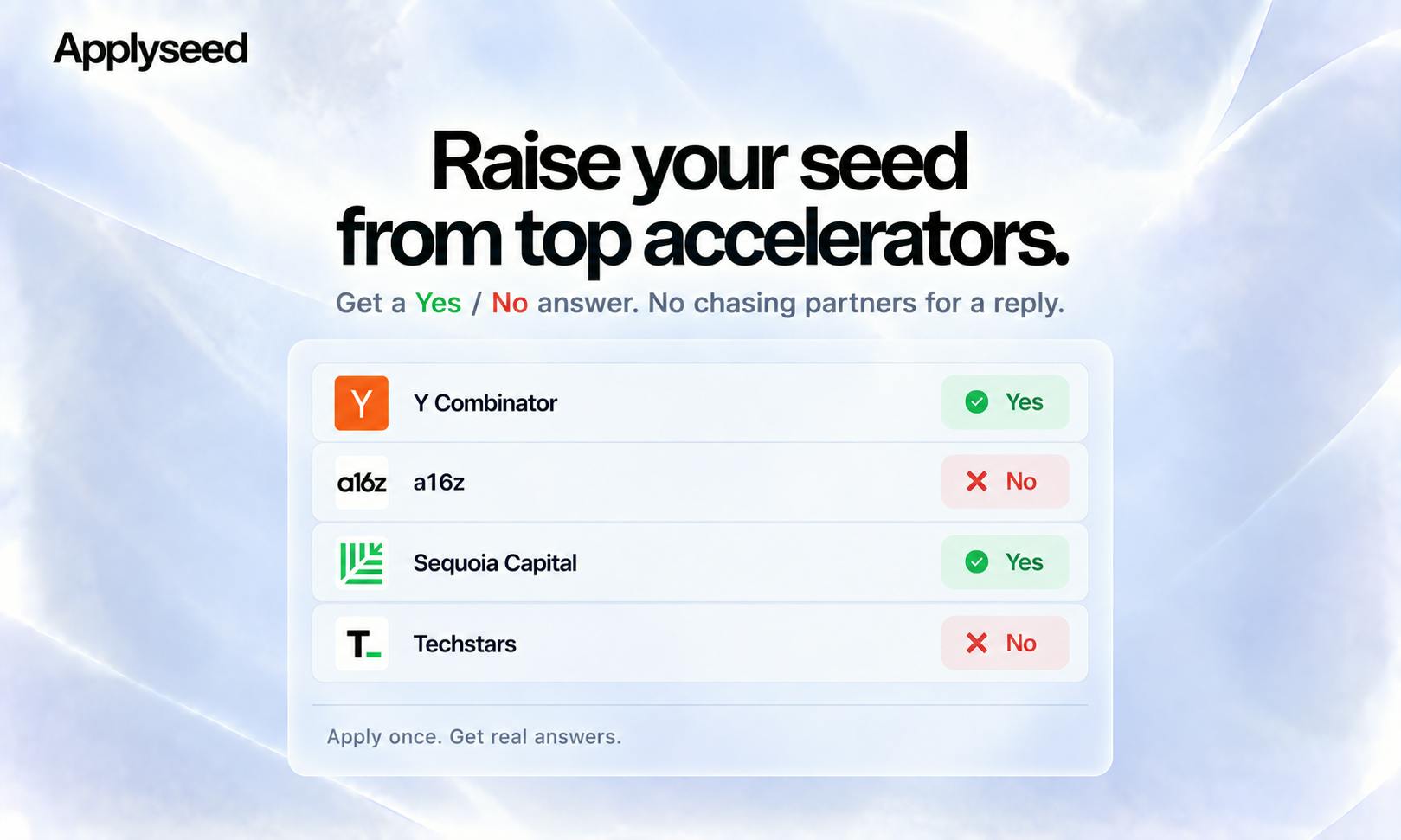
ApplySeed uses AI to auto-fill accelerator applications for early-stage founders, boosting efficiency and match rates.
ApplySeed is an AI-powered fundraising application tool for seed-stage founders, built to automate the tedious process of applying to accelerators and incubators. Founders import a pitch deck, scattered notes, or ChatGPT-generated startup info, and the tool diagnoses missing materials, matches eligible programs by industry and stage, and auto-fills each application form. Its "AI fills, human reviews" model preserves efficiency while keeping founders in control. The product ranked 10th on Product Hunt's OpenAI Day. That said, its promise of "clear Yes or No" answers should be taken with nuance — admission decisions still rest with the accelerators — and database coverage and content quality are key variables to watch.
A Fundraising Application Tool Built for Seed-Stage Founders
For early-stage founders, applying to accelerators and incubator programs often feels like a war of attrition. You submit dozens of applications, fill out countless forms in wildly different formats, and mostly receive vague "let's keep in touch" responses — not quite a rejection, not quite an acceptance. ApplySeed is designed to solve exactly this problem. It advocates for founders getting a clear "Yes" or "No" from accelerators, rather than enduring an endless wait.
The product launched on Product Hunt during an OpenAI Day event, earning 99 upvotes and 31 comments, ranking 10th overall in the "Fundraising" category.
How It Actually Works
ApplySeed's core logic is to transform the materials a founder already has into targeted, tailored applications. You come with what you've got: a pitch deck, scattered notes, or you can use ApplySeed's prompts with ChatGPT to generate your startup profile from scratch.
From there, the tool handles three things:
Diagnosing Missing Information
ApplySeed identifies what's "missing" from your current materials. Accelerator applications typically require information across multiple dimensions — team background, market size, traction data, business model, and more. Missing any one of these can affect how evaluators assess your application. Surfacing these gaps upfront is far more valuable than submitting and hearing nothing back.
Matching You to Eligible Programs
Based on your startup's profile, ApplySeed filters and surfaces accelerators and incubators you're actually qualified to apply to. Different programs have distinct preferences around industry, geography, and stage of development. Blasting out generic applications is inefficient — precise matching means directing your limited energy toward programs that might actually say "Yes."
Major global accelerators and incubators vary significantly in their selection criteria. Y Combinator accepts early-stage teams from almost any industry but is intensely competitive, with an acceptance rate under 2%. Techstars runs vertical-focused programs across multiple cities worldwide. Europe's Entrepreneur First intervenes even before teams are formed, operating at an earlier stage than most. Domestic industry incubators in China often come with explicit regional and sector requirements. For founders unfamiliar with each program's real preferences, blind submissions typically result in collective silence. ApplySeed's matching logic only delivers on its core value if it can effectively map and distinguish these differences.
Auto-Filling Application Forms
This is the most time-saving feature. ApplySeed adapts your information and automatically populates each unique application form — "We fill it, you review and send it." This division of labor between AI-generated drafts and human review preserves efficiency while keeping the final call in the founder's hands.
Targeting the Right Pain Point
ApplySeed's product narrative zeros in on a genuine, high-frequency problem. The tedium of accelerator applications is widely acknowledged among early-stage teams: every program has a different form structure and different phrasing for its questions, yet the underlying information being requested is largely the same. Manually reformatting and rewriting the same content is not only time-consuming — fatigue inevitably degrades quality.
Handing this adaptation and form-filling process to AI is logically sound. At its core, it applies large language models' strength in "information reorganization and format conversion" to a specific vertical with a clear willingness to pay. Its placement in the OpenAI Day event also suggests the underlying tech stack is almost certainly built on GPT-class models.
Large language models excel at "information reorganization and format conversion" because of how they're trained: by learning from vast amounts of text, they internalize the many ways the same idea can be expressed across different contexts. This lets them naturally rewrite a company description to fit the specific phrasing of a given form. This capability is especially well-suited to application writing — because different accelerators tend to ask the same type of questions, just with different wording, word limits, and emphases. GPT-4 and similar models also support Structured Output, enabling unstructured pitch deck content to be parsed and mapped to fixed fields, further reducing manual adaptation effort. This is the underlying technical logic behind ApplySeed's approach.
Questions Worth Asking
Based on publicly available information, a few things about ApplySeed remain unresolved. First, there's the promise of a "clear Yes or No" — accelerator admission decisions are not in the tool's hands. ApplySeed is more likely to improve certainty indirectly through better matching and higher-quality applications, rather than actually prompting programs to respond immediately. Users should take this tagline with a grain of salt.
Second, there's the question of accuracy and honesty. If AI-generated content contains exaggerations or inaccuracies, the responsibility ultimately falls on the founder — which is why the "you review" step cannot be skipped. Third, the size of the accelerator database it covers and how frequently it's updated directly determines how much real-world value the matching feature can deliver.
Summary
ApplySeed is a tightly focused AI fundraising application tool that frees founders from the grind of repetitive form-filling while improving application hit rates through intelligent program matching. Its reception on Product Hunt suggests the pain point genuinely resonates. For early-stage teams actively applying to accelerators, it's worth trying — but the marketing promise of "clear answers," the breadth of database coverage, and the quality of auto-generated content all remain things to verify through actual use.
Related articles
Free Open-Source Tool Rejected: The Community Controversy Sparked by r/DnD's AI Ban
A free open-source DnD campaign tool was rejected by r/DnD's AI ban — yet the same tool was approved a year ago. The case highlights the blurry line between AI tools and AI-generated content.

What LLMs Can You Run with 1.9TB of RAM? Exploring the Ceiling of Local AI Deployment
A Reddit user with 1.9TB of RAM sparked debate about local LLM deployment. We break down what massive RAM enables, where CPU inference falls short, and the real bottlenecks.
Researchers Use Claude to Hack OpenAI Systems: A New Wake-Up Call for AI Security
Security researchers used Anthropic's Claude to breach OpenAI systems, taking over employee accounts and accessing internal repos. What this means for AI security.