Appwrite 2.0: An Open-Source Cloud Platform for AI Agents and Developers
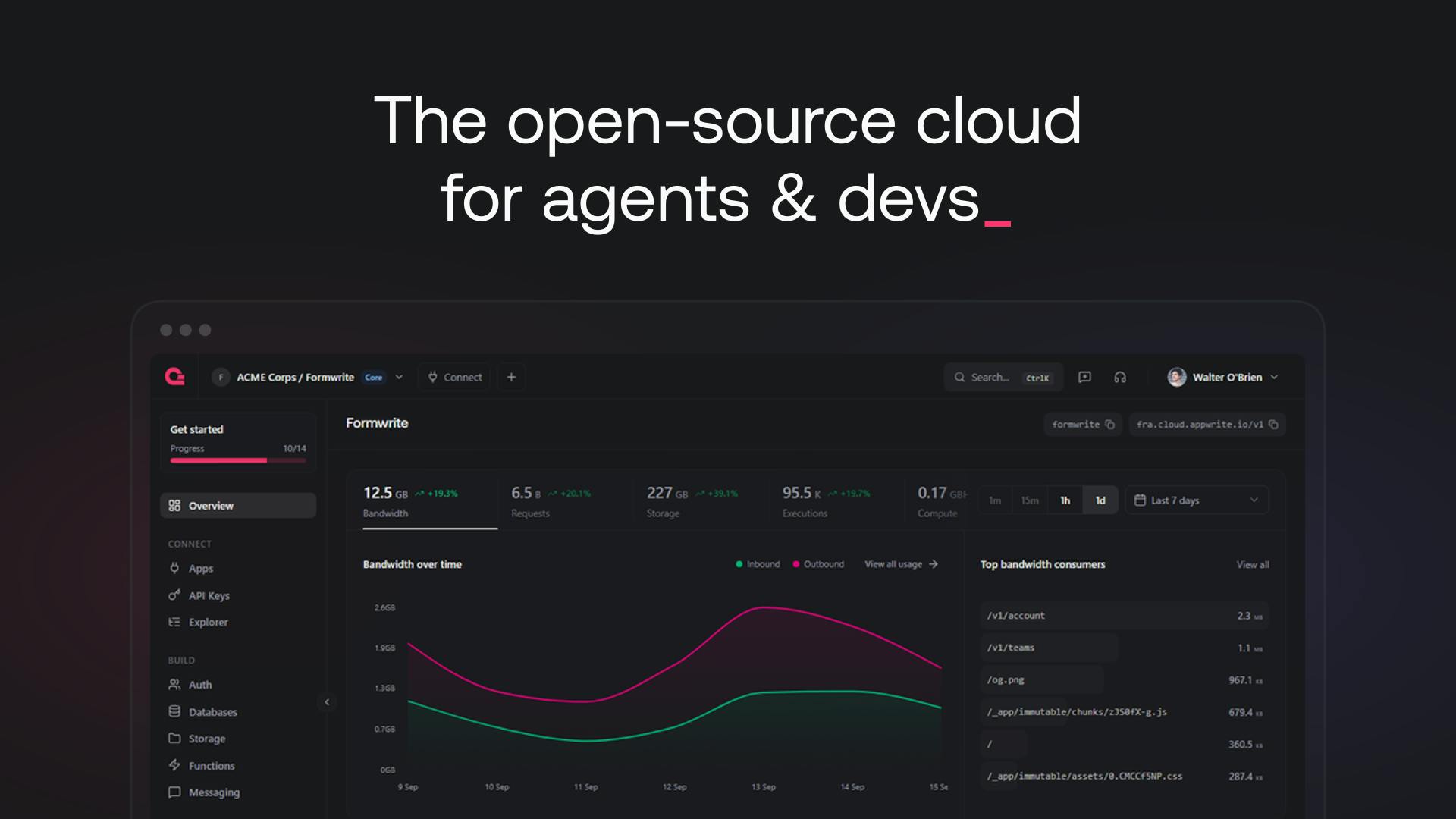
Appwrite 2.0 rebuilds its engine and adds vector data and identity capabilities to become an open-source cloud for AI agents.
Appwrite 2.0 is the second major upgrade to this open-source BaaS platform, featuring a ground-up rebuild of both the core engine and console. The data layer now supports relational, schemaless, and vector data — with native vector support directly addressing RAG, semantic search, and agent memory needs. Native PostgreSQL and MySQL engines improve production readiness, while S3-addressable storage, OAuth 2.1/OIDC-compliant identity, and a unified network layer complete the platform's four backend pillars. Appwrite repositions itself from "developer backend" to "open-source cloud for AI agents and developers."
The open-source Backend-as-a-Service (BaaS) platform Appwrite has launched its second major generation. Appwrite 2.0 is not a simple feature add-on — it's a ground-up rebuild from the core engine to the console, repositioning the platform from a traditional "developer backend" to an "open-source cloud for AI agents and developers." The product earned 125 upvotes on Product Hunt, ranking #2 for the day, at the intersection of Open Source, Developer Tools, and Artificial Intelligence.
Starting from the Ground Up
Unlike many "major version" releases that amount to little more than a UI refresh, Appwrite 2.0 touches the most fundamental parts of the platform. The official description explicitly states that 2.0 "replaces the underlying engine and rebuilds the Console on top of it." This means the familiar interface developers know is now running on an entirely new runtime foundation.
This kind of "engine transplant" upgrade typically unlocks higher performance ceilings and cleaner architectural boundaries. For an open-source project, rewriting the engine is a high-stakes decision — it risks breaking backward compatibility, but also opens the door for future capability expansion. Appwrite's choice to do this in generation two is clearly a deliberate move to build in architectural flexibility for the demands of the "agentic era."
The Data Layer: Unified Relational, Schemaless, and Vector Data
One of the most notable changes in 2.0 is the expansion of data types a single project can handle. According to the official announcement, Appwrite 2.0 supports three data paradigms: relational, schemaless, and vector.
Why Vector Data Is the Key
Native vector data support is the clearest signal that this update directly aligns with the "AI agents" positioning. Vector storage is the foundational infrastructure for building RAG (Retrieval-Augmented Generation), semantic search, and agent memory. Previously, developers typically had to bring in a dedicated vector database (like Pinecone or Weaviate) for this kind of work. By baking vector capabilities into the platform, Appwrite can theoretically reduce the architectural complexity of AI applications.
Offering both relational and schemaless paradigms simultaneously means developers can handle strictly structured business data alongside flexible, unstructured content — without jumping between multiple backends.
Background: What is RAG? RAG (Retrieval-Augmented Generation) is the dominant architectural pattern for AI applications today. Before invoking a large language model to generate a response, the system first retrieves semantically relevant document chunks from a vector database and injects them as context into the prompt. This allows the model to draw on private knowledge bases or up-to-date data rather than relying solely on its static training knowledge. The core step is converting text, images, or other content into high-dimensional floating-point vectors using an embedding model, then performing similarity search via Approximate Nearest Neighbor (ANN) algorithms. A vector database's specialized value lies in making this retrieval process efficient. Embedding vector storage directly into a BaaS platform means developers no longer need to deploy and maintain a separate vector database service — they can handle everything from user authentication and business data to AI memory within a single platform.
Database Engines: Native PostgreSQL and MySQL
Appwrite 2.0 introduces native PostgreSQL and MySQL engines. This is a significant signal for production readiness — supporting the two most widely used relational databases in the industry means enterprises can run Appwrite on familiar, battle-tested technology stacks rather than being locked into a proprietary storage solution.
For open-source self-hosted users, the ability to connect to standard database engines also gives them far more control over data migration, backup, and operations. This aligns with Appwrite's long-standing emphasis on openness.
Storage, Identity, and the Network Layer
Beyond data and engines, 2.0 also expands several foundational capabilities:
- Storage: Provides S3-addressable storage, compatible with the industry's de facto standard object storage protocol, making integration with existing cloud storage ecosystems straightforward.
- Authentication: Includes a built-in identity provider (IdP) compliant with OAuth 2.1 and OIDC standards. This is more than a login feature — it's a standardized IdP for unified management of user and agent identity and authorization.
- Network Layer: The official announcement specifically mentions "a network layer sitting in front of all of these," hinting that 2.0 introduces unified handling at the traffic ingress, routing, and access control level.
This combination sketches out a complete backend landscape: data, storage, identity, and networking — all four pillars in place at once.
Background: OAuth 2.1 and OIDC OAuth 2.1 is a security-hardened revision of the OAuth 2.0 authorization framework. It consolidates and deprecates several grant types from the original spec that had known security vulnerabilities (such as the implicit flow), and mandates the use of PKCE (Proof Key for Code Exchange) to prevent authorization code interception attacks. OIDC (OpenID Connect) is an identity authentication layer built on top of OAuth 2.0/2.1, standardizing the answer to "who is this user?" through ID Tokens (typically in JWT format). When Appwrite positions itself as an identity provider, it means the platform can not only manage human user logins but also issue machine identity credentials (service account tokens) for AI agents. This gives agents standardized, auditable, and revocable permissions when accessing APIs, databases, or external services — which is especially important for permission isolation and security governance in multi-agent collaboration scenarios.
What Does Positioning as an "Agent Cloud" Actually Mean?
Appwrite's redefinition of itself as an "open-source cloud for agents and developers" is a tagline worth unpacking. As AI agents move from demos into production, they need more than just model APIs — they need persistent memory (vector data), identity and permissions (OAuth 2.1/OIDC), and a reliable data and storage backend. Appwrite 2.0 packages all of these capabilities into a single open-source, self-hostable platform.
For teams looking to build AI-native applications without being locked into a closed-source cloud vendor, this is a compelling option to evaluate. That said, as a freshly launched second-generation platform, its stability in production environments, performance characteristics, and backward-compatible migration experience will still need to be validated through real-world use.
Summary
Appwrite 2.0 completes a repositioning leap — from "developer backend" to "agent cloud" — through a bottom-up engine rewrite, a rebuilt console, and comprehensive expansion across data types, database engines, storage, identity, and the network layer. Native vector data support and standardized identity capabilities are its two most concrete gestures toward the AI era. For the open-source ecosystem and AI developers alike, this is a major iteration with a clear direction.
Related articles
AI Agent Learning Roadmap: A Four-Stage Guide for Complete Beginners
A four-stage AI Agent learning roadmap for beginners: from core concepts and model deployment to RAG, LangChain, LoRA, and interview-ready projects.
Free Access to Mystery Model & DeepSeek V4 via Cline: Complete Setup Tutorial
Learn how to use DeepSeek V4 and the mystery "Niumai" model for free on Cline — covering IDE extension and CLI installation, account setup, and model selection.
Cline + VS Code in Practice: Generate a To-Do App from a Single Prompt
Cline is an autonomous coding agent inside VS Code. This hands-on guide shows how to generate a to-do app from one prompt and compares Claude, Ollama, and Groq integrations.