Arc Browser Stops Updates on December 22 as The Browser Company Goes All-In on Dia
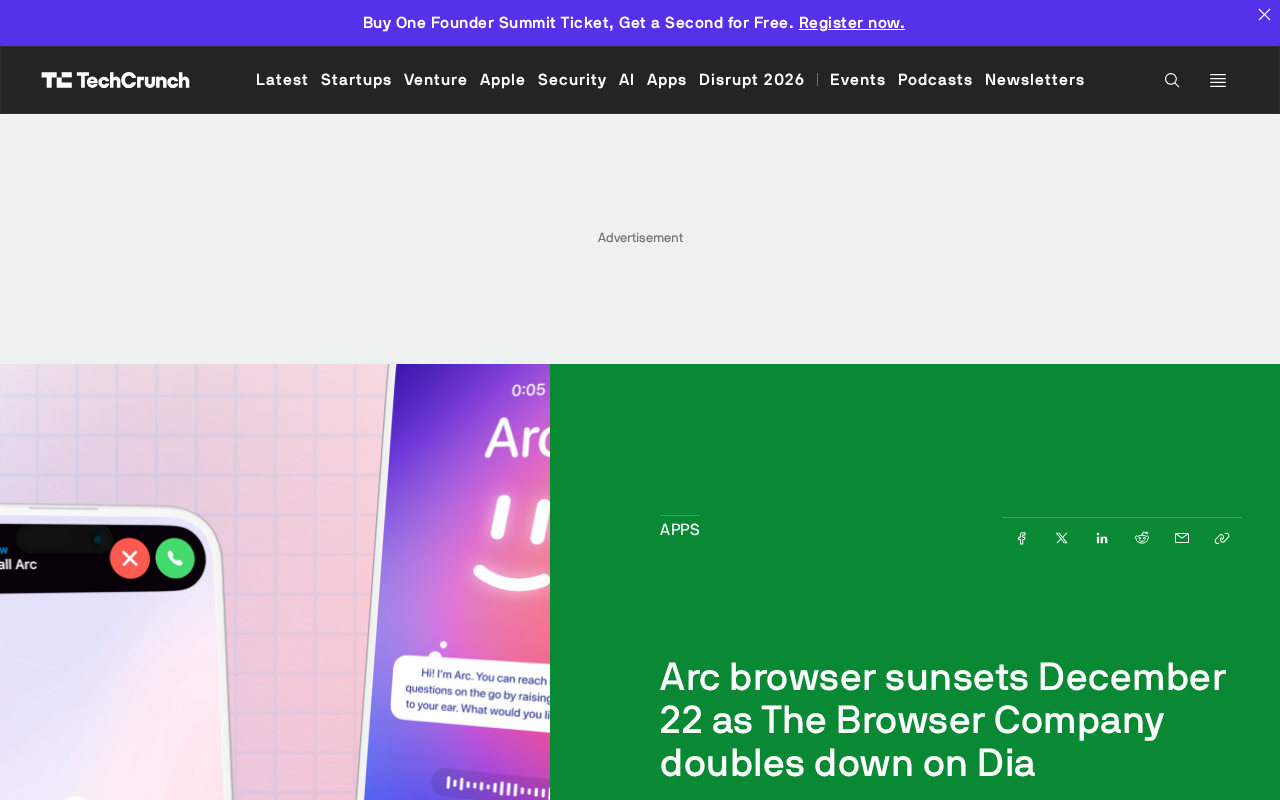
Arc Browser stops updates on December 22 as The Browser Company goes all-in on the AI browser Dia.
The Browser Company announced that Arc Browser will stop receiving updates on December 22, with resources shifting fully to the AI-native browser Dia. Arc earned praise among geeks for innovative interactions such as sidebar tabs, Spaces grouping, and split-screen browsing, but user growth fell far short of expectations and its complexity deterred ordinary users. In a market dominated by Chrome, Safari, and Edge, interface micro-innovations struggle to shift mass habits. Dia is betting on the paradigm shift brought by large models, embedding AI into page understanding, summarization, and task automation. After updates stop, Arc remains usable but no longer receives feature updates or security patches, creating long-term risks. This pivot reflects the browser competition's shift from interface innovation to AI capability.
Arc Browser was once seen as one of the strongest challengers to Chrome, with a devoted fan base. But that story is now coming to an end: The Browser Company has announced that Arc will officially stop receiving updates on December 22, and the company will shift all of its efforts to the AI browser Dia.
The End of Arc: A Critically Acclaimed but Commercially Disappointing Experiment
Arc did not start from a weak position. With innovative interactions such as sidebar tab management, Spaces grouping, and split-screen browsing, it built an excellent reputation among geeks and productivity enthusiasts. Many users regarded it as a product that "truly rethought the form of the browser," and even championed it spontaneously on social platforms.
However, enthusiasm did not translate into scale. The Browser Company founder Josh Miller has admitted that Arc's user growth fell far short of expectations, and the product's complexity deterred ordinary users. The browser market has long been dominated by the three giants Chrome, Safari, and Edge, and for a newcomer to shift mass habits is far harder than imagined. Arc's dilemma was this: it won the hearts of a small group of people, but never made it onto most people's desktops.
Why Dia?
Abandoning Arc was not an impulsive decision, but a shift in strategic focus. The Browser Company positions Dia as an "AI-native browser," attempting to embed large-model capabilities into every part of the browser—from page understanding and content summarization to task automation. Unlike Arc, which emphasized interface innovation, Dia is betting on the paradigm shift in interaction brought by AI.
There is clear business logic behind this pivot. Arc's maintenance costs were not low, while its user base was limited, making it difficult for continued investment to create a positive cycle. Dia, by contrast, carries the company's imagination of the next computing platform: when AI can directly understand web pages and perform operations on users' behalf, the value of the browser will be redefined. Concentrating resources on Dia is a high-stakes bet by the company within a limited window of opportunity.
"AI-native browser" refers to treating large language models (LLMs) as a core component at the product architecture level, rather than treating AI as an optional add-on feature as traditional browsers do. Such browsers typically use built-in model interfaces so that page content can be directly parsed, summarized, queried in Q&A form, and even used to drive automated operations. Compared with AI extensions based on plugins or sidebars, AI-native approaches can access lower-level browsing context, and interactions are more coherent. This concept differs from "AI-powered": the latter often merely layers AI capabilities on top of an existing product, while native design means that the model's input and output, context management, and permission model are all taken into account from the outset. Dia is precisely trying to follow this path to redefine how users interact with web pages.
What It Means for Users and the Industry
For loyal Arc users, although the product will remain usable after December 22, it will no longer receive feature updates or security patches, creating long-term risks. This also reminds people that niche tools dependent on a single startup always face uncertainty in their product life cycle.
For the browser industry, Arc's exit provides an intriguing case study. Micro-innovations at the interface level are enough to earn praise, but difficult to shake up the existing landscape; the injection of AI capabilities may be the real variable in the next round of competition. Whether Dia can use AI to tell a different story will determine whether The Browser Company's pivot is a wise stop-loss or yet another strong start followed by a weak finish.
At least for now, the company has made its choice: rather than guarding a small and beautiful Arc, it is better to go all-in on the AI browser track.
As software products, browsers' security patches are often underestimated in importance. Chromium-based browsers need to continuously track upstream security fixes; otherwise, known vulnerabilities remain exposed for long periods. Once Arc stops updating, it will no longer synchronize these fixes, and over time, the number of unpatched vulnerabilities will accumulate. For everyday browsing, logging into accounts, and handling payments, this creates real risks. If users continue to use it, they should avoid sensitive operations within it and consider gradually migrating their data. This also explains why many products still maintain a period of security maintenance after feature updates stop—yet Arc does not even have this buffer, reflecting how decisive the company's resource shift is.
One-line Summary
Arc Browser stops updates on December 22 as The Browser Company goes all-in on the AI browser Dia.
Paragraph Summary
The Browser Company has announced that Arc Browser will stop receiving updates on December 22, with resources shifting fully to the AI-native browser Dia. Arc once earned praise among geeks with innovative interactions such as sidebar tabs, Spaces grouping, and split-screen browsing, but user growth fell far short of expectations, and its complex design deterred ordinary users. In a market dominated by Chrome, Safari, and Edge, interface micro-innovations struggle to shift mass habits. Dia, by contrast, is betting on the paradigm shift in interaction brought by large models, attempting to embed AI capabilities into page understanding, content summarization, and task automation. After updates stop, Arc will remain usable but will no longer receive feature updates or security patches, creating long-term risks. This pivot reflects that the focus of browser competition is shifting from interface innovation to AI capabilities.
Related articles

LLaMA-Factory in Practice: A Complete No-Code Guide to Fine-Tuning Large Models
An introduction to LLaMA-Factory, the open-source fine-tuning tool: its 60.1K-star background, supported models and algorithms, local vs. cloud deployment, and CUDA setup steps.

Zeng Ming's Deep Retrospective: Why OpenAI May Not Be the Ultimate Winner — and Why the Corporate System Will Disappear
Zeng Ming's deep retrospective on the AI endgame: model companies are just infrastructure, OpenAI and Anthropic won't be the final winners; the next battle is the Agent entry point standard; the corporate system will disappear as AI restructures collaboration, and only mission-driven companies can survive the cycle.

OpenHands v1.28.0: OpenCode and PI Added as Built-in Agents, API Keys Requestable In-Conversation
OpenHands ships 5 releases in 21 days: v1.27.0 adds OpenCode and PI as built-in agents, v1.28.0 enables in-chat key requests. ACP integration, credential reuse, model list changes, and upgrade advice.