Are Entry-Level ML Positions Disappearing? A Realistic Path Into Machine Learning Engineering

Entry-level ML jobs are vanishing—here's how to break in through backend development and data engineering.
True junior ML/AI positions have nearly disappeared as hiring bars rise. This article examines why—compound skill requirements, supply-demand imbalance, and experience inflation—then offers realistic alternative paths: Python backend development, data engineering, and data analysis. It recommends prioritizing software engineering fundamentals over ML theory for near-term job prospects, with a practical 80/20 learning split.
A Real Dilemma: Entry-Level ML Positions Have Nearly Vanished
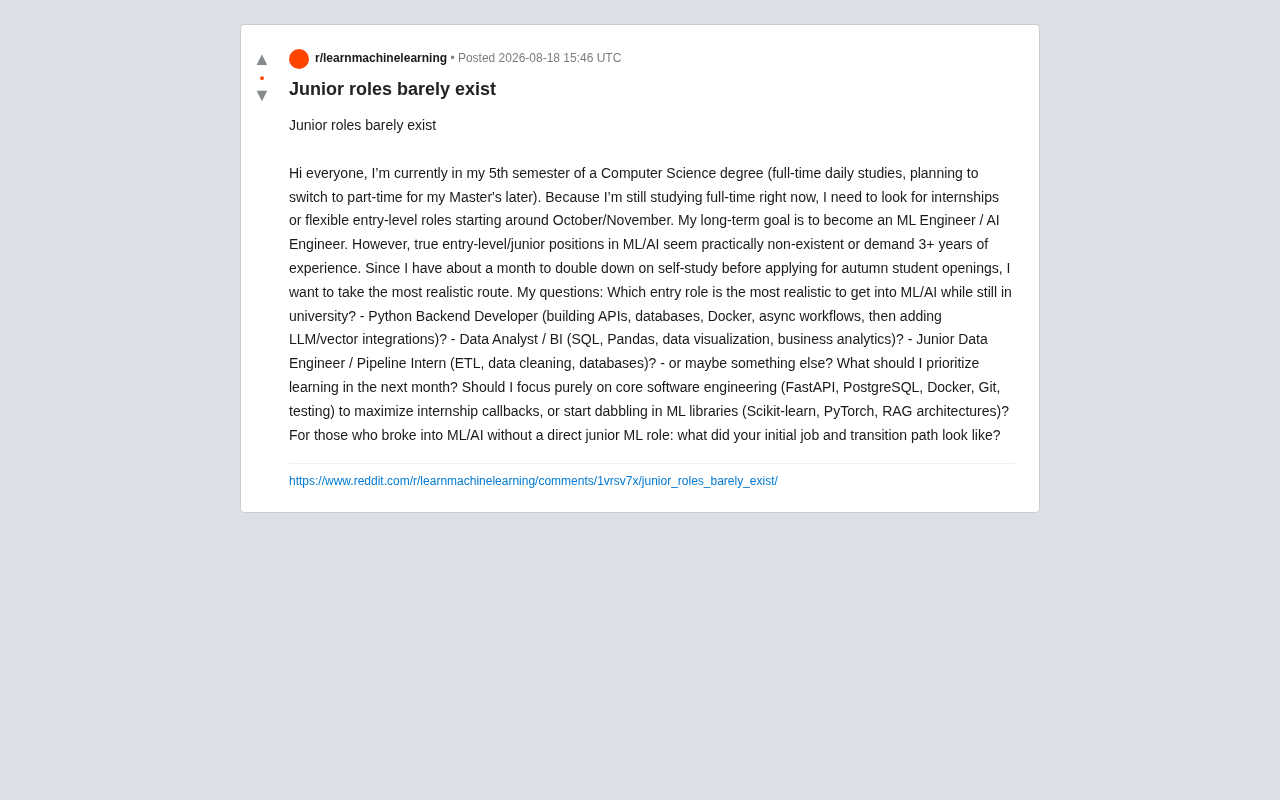
Recently on Reddit, a computer science student posed a question that resonated widely. This undergraduate in their fifth semester, planning to pursue a master's degree, was looking for an internship or flexible entry-level position starting October, with the long-term goal of becoming a Machine Learning Engineer or AI Engineer.
However, they discovered a harsh reality: truly entry-level/junior ML/AI positions barely exist, or they demand 3+ years of experience.
This isn't an isolated case. As large language model technology has exploded, hiring bars for AI positions have risen rather than fallen. Many positions labeled "junior" actually require solid engineering capabilities, production environment experience, and deep understanding of deep learning frameworks. For students, this barrier feels particularly steep.
Why Are Entry-Level ML Positions So Scarce?
The Inherently High Barrier of the Role
ML/AI engineering is fundamentally a "compound" role. It requires practitioners to simultaneously possess software engineering skills, data processing abilities, and machine learning theoretical foundations. When companies hire ML engineers, they often expect candidates to independently handle the entire pipeline from data pipeline construction and model training to deployment—this naturally demands significant experience.
Specifically, a complete ML engineering workflow involves multiple technical layers: the Data Pipeline handles extracting, transforming, and loading data from various sources; the model training phase requires mastery of distributed computing, GPU resource management, and hyperparameter tuning; and deployment involves MLOps—an engineering practice system for reliably deploying machine learning models to production environments and continuously monitoring their performance. MLOps borrows from DevOps principles, encompassing model version management, A/B testing, model performance monitoring, and automated retraining. This means ML engineers essentially need to play the triple role of data scientist, backend engineer, and operations engineer simultaneously. This compound requirement makes it difficult for companies to trust a complete newcomer with no engineering experience to independently handle projects.
Supply-Demand Imbalance Intensifies Competition
The large model wave has attracted massive talent flowing into the AI field, but the actual "pure ML" entry-level positions companies can offer have grown limitedly. Since ChatGPT's release in late 2022, enrollment in AI/ML-related courses and bootcamps has grown exponentially worldwide, and AI-related majors at universities have seen unprecedented application surges. However, the reality on the enterprise side is: most companies aren't building ML systems from scratch but integrating AI capabilities into existing technical architectures. This means they need experienced senior engineers who can hit the ground running, not newcomers who need to be trained from zero.
In contrast, companies prefer to assign ML-related work to experienced senior engineers or have existing software engineers and data engineers "laterally expand" into ML. Many tech companies adopt this strategy: training senior software engineers who are already familiar with the company's codebase and business logic in ML, rather than externally hiring someone who knows ML but doesn't understand the company's business. This "internal transfer priority" strategy further compresses the supply of external junior positions. This creates a structural scarcity of entry-level positions.
The Definition of "Junior" Has Been Quietly Raised
You might not have noticed, but many so-called "junior" positions are actually "junior for someone who already has ML experience." Companies expect someone who has already accumulated engineering experience in other roles and is only a newcomer in the ML direction—not a complete fresh graduate.
This phenomenon is known as "experience inflation" in tech recruiting. A decade ago, a "junior software engineer" position might only require mastery of one programming language and basic data structure knowledge. Today, a "junior ML engineer" job description might include: familiarity with TensorFlow or PyTorch, model deployment experience, understanding of distributed training, and familiarity with cloud platform (AWS/GCP/Azure) ML services—requirements that five years ago would have matched a mid-level or even senior position. The fundamental reason for this threshold creep is: when the supply of job seekers is excessive, companies can hire "mid-level" talent at "junior" salary standards.
The Indirect Approach: More Realistic Paths Into ML
Addressing the core question from the original post—"What's the most realistic ML/AI entry-level position while still in school"—here are several proven viable paths.
Path One: Python Backend Development (Recommendation: ★★★★★)
This is currently the most realistic entry point with the highest return on investment. After mastering building APIs, database operations, Docker containerization, and async workflows, then gradually incorporating LLM/vector database integration, you can naturally transition into the "AI engineering" domain.
In fact, a large portion of current "AI application development" work is essentially backend engineering—building RAG systems, calling LLM APIs, managing vector retrieval—all built upon solid backend capabilities. RAG (Retrieval-Augmented Generation) is one of the most mainstream architectural patterns in current AI applications: it matches user queries with relevant documents from an external knowledge base, then passes the retrieved contextual information along with the user's question to a large language model, generating more accurate, evidence-based answers. This process involves text vectorization (Embedding), similarity search in vector databases (such as Pinecone, Weaviate, Milvus), context window management, and more—each step requires reliable backend engineering to support it.
An engineer who can write reliable API services is more welcomed by companies than someone who only knows how to tune parameters but doesn't understand engineering. This is because in actual production environments, model inference only accounts for a small part of the entire AI system, while request routing, load balancing, caching strategies, error handling, and log monitoring—the "dirty work"—are what keep AI systems running stably. And these are precisely the core skills of backend engineers.
Path Two: Data Engineer/Data Pipeline Internship (Recommendation: ★★★★)
ETL workflows, data cleaning, database management—data engineering is the "upstream" component of ML. ETL stands for Extract, Transform, Load, representing the standard process of data flowing from raw sources to its final usable state. In ML projects, model quality is highly dependent on training data quality. The industry saying "garbage in, garbage out" captures this well—if the data fed into a model has missing values, duplicate records, format inconsistencies, or labeling errors, even the most advanced algorithms cannot produce reliable results.
Any ML project is inseparable from high-quality data pipelines. Modern data pipelines typically use orchestration tools like Apache Airflow or Prefect to manage complex data processing workflows, involving extraction from various data sources (relational databases, API endpoints, log files, streaming data), performing cleaning, standardization, and feature engineering, ultimately storing results in data warehouses or Feature Stores for model training. Starting from data engineering gives you deep understanding of data flow processes, laying a solid foundation for later transitioning to ML modeling. Moreover, the market demand for data engineering positions is relatively strong, with more entry opportunities available. According to data from platforms like LinkedIn, data engineer job demand has grown continuously over the past three years, far exceeding the growth rate of pure ML positions.
Path Three: Data Analysis/BI (Recommendation: ★★★)
SQL, Pandas, data visualization, business analysis—this path has the lowest barrier and allows quick accumulation of data-related experience. However, note that data analysis is relatively far from ML engineering, and transitioning requires additional engineering skills. It's better suited as a "stepping stone" rather than a long-term goal.
What Should You Prioritize Learning in the Next Month?
The original poster faces a classic choice dilemma: should they purely focus on core software engineering (FastAPI, PostgreSQL, Docker, Git, testing) to maximize internship interview opportunities? Or should they get an early start on ML libraries (Scikit-learn, PyTorch, RAG architecture)?
Engineering First, ML Second
With only one month of preparation time and the goal of landing an internship offer, prioritizing solid software engineering fundamentals is the more rational choice. The reasons are straightforward:
- Engineering skills are hard currency: FastAPI is one of the highest-performance modern web frameworks in the Python ecosystem, based on async programming and type annotations, capable of auto-generating API documentation, and widely used in AI application backend development; PostgreSQL is the most mature open-source relational database in the industry, used by companies of virtually all sizes; Docker solves the classic "it works on my machine" problem by using containerization to ensure applications run consistently in any environment—this is especially important in ML model deployment because ML environment dependency management (CUDA versions, Python package conflicts, etc.) is notoriously complex. These skills are needed in virtually all technical roles and can significantly improve interview success rates.
- ML theory is hard to master quickly: It's difficult to truly grasp deep learning within one month. Deep learning involves mathematical foundations like linear algebra, probability theory, and optimization theory, as well as deep understanding of core concepts like backpropagation, gradient descent, and regularization. A superficial attempt might actually expose weaknesses in interviews.
- Engineering skills are the foundation of ML engineering: Even if you focus on ML in the future, solid engineering fundamentals are indispensable. In actual work, ML engineers may spend 60-70% of their time on data processing, system integration, and engineering optimization, with actual model development and experimentation occupying only a small portion. Google pointed out in their famous paper Hidden Technical Debt in Machine Learning Systems that ML code represents only a small fraction of an entire ML system, surrounded by massive amounts of data collection, feature extraction, configuration management, monitoring, and serving infrastructure code.
A Pragmatic Learning Allocation Plan
You can invest 80% of your effort in core software engineering skills and use 20% of your time to build a small "AI application" project—for example, implementing a simple RAG Q&A system with FastAPI + a vector database.
Specifically, the technical architecture of such a project works as follows: first, use a text embedding model (such as OpenAI's text-embedding-ada-002 or open-source sentence-transformers) to convert documents in a document library into high-dimensional vectors; then store these vectors in a vector database (ChromaDB is suitable for local development, Pinecone for production); when a user asks a question, vectorize the question similarly, perform nearest-neighbor search in the vector database using cosine similarity or Euclidean distance to find the most relevant document fragments; finally, concatenate these document fragments as context into a Prompt and call a large language model API to generate the final answer. The entire workflow is exposed as a RESTful interface through FastAPI and packaged for deployment with Docker. While this project isn't large, it comprehensively demonstrates capabilities in data processing, vector retrieval, API design, and containerized deployment.
This approach both showcases engineering ability and proves your interest in and basic understanding of the AI direction—killing two birds with one stone.
Career Transition Wisdom from Those Who've Been There
For the question "how to transition into ML/AI without a direct ML junior position," the common experience in the community is:
- Enter an adjacent field first: The vast majority of ML engineers' first jobs were not ML positions, but rather software engineer, data engineer, or data analyst roles. This "land first, then pivot" strategy is very common in technical career development. Statistics show that many people currently serving as ML engineers at Google, Meta, and other companies originally joined with software engineer titles.
- Seek ML opportunities within your job: After joining a company, proactively take on ML-related tasks and gradually move toward that direction. For example, as a backend engineer, you can proactively participate in engineering optimization of the company's recommendation system, help the data science team deploy models to production, or initiate a small project within your team that uses ML to solve an existing business problem.
- Let projects and portfolio speak for you: Accumulate demonstrable ML achievements through personal projects, open-source contributions, or Kaggle competitions. It's worth noting that compared to high rankings in Kaggle competitions, an end-to-end ML application project (from data collection to model deployment, with a complete code repository and documentation) is often more persuasive during job searches, as it demonstrates engineering capability rather than pure modeling ability.
- Continue learning and wait for the right moment: Once you've established yourself in an engineering role, internal transfers are often easier than external job hunting. Most tech companies have internal transfer mechanisms, and once you've proven your engineering capabilities and passion for ML, the resistance to transferring from a software engineering team to an ML team is far less than competing for an ML position as an external candidate.
Conclusion: Accept Reality, Plan Rationally
"Entry-level ML positions barely exist" is an accurate portrait of today's AI job market, but this doesn't mean the path to becoming an ML engineer is sealed off. On the contrary, the indirect approach is often the more robust path.
For students, rather than fixating on scarce "pure ML" entry positions, it's better to first establish engineering capabilities and workplace experience through backend development or data engineering, then gradually migrate toward the AI direction. In today's era of large-scale AI application deployment, the combination of engineering capability and AI capability is the most competitive combination. It's worth mentioning that as the AI infrastructure layer matures (LLM APIs becoming cheaper, open-source models becoming more powerful, MLOps toolchains becoming more complete), the future "AI engineer" role will likely lean more toward application-layer system integration and engineering optimization rather than underlying model research—which demands higher engineering capabilities and lower dependence on pure academic ML backgrounds.
Key Takeaways
Related articles

Apple HomeView Hands-On Review: Is the $300 Smart Home Hub Worth It?
Apple HomeView hands-on: a $300 smart home hub with facial recognition for quick account switching, but no App Store or voice recognition. Is the wall-mounted version worth it? Should you buy the first generation?

Meta Muse Wonder Launch: What It Means for Meta's Return to the Frontier AI Race
Meta releases Muse Wonder and WonderFull, benchmarks reach the frontier, community feedback is polarized. An in-depth look at Meta's return to the frontier AI race, its personal agent strategy, and Zuckerberg's different path.

Apple Home Smart Home Lineup Leaked: LG and Schneider Team Up, UWB Door Lock on Board
Apple Home ecosystem gains new LG and Schneider devices: UWB smart lock with proximity unlock, 2.5K dual-camera doorbell, privacy indoor camera, and AirPods-like seamless pairing.