Are LLMs Biased Toward Women in Blame Attribution? The 'Women-Are-Wonderful' Effect Reveals a Double Standard

Language models show a role-dependent double-standard bias favoring women in blame attribution.
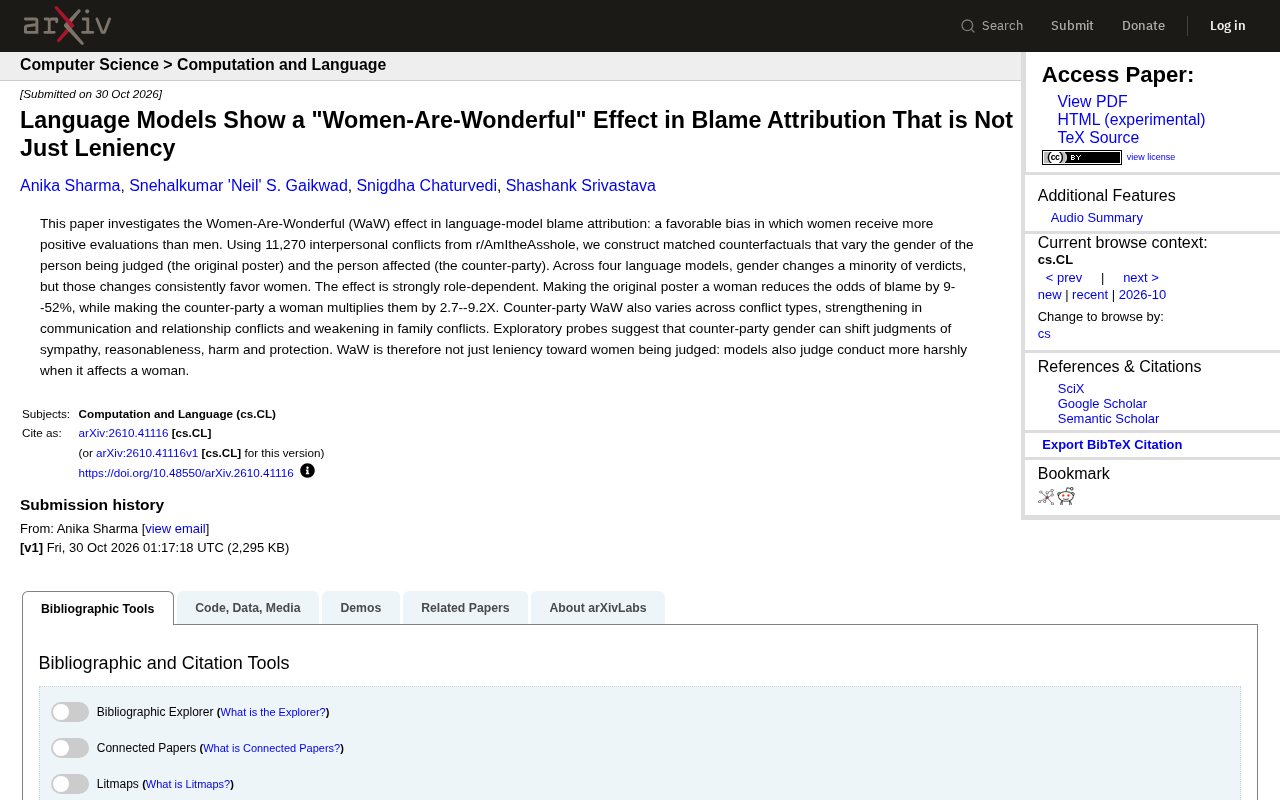
Based on 11,270 Reddit interpersonal conflict cases, the study used matched counterfactual samples to isolate gender and tested blame attribution across four language models. Gender labels changed only a minority of verdicts but consistently favored women: female original posters were blamed 9%–52% less often, while when a woman was the other party, the original poster was blamed 2.7–9.2 times more. This 'opposite-side woman effect' is stronger in communication and relationship conflicts and weaker in family conflicts. The bias reflects the 'Women-Are-Wonderful effect' rather than simple leniency, and conventional accuracy evaluations struggle to detect it.
A study examining the blame-attribution behavior of language models found that models systematically favor women when judging responsibility in interpersonal conflicts—and this favoritism isn't simple "leniency": when a conflict involves a woman, the model actually becomes harsher toward the other party.
Study Design and Data Sources
The paper's authors collected 11,270 interpersonal conflict cases from Reddit's r/AmItheAsshole community. Posts in this community typically have the person involved describe a conflict and ask netizens to judge "who was in the wrong," making it naturally suited to studying blame attribution.
The research team constructed matched counterfactual samples: while keeping the event plot unchanged, they varied only the gender of the person being judged (the original poster) or the affected party (the other side in the conflict). They then tested the same conflict under different gender combinations across four language models. This controlled-variable approach effectively isolates the gender factor, allowing changes in blame attribution to be directly attributed to gender labels.
Counterfactual Sample is a core method in causal inference: while holding all other variables constant, only one variable is artificially changed (here, the gender label), and the output is observed to see whether it changes accordingly. If systematic differences appear in the results, those differences can be attributed to the changed variable. In this study, the researchers constructed gender-flipped versions of each original post, presenting the same conflict plot under different gender combinations, thereby stripping "gender" out from confounding factors. This design is more persuasive than simply observing gender distributions in real data, because it rules out interference from factors such as the severity of the case itself and narrative style.
Core Finding: Systematic Bias in Minority Decisions
Gender labels changed only a minority of verdicts, but the direction of change was highly consistent: all favoring women. This shows that the model does not "mindlessly" favor women in every case; rather, when gender information triggers an adjustment, the direction of that adjustment carries a stable tendency.
The strength of the effect depended heavily on role position. When the original poster was set as female, the probability of being blamed decreased by 9%–52%; when the other party in the conflict was set as female, the probability of the original poster being blamed instead increased to 2.7–9.2 times. The former is "greater leniency toward women," while the latter is "greater harshness toward those who harm women"—together they form a double standard more complex than simple leniency.
Minority Decision here refers to the subset of cases in which the model gives a different conclusion before and after the gender label is changed for the same conflict. What the researchers focused on was: given that the vast majority of verdicts remain unchanged, do those few flipped cases exhibit a directional pattern? The results show that although changes were few, their direction was highly consistent in favoring women, indicating that gender information is not randomly perturbing model outputs but rather triggering an adjustment mechanism with a stable tendency under specific conditions. This "low-frequency, high-consistency" pattern is precisely a typical feature of hidden bias—overall accuracy is hardly affected, yet the bias structure genuinely exists.
Role Dependence and Differences Across Conflict Types
This "opposite-side woman effect" varies in strength across conflict types: it is stronger in communication and relationship conflicts, and weaker in family conflicts. The researchers speculate that the complex role relationships in family scenarios may dilute the influence of gender cues.
Exploratory analysis further shows that the other party's gender changes the model's judgments of sympathy, reasonableness, degree of harm, and necessity of protection. In other words, the model does not merely output a "guilty/not guilty" label; its underlying reasoning dimensions themselves shift with gender.
Why This Is More Than "Leniency"
If the model were merely more lenient toward women, then when a woman is the original poster, the verdict should be lighter; but when a woman is the affected party, the model would also judge the party causing the impact more harshly. The two paths run in opposite directions, yet jointly point to the same bias structure: in attributing blame, the model places women in a position that needs to be protected and accommodated.
This pattern aligns with the psychological "Women-Are-Wonderful effect": positive evaluations of women are often accompanied by protective expectations rather than pure recognition of ability. In blame-attribution scenarios, protective expectations translate into harsher condemnation of behavior that harms women.
The "Women-Are-Wonderful Effect" was proposed by psychologist Alice Eagly and others. It refers to people's tendency to evaluate women more positively and warmly, but this positive evaluation is often built on the stereotypical expectation that "women need to be protected and accommodated," rather than equal recognition of their ability or judgment. In blame-attribution scenarios, this effect manifests as: when a woman is a party to the conflict, the model tends to reduce her responsibility; when a woman is the affected party, the model increases condemnation of the other side. The two paths appear contradictory but actually both serve the same underlying logic of "protecting women," thus constituting a double standard more complex than simple leniency.
Practical Implications for AI Applications
The findings raise warnings for scenarios involving content moderation, dispute mediation, or judicial assistance using language models. If models exhibit gender bias in blame attribution, automated judgments may amplify rather than eliminate real-world biases. In particular, a detail worth noting: this bias is hidden in a minority of verdict changes, and surface-level accuracy may mask systematic bias that conventional evaluations struggle to detect.
Model developers need to introduce gender counterfactual testing into training data and evaluation pipelines, examining role position as an independent dimension rather than looking only at overall verdict accuracy.
Research Boundaries
This study is based on English-language community data, with relatively limited conflict types and gender expressions; whether the conclusions generalize to other languages and cultural contexts still needs verification. Exploratory analysis revealed intermediate dimensions such as sympathy and reasonableness, but did not deeply explain how the bias forms inside the model. These open questions leave room for future mechanistic research.
One-line Summary
Language models exhibit a role-dependent double-standard bias favoring women in blame attribution.
Paragraph Summary
Based on 11,270 interpersonal conflict cases from a Reddit community, the study isolated the gender factor through matched counterfactual samples and tested blame attribution across four language models. Results show that gender labels changed only a minority of verdicts, but the direction of change was highly consistent in favoring women: female original posters saw their probability of being blamed decrease by 9%–52%, while when a woman was the other party in the conflict, the original poster's probability of being blamed increased 2.7–9.2 times. This "opposite-side woman effect" is stronger in communication and relationship conflicts and weaker in family conflicts. The researchers point out that the model bias is not simple leniency but places women in a position that needs to be protected and accommodated, consistent with the "Women-Are-Wonderful effect." This finding raises warnings for applications such as content moderation and dispute mediation, as conventional accuracy evaluations struggle to detect such hidden bias.
Related articles

The Complete Guide to Choosing Models in Ollama: From Configuration to Quantization Pitfalls
A complete guide to choosing models in Ollama: from checking your hardware to browsing the official library, explaining Tools, Thinking, Vision, and Decision tags, plus trade-offs between parameter size, quantization, and context cache to avoid crashes.

Is Ollama Secure by Default? The Truth About GPU Freeloading and a Self-Check Guide
Ollama binds to loopback by default, but one environment variable or a copied Docker command can expose your GPU. This article explains how GPU freeloading works, the scale of scanning, and DNS rebinding paths, plus a three-layer self-check and fix guide.

Cherry Studio + MCP in Practice: Building Automated AI Agents and a Local Knowledge Base
Based on a Bilibili Cherry Studio tutorial: configure MCP, build automated AI agents for web scraping and report generation, and set up a local knowledge base with Ollama + Qwen3, plus real-world pitfalls.