Are There Hidden Dimensions Beyond the Three We Know? Physics Has a More Surprising Answer

From string theory to quantum entanglement, physics reveals that space itself may be an emergent illusion.
Starting from what a dimension actually is, this article explains why our brains can't visualize higher dimensions without that being evidence against them, how string theory mathematically requires 10 or 11 dimensions, why quantum mechanics' "many worlds" are not extra spatial dimensions, and why some physicists now believe space itself may emerge from quantum entanglement — shifting the question from "how many dimensions exist" to "what gives rise to dimensions at all."
What Is a Dimension, Really?
We take it for granted that space has exactly three directions: left-right, forward-backward, up-down. This certainty feels so fundamental that almost no one thinks to question it. But that certainty may reveal more about the limits of the human brain than about the nature of reality itself.
In physics, a dimension isn't simply "a direction you can move in." More precisely, a dimension is an independent coordinate — a separate number you need to specify the location of something. A one-dimensional world is like a line: one number locates a point. A two-dimensional world is like a flat map: two numbers. Three-dimensional space requires three. The key word is "independent" — moving upward can't be replicated by any combination of moving left or forward. It offers a genuinely new degree of freedom.
Mathematicians can extend this pattern indefinitely: four coordinates, five, ten, even a thousand. We may not be able to visualize these spaces, but the mathematics works perfectly within them.
As for the question many people ask — "Isn't time the fourth dimension?" — in Einstein's relativity, we do use four coordinates (three spatial, one temporal) to describe events, and together they form spacetime. But time is not simply another spatial direction. The geometry of spacetime treats the time coordinate in a fundamentally different way, and we can't turn around in time the way we can spin around in a room.

Why the Brain Can't Visualize the Fourth Dimension
A tesseract is the four-dimensional analog of a cube, with all right-angle corners. Just as a 3D cube is generated by extending a 2D square along a third dimension, a tesseract is a 3D cube extended along a fourth.
Why is a fourth spatial dimension so hard to picture? Because the human brain simply didn't evolve to comprehend one. Our ancestors needed to judge whether a branch was within reach, whether a predator was closing in, whether a cliff was safe — brains that could rapidly model nearby three-dimensional space had an enormous survival advantage. Being able to imagine a direction no animal could ever travel offered no survival benefit whatsoever.
This is precisely why intuition breaks down where mathematics doesn't. You can't truly "see" four mutually perpendicular spatial directions, but you can reason about them. Just as you can't see radio waves, magnetic fields, or the curvature of spacetime — yet experiments confirm they have measurable physical effects.

In other words, our failure to imagine higher dimensions cannot be taken as evidence that they don't exist. Reality has no obligation to fit inside the "visualization software" that evolution installed in our brains.
Does Physics Actually Allow Extra Dimensions?
The surprising answer is: yes. Extra spatial dimensions have appeared in serious physics for over a century.
In the 1920s, Theodor Kaluza and Oskar Klein explored a theory with an additional spatial dimension and discovered an intriguing connection between gravity and electromagnetism. Though its predictions didn't match observations, the idea eventually evolved into string theory. Modern string theory mathematically requires 10 or 11 spacetime dimensions to remain self-consistent.
This doesn't mean physicists have discovered six or seven extra directions hiding around us. These dimensions may be "compactified" — curled into tiny geometric structures that are nearly impossible to detect directly.
The classic analogy is a garden hose: from a distance, it looks like a one-dimensional line stretching across the lawn; up close, you see it also has a curled dimension running around its circumference. Compactified extra dimensions work similarly — at everyday scales, space appears three-dimensional, but at extremely small scales, those extra directions might become relevant.
It must be emphasized: to date, there is no confirmed experimental evidence that extra spatial dimensions actually exist. Physics permits them, important theories invoke them, but nature has not yet told us they are real.
String theory's mathematical requirement for higher-dimensional spacetime stems from its attempt to eliminate the infinite divergences that appear in quantum field theory calculations. In ordinary bosonic string theory, spacetime must be exactly 26-dimensional for the theory to be mathematically consistent. Superstring theory, which incorporates fermions and supersymmetry, reduces this to 10 dimensions. M-theory, the unifying framework for the five superstring theories, requires 11 dimensions. Compactification is the standard mechanism for hiding the extra dimensions: these additional directions are curled into extraordinarily small geometric shapes — typically envisioned as six-dimensional surfaces called Calabi-Yau manifolds — at scales near the Planck length (around 10⁻³⁵ meters), far beyond the resolving power of any existing detector. This is why the Large Hadron Collider (LHC), despite dedicated searches, has found no direct signal of extra dimensions.
Quantum Mechanics: Don't Confuse Mathematical Dimensions with Physical Ones
The word "dimension" appears in quantum mechanics too, but with an entirely different meaning — and this is a major source of confusion.
Take the famous double-slit experiment: electrons are fired one at a time at a barrier with two slits. Each electron arrives as a single localized dot on the detector, but as thousands of dots accumulate, they build up an interference pattern — the kind only waves produce. And once the apparatus can reveal which slit the electron passed through, the interference vanishes.
It's tempting to interpret this as the electron "sneaking through another dimension" or "jumping between realities." But quantum mechanics requires no such explanation. It describes particles like electrons and photons using a mathematical object called the wave function, which allows physicists to calculate the probability of each possible measurement outcome. The wave function evolves like a wave until a measurement occurs — and this wave-like evolution naturally predicts the interference pattern in the double-slit experiment.
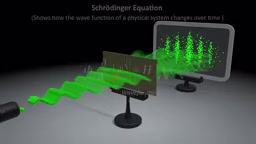
The wave-like evolution of the wave function itself is not controversial — it's part of the mathematics of quantum mechanics. What physicists genuinely disagree about is: what does the wave function actually represent? And what exactly happens when a measurement takes place?
One of the most striking answers is the many-worlds interpretation. Popular culture often conflates this with "extra dimensions," but that's a misreading. The many-worlds interpretation holds that the wave function never collapses — every possible outcome continues to exist, distributed across different branches of reality. When we observe an electron with spin-up, another branch contains an observer who measured spin-down.
But note: these branches are not the extra spatial dimensions of string theory. They are different branches of the same universal wave function — informally called "parallel universes." And many-worlds is just one of several interpretations of quantum mechanics. It makes the same experimental predictions as other interpretations, and no experiment has established it as the correct one.
Part of why wave functions evoke "hidden dimensions" is that they literally inhabit a high-dimensional mathematical space. The wave function of a single particle is defined in ordinary three-dimensional space, but the wave function of two particles lives in a six-dimensional configuration space (three coordinates per particle), and for N particles, it lives in 3N dimensions. This abstract space — called Hilbert space — can be infinite-dimensional, but it is a purely mathematical tool for tracking probability amplitudes across all possible states, not a physical space through which particles actually travel. Conflating the high dimensionality of Hilbert space with genuinely existing extra spatial directions in the physical world is one of the most common misreadings in popular science. The interpretational debates in quantum mechanics — Copenhagen, many-worlds, pilot-wave theory, and others — are disputes about how to understand the physical reality behind this mathematical tool, not discoveries of new physical directions in space.
The Most Astonishing Possibility: Space Itself May Not Be Fundamental
Quantum mechanics offers no evidence of electrons vanishing into hidden dimensions — but it may tell us something far more profound about space itself, in a way no one expected.
Some physicists have proposed that space — even spacetime — may not be fundamental at all. We normally imagine the universe coming pre-equipped with three spatial dimensions and one time dimension as a "stage," with everything playing out on that four-dimensional backdrop. But what if the stage itself emerges from something deeper?
This idea has precedent. Consider temperature: a single molecule has no temperature. Temperature only appears when enormous numbers of molecules are colliding and moving — it's an emergent property that exists only at large scales.
One frontier conjecture is that space may emerge from quantum entanglement. Entanglement is a strange quantum correlation in which two quantum objects become so intertwined that neither can be fully described independently.

These theories invert the usual logic: rather than saying two objects are highly entangled because they are close together, they propose that objects appear close together because they are highly entangled. Strongly entangled objects look nearby; weakly entangled ones look distant. In other words, entanglement might give rise to the very concept of distance.
If space isn't fundamental, what exactly is being entangled? The honest answer is: we don't know. Whatever these basic building blocks are, they don't exist within space — they exist in a deeper layer of reality where the concepts of distance, direction, and position don't yet apply. Some theories envision them as tiny quantum bits of information (qubits); others describe them as more abstract quantum degrees of freedom.
Imagine drawing a dot for each fundamental quantum object, then drawing a line between any two that are entangled. You'd quickly weave a vast network. If enormous numbers of quantum correlations form just the right pattern, a smooth three-dimensional space might emerge from that network — not because anyone laid out a three-dimensional grid, but because the pattern of quantum connections naturally behaves like one. It's a bit like a digital photo: zoom in and you see only pixels; zoom out and you see landscapes, faces, and an entire world.
The most influential concrete version of this idea comes from Juan Maldacena's AdS/CFT correspondence, proposed in 1997 — also called holographic duality. This conjecture suggests that a (d+1)-dimensional spacetime containing gravity is mathematically equivalent to a d-dimensional quantum field theory without gravity on its boundary. In other words, the gravitational physics of three-dimensional space can be completely encoded in quantum information on a two-dimensional boundary — much like a three-dimensional holographic image whose information is stored on a two-dimensional film. In this framework, the geometry of spacetime (including its dimensionality and curvature) is determined by the entanglement structure of quantum states in the boundary theory. Physicist Mark Van Raamsdonk illustrated this vividly with a thought experiment: if you sever the entanglement between two regions, the corresponding spacetime geometry splits into two disconnected pieces. Entanglement isn't merely correlated with space — in some sense, it is the source of spatial connectedness.
The Truly Deep Question
We began by asking whether there are directions we can't see. We ended up asking where the concept of direction comes from in the first place.
Perhaps the deepest insight isn't that there are dimensions you can't see — it's that your very understanding of "dimension" is itself an emergent part of reality. Space may not be the container that holds the universe. Space may be something the universe does.
If that's true, then "how many dimensions does reality have" may not be the deepest question. The deeper question is: what gives rise to dimensions at all? The further physics digs, the less reality looks like a place — and the more it looks like a web of relationships and quantum information.
Related articles

Bilibili's Hit Dify Tutorial: A Practical Guide to Building 20+ AI Apps from Scratch
A distilled guide to Bilibili's top-rated Dify tutorial: Windows + Docker deployment, MySQL connection, five app types, model integration strategy, and publishing.

Agent Skills Beginner's Guide: From Concepts to Multi-Agent Collaboration in Practice
A comprehensive guide to Agent Skills: core concepts, components, the importance of Description, standardization, beginner learning paths, and multi-agent collaboration.

One Neuron Detects Both Cats and Cars? We Reproduced It and Found a New Explanation
The cat-car neuron reinterpreted: researcher Cammarata argues it distinguishes pointy from round, not cats from cars. We reproduced the experiment and found the new explanation holds on most inputs—but cars are the exception. The interpretability debate continues on language models.