Ashwa: The AI Companion That Never Forgets, Giving Conversations Long-Term Memory
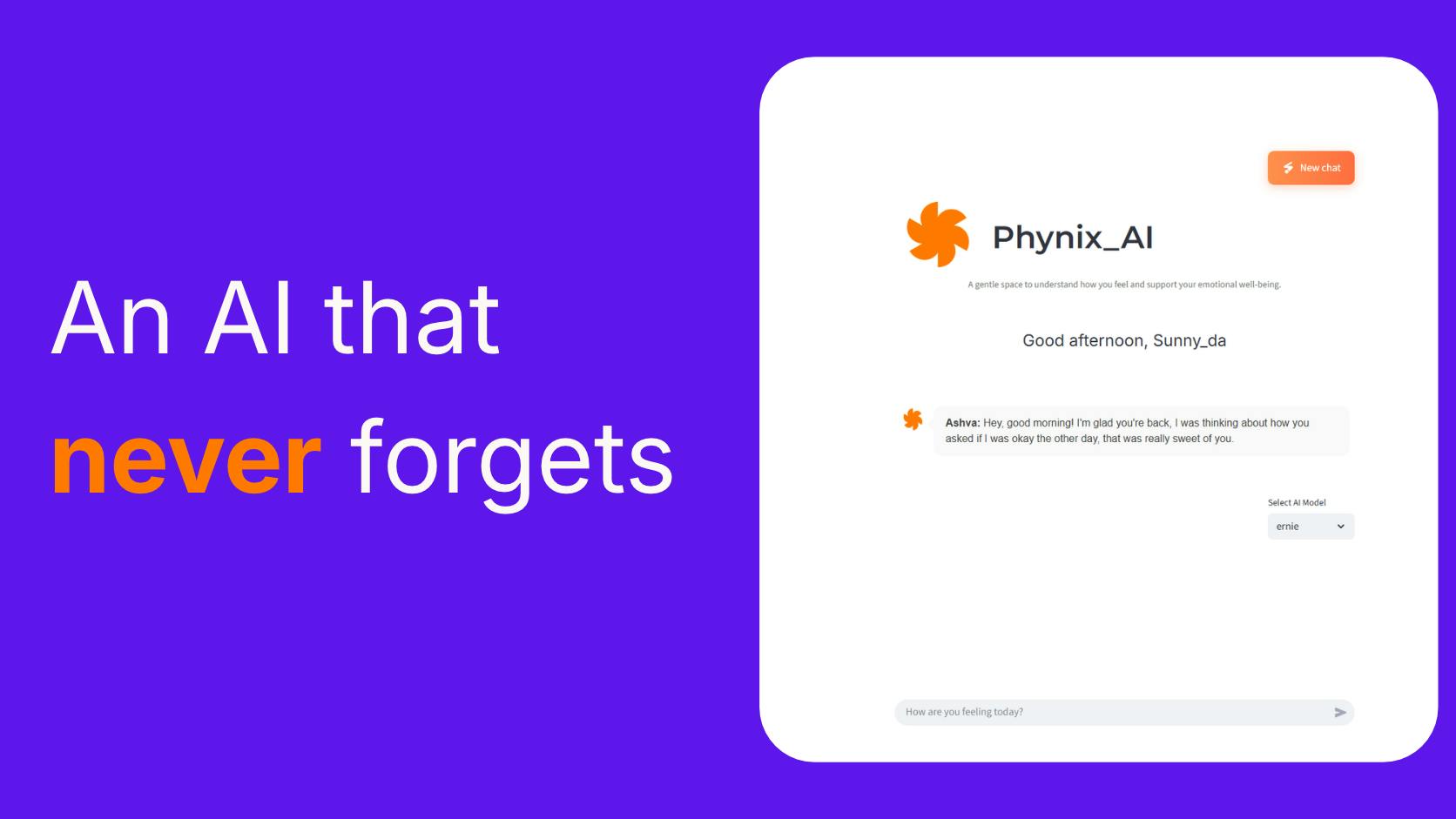
Ashwa features cross-session long-term memory and a private diary, positioning itself as an AI emotional companion with memory.
Ashwa is an AI companion product launched on Product Hunt, whose core selling point is cross-session long-term memory: even after 100 days away, it can retrieve relevant details from past conversations and diary entries, so users don't need to re-explain background context. The product also includes a private diary feature, with responses incorporating the emotional context users share, positioning it toward emotional companionship rather than a productivity tool. Ashwa is released as open source, with Suvroneel Nathak as the Maker, and received 76 votes and 5 comments on Product Hunt, ranking 20th. The article argues that the differentiation of memory-based AI companions lies in the retention moat formed by personalized data accumulation, but memory accuracy, the logic for handling conflicts between historical and current context, and the privacy compliance of private data remain questions to be verified for this type of product.
In an era where AI assistants are everywhere, most conversational experiences share the same awkward flaw: close the window, and the memory resets to zero. Ashwa, newly launched on Product Hunt, tries to solve this pain point — it bills itself as an AI companion that "never forgets what you've said," able to recall relevant details from your past conversations and diary entries even if you come back 100 days later, so you never have to repeat your story.
Long-Term Memory: From "Conversation Tool" to "Relational Companion"
Ashwa's core selling point is clear: cross-session long-term memory. According to its Product Hunt page, the product can retrieve relevant information from historical conversations and diary entries even after you've been away for 100 days. This means it's no longer a Q&A bot that needs background context re-explained from scratch each time — it's more like an acquaintance that gradually gets to know you.
This design approach directly targets a structural shortcoming of current AI chat products. Mainstream conversational models typically retain only the context window of a single session; once the session ends, personalized information is lost. Through persistent storage and retrieval mechanisms, Ashwa transforms users' expressions into memory assets that can be called upon later, creating the feeling of "being remembered" at the experience level.
Context window refers to the range of text a large language model can "see" during a single inference, usually measured in tokens. Mainstream models' windows have expanded from an early 4K to today's 128K or even millions — but no matter how large, it's only valid within a single session: the session ends, the window clears, and the model automatically retains nothing. To achieve cross-session memory, a product must therefore build a separate persistent storage (such as a vector database) and retrieval layer (such as RAG, retrieval-augmented generation) outside the model, recalling relevant historical fragments and inserting them into the prompt before each conversation. What Ashwa calls "still able to recall after 100 days" essentially relies on this kind of external memory architecture, not on any inherent memory capability of the model itself.
Diary and Emotional Context: A Second Layer Beyond Memory
In addition to conversation memory, Ashwa also includes a private diary feature. Users can use it to record daily life and process emotions, and the system shapes its responses based on the emotional context you share. In other words, Ashwa's memory isn't just factual — "you said last week you were going on a trip" — it also includes emotional layers — "you were anxious about it at the time."
This design steers the product toward "emotional companionship" rather than "productivity tool." The word "companion" in the tagline isn't chosen casually — it emphasizes a sense of continuous presence and growing familiarity, rather than efficient completion of a single task.
Open Source and Community Response
In Product Hunt's category tags, Ashwa is listed under Open Source, Artificial Intelligence, GitHub, and Chat, with Suvroneel Nathak as the Maker. The open-source attribute carries special significance for this type of memory-based product: users are naturally sensitive about where their personal conversations and diary data are stored and how they're accessed, and code visibility can alleviate privacy concerns to some extent.
Judging from community feedback, the product received 76 upvotes and 5 comments, ranking 20th on that day's Product Hunt leaderboard. This is a mid-to-upper level of exposure, suggesting that the topic of "AI long-term memory" can indeed attract attention, though it hasn't yet achieved explosive virality.
Product Hunt is a community platform for new product launches, where each product competes on the daily leaderboard on its "launch day," with rankings primarily based on community upvotes and comment engagement. The daily leaderboard typically features dozens to over a hundred products competing, and making the top 20 means gaining some exposure — though still a far cry from the top-ranked products that rack up hundreds or thousands of votes. For early-stage projects, Product Hunt's value lies more in seed user acquisition and feedback collection than in direct commercial conversion; the scale of 76 votes and 5 comments suggests the product has reached the core audience interested in the AI memory space but hasn't yet broken out of that circle.
The Promise and Challenges of Memory-Based AI
The "AI companion with memory" track that Ashwa represents is becoming a niche within the AI application layer. As underlying model capabilities gradually converge, product differentiation increasingly depends on personalized data accumulation — whoever lets users build up more non-transferable conversation history and emotional records holds a stronger retention moat.
However, this type of product also faces several unavoidable questions. How is memory accuracy ensured? When historical information conflicts with the current context, which should the system prioritize? How can long-term stored private diary data be kept secure and compliant? These questions aren't elaborated on Ashwa's product page and need to be tested in actual use.
For users who want to try it, Ashwa offers an interaction paradigm different from mainstream assistants: treat it as a conversation partner that remembers you, rather than a tool that resets at any moment. Whether this experience holds up ultimately depends on the precision of memory retrieval and the naturalness of emotional responses.
The product is currently live on Product Hunt and can be explored further via its official website link.
One-line Summary
Ashwa focuses on cross-session long-term memory and a private diary, positioning itself as an AI emotional companion with memory.
Paragraph Summary
Ashwa is an AI companion product launched on Product Hunt, whose core selling point is cross-session long-term memory: even after 100 days away, it can retrieve relevant details from past conversations and diary entries, so users don't need to re-explain background context. The product also includes a private diary feature, with responses incorporating the emotional context users share, positioning it toward emotional companionship rather than a productivity tool. Ashwa is released as open source, with Suvroneel Nathak as the Maker, and received 76 votes and 5 comments on Product Hunt, ranking 20th. The article argues that the differentiation of memory-based AI companions lies in the retention moat formed by personalized data accumulation, but memory accuracy, the logic for handling conflicts between historical and current context, and the privacy compliance of private data remain questions to be verified for this type of product.
Related articles

Developer Naming Woes: The Technical Names That Drive Us Crazy
Why is technical naming so maddening? From Nginx and Vite to Qt and Sudo, a YouTube creator rants about the chaos of developer naming and pronunciation, revealing the tug-of-war between creators' intentions and community habits, and the cultural roots behind spelling traps like PyPI and GNOME.

Figma Workplace Scandal: Employee Sues CEO for Forcing Confrontation with Harasser
Figma and its CEO are sued by a current employee alleging sexual harassment and discrimination, and forcing the victim to confront her harasser. This article outlines the background, potential impact, and industry reflection.

Jensen Huang and Nvidia: Elite Privilege Behind the Revolving Door of Business and Politics
An opinion piece uses Jensen Huang's reappointment as Nvidia CEO to examine business-government ties and elite impunity, questioning free-market ideals and AI industry governance.