Ass Auction: The Marketing Logic Behind an Absurd Ad Bidding Experiment
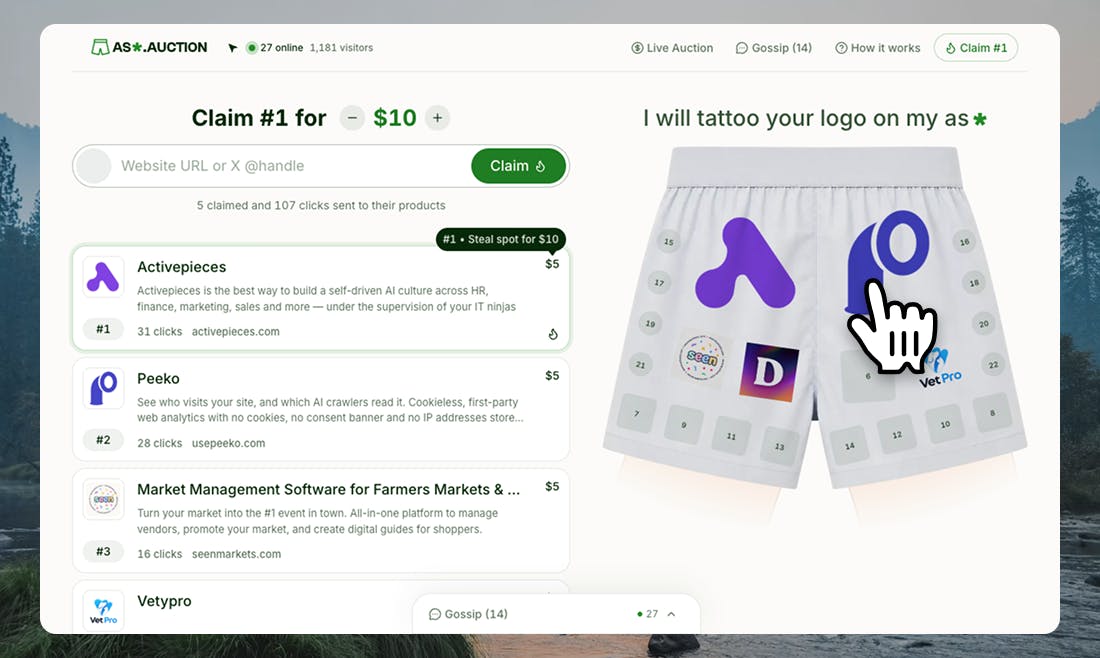
Brands bid to print logos on underwear — dissecting the marketing genius behind Ass Auction.
Ass Auction, an indie project that hit #10 on Product Hunt, lets brands compete to print their logos on boxer briefs. Behind the absurdity lies a sophisticated experiment in attention economics, gamified bidding mechanics, and viral growth design. This analysis unpacks how low-barrier participation, dynamic leaderboards, and social feedback loops turn a joke into a masterclass in creative marketing.
An Ad Network with Only One Ad Slot
On Product Hunt, a product called Ass Auction rode its absurd creativity to the #10 spot of the day, earning 90 upvotes. Its tagline is blunt and provocative: "Brands outbid each other to put their logo on my ass."
Product Hunt is the world's most influential new product launch platform, founded by Ryan Hoover in 2013 and later acquired by AngelList. Dozens of products launch there every day, and community members vote (Upvote) to determine rankings. The ranking algorithm considers not just total votes but also weights the voter's community influence and vote timing distribution to prevent manipulation. For indie developers and startup teams, landing in the top five on launch day typically translates to thousands or even tens of thousands of direct visits, along with significant follow-up coverage from tech media. Many well-known products like Notion, Loom, and Figma leveraged Product Hunt for their cold starts. Earning 90 votes and cracking the top ten means Ass Auction has already broken through the attention threshold of the early tech community.
Built by indie developer Mahdi Farra, the product is essentially an ad network with a single ad slot — and that ad slot is a pair of boxer briefs. Anyone can pay $5 or more to get their logo on the leaderboard, with ranking determined by how much they've spent.
At first glance, this looks like a pure joke project, categorized under "Funny, Marketing, Advertising" on Product Hunt. But if you dissect its mechanics carefully, you'll find it's an ingenious experiment in attention economics, social competition psychology, and viral growth.
The concept of the "attention economy" was first introduced by Nobel laureate Herbert Simon in 1971, who observed that "a wealth of information creates a poverty of attention." In the digital age, as content supply approaches infinity, limited human attention becomes the truly scarce resource. The advertising industry is fundamentally built around the competition for attention: from traditional CPM (cost per mille) to CPC (cost per click), the evolution of pricing models has always been an attempt to more precisely measure the value of attention. Ass Auction takes this abstract concept and materializes it into a biddable physical ad slot, letting market participants determine the price of attention in real time.
The Bidding Mechanism: Turning an Ad Slot into a Game
Cumulative Spending Determines Ranking
Ass Auction's core rule is simple yet highly compelling: your cumulative spending determines your ranking. Anyone can pay more to leapfrog you and push you down. And when you want to climb back to your previous position, you only need to pay the difference — no need to repay the full amount.
This mechanism cleverly borrows from the "leaderboard competition" logic in gamification design. Gamification is the methodology of applying game mechanics — such as points, leaderboards, and achievement badges — to non-game contexts. Its theoretical foundations draw from psychologist Mihaly Csikszentmihalyi's "flow theory" and Edward Deci's "self-determination theory." Leaderboards are among the most powerful mechanics because they simultaneously activate social comparison psychology and status competition instincts. Research shows that leaderboards can boost user engagement by up to 47%. In the business world, from Duolingo's learning rankings to Salesforce's sales performance boards, leaderboards have proven to be a core tool for driving sustained engagement.
Unlike traditional ad slots that are one-time static purchases, Ass Auction offers a dynamic position that can be challenged at any time. The logos of the top 22 brands will actually be printed on the underwear and worn in public, creating clear scarcity and a focal point of competition for top positions.
Zero-Barrier Entry Design
The product minimizes the barrier to participation:
- No account registration required — just provide a URL or social media handle
- Payments processed through Stripe
- Starting bid of $5 — anyone can join
Stripe is one of the world's largest online payment infrastructure companies, valued at over $65 billion as of 2024. It provides developers with extremely clean API interfaces — as few as a handful of lines of code can integrate full payment functionality, supporting over 135 currencies and dozens of payment methods. For indie developers, Stripe's significance lies in completely eliminating the technical barriers of payment systems — payment modules that once took months to develop can now be completed in hours. Stripe also offers products like Checkout (pre-built payment pages) and Payment Links (no-code payment links), enabling lightweight projects like Ass Auction to monetize with minimal technical overhead.
This "zero-friction" design dramatically lowers the cost of participation. For brands or individuals, $5 is practically a throw-away amount to try on a whim. And once someone starts bidding, it triggers the competitive instinct in others — this is the most powerful psychological engine of any auction mechanism.
From a behavioral economics perspective, auction mechanisms sustain escalating prices through a stack of cognitive biases. The "endowment effect" makes bidders feel ownership over the ranking position they've claimed, making them reluctant to let it go. The "sunk cost fallacy" drives those who've already invested to keep doubling down. "Competitive arousal" triggers adrenaline in public competitive environments, leading to irrational overbidding. Nobel laureate Richard Thaler called the overbidding phenomenon in auctions the "winner's curse" — the final winner often pays far beyond any rational valuation. Ass Auction's "you've been outbid" email notifications are a precision-targeted exploitation of loss aversion, compelling users to impulsively return and raise their bids under the pain of "losing their ranking."
Design Hooks for Viral Spread
Real-Time Feedback and Social Fission
Ass Auction isn't just a static bidding page — it has multiple built-in features that promote sharing and interaction:
- Real-time click counter: Lets bidders see their exposure at a glance
- Share cards: Make it easy for participants to show off their rankings on social media
- Outbid notification emails: When someone overtakes you, you get an email nudging you to come back for "revenge"
- Gossip feed: Lets spectators comment and trash-talk in real time
These features form a complete "attention loop." Outbid notifications create ongoing motivation to revisit, share cards drive external traffic, and the gossip feed transforms cold bidding into a public performance with an audience and dramatic tension.
From a growth engineering perspective, the quantitative core of viral growth is the K-factor (viral coefficient) — the average number of new users each existing user brings in. When K > 1, the product achieves self-sustaining growth. K-factor = invitations sent × conversion rate. Ass Auction's design optimizes both sides: share cards and the gossip feed increase invitation volume (giving users both the motivation and tools to share), while the absurd concept itself boosts conversion rate (people who see the shares are more inclined to click through). Jonah Berger, in his book Contagious, summarized six principles of viral spread: Social Currency, Triggers, Emotion, Public, Practical Value, and Stories. Ass Auction hits at least three — Social Currency (sharing it makes you look fun), Emotion (humor and surprise), and Stories ("someone bid to print their logo on a butt" is inherently a great story).
Absurdity Itself Is the Viral Force
Indeed, this project's most powerful weapon for spreading is its inherent absurdity and provocativeness. The concept of "printing a logo on someone's butt" is inherently buzzworthy — perfectly suited to spark discussion, retweets, and jokes on social media. In an environment of extreme attention scarcity, ideas that make people crack a smile and share voluntarily often outperform carefully planned serious marketing campaigns.
Marketing Lessons Beneath the Absurd Shell
Scarcity + Competition = Premium Pricing
Peel away the joke, and Ass Auction actually demonstrates a classic business principle: when a resource is both scarce and openly contestable, its value is continuously driven up by the participants themselves. The physical display for the top 22, the "your spending equals your ranking" rule, and the dynamic nature of being challengeable at any time together form a self-reinforcing premium system.
This mirrors the logic behind some NFT projects, charity auctions, and even social media "tip leaderboards" — competition itself creates value, and the product creator only needs to build the stage. NFTs (Non-Fungible Tokens) are digital asset certificates based on blockchain technology that experienced explosive growth in 2021, with annual transaction volume exceeding $25 billion. The core business logic of NFT projects is remarkably similar to Ass Auction: artificially creating scarcity (limited editions) and public market competition (auctions and secondary market trading) to let community participants drive up asset value themselves. The success of projects like Bored Ape Yacht Club and CryptoPunks was fundamentally a compounding effect of "scarcity + social flexing + community belonging." However, after 2022, the NFT market cooled dramatically with trading volume dropping over 90%, warning that business models purely reliant on scarcity and social competition are fragile once the hype fades — a challenge Ass Auction may face in the future as well.
The Creative Dividend for Indie Developers
For indie developers, Ass Auction is a case study worth examining. It requires no complex technology — at its core, it's just a bidding leaderboard plus Stripe payments. But through bold creative positioning and carefully designed psychological hooks, it successfully captured attention on Product Hunt.
This reinforces a key insight: in today's landscape of product homogeneity, unique narratives and buzzworthiness can sometimes generate more early traction than technical sophistication. Of course, the sustainability of such projects is questionable — absurd ideas often go viral briefly but struggle to form a long-term, stable revenue model.
Conclusion
Ass Auction is a creation that straddles the line between a prank and a marketing experiment. Using an ad slot on a pair of underwear, it demonstrates the complete logic of attention economics, social competition, and viral growth. While its format is highly controversial, the underlying mechanism design — low-barrier participation, dynamic bidding, and real-time social feedback — offers valuable inspiration for anyone looking to build "participatory products."
Perhaps this is the true value of this absurd project: it reminds us that the most effective marketing hooks are often hiding in the most unexpected places.
Related articles
DuckFightClub: An AI Robot Duck Fighting Arena
DuckFightClub combines reinforcement learning with open-source robots. Teams train MicroDuck AI strategies, competing from simulator battles to real-world combat in a multi-agent adversarial arena.
Vercel AI SDK Vue 2.0.253 Update Analysis: Multi-Framework Adaptation Strategy and Development Practices
In-depth analysis of Vercel AI SDK Vue 2.0.253 patch update, covering its multi-framework architecture, dependency sync mechanism, and practical value for Vue developers integrating AI capabilities.
Rails 8 Deep Dive: New Features and Upgrade Guide
Deep dive into Rails 8 core features: Kamal 2 deployment, Solid Trifecta, built-in authentication. Covers runtime requirements, upgrade paths, and best practices for migration.